


EB-5 Processing Time in 2026: What to Expect

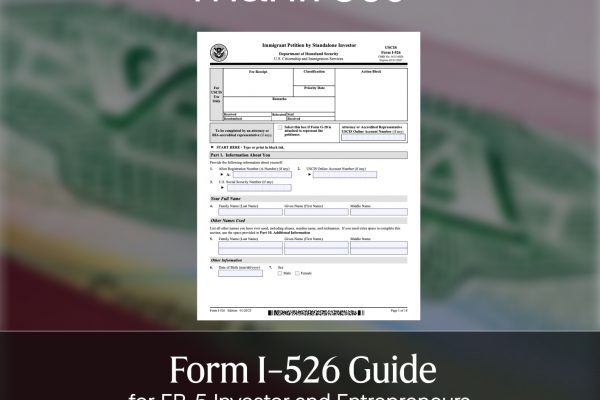
- The full EB-5 journey involves three main USCIS filings—Form I-526 or I-526E, Form I-485 (or DS-260 for consular processing), and Form I-829—and can take 3 to 6+ years depending on project type and country of birth.
- As of June 2026, processing for Form I-526E (regional center) takes around 32.5 months, standalone Form I-526 takes 33 months, and Form I-829 is around 20 months.
- Rural TEA projects benefit from Priority Processing (different from premium processing) and a 20% visa set-aside, making them the fastest track for most investors, especially those from backlogged countries.
- Premium processing is not available for any EB-5 form, so your timeline depends on the project you choose, documentation of a clean source of funds, and avoiding RFEs.
EB-5 processing times vary widely, and most investors wait one to two years for their conditional Green Card and three to six years (or more) to receive a 10-year Green Card. A big reason for this longer timeline is how the program is built. You get a two-year conditional Green Card first, and during that window, your money has to stay invested, and your project has to create at least 10 U.S. jobs.
Only then will USCIS remove the conditions and issue your full 10-year Green Card. The EB-5 process also involves multiple filings with USCIS and per-country visa limits, so it can be longer than other Green Card paths.
| 💡 What is the EB-5 visa? The EB-5 is an employment-based Green Card for foreign investors who put capital into a new commercial enterprise that creates or preserves at least 10 full-time jobs for U.S. workers. It requires a qualifying investment of $800,000 (in a Targeted Employment Area) or $1.05 million elsewhere. |
What are EB-5 processing times in June 2026?
There is no single EB-5 processing time, because the EB-5 Green Card process involves multiple USCIS forms filed years apart. How long you wait depends on which form you are on, whether you invested through a regional center or as a standalone investor, your project’s targeted employment area (TEA) status, and your country of birth.
As of June 2026, here is what current USCIS data and recent adjudication trends show for each stage of the process.
- Form I-526E (Regional Center Investor): 32.5 months
- Form I-526 (direct EB-5): 33 months
- Form I-485 (adjustment of status): 9 to 42.5 months
- DS-260 (consular processing): ~1 month for NVC processing once documents are submitted; interview scheduling at the consulate varies significantly by post, with busier ones adding several months to the timeline
- Form I-829 (remove conditions): 20 months
- Legacy I-526 (filed before March 15, 2022, non-China): 97.5 to 109.5 months
*Note that USCIS publishes processing times as the number of months it took to complete 80% of adjudicated cases over a rolling window. Your individual case may move faster or slower. Visit our USCIS Processing Times page to see the current wait period for all U.S. visas.
Subscribe to our newsletter for immigration resources and news, without the legal jargon.
The full EB-5 timeline, stage by stage
Unlike shorter work visas, the EB-5 is a multi-year commitment with distinct phases. Understanding what happens at each stage helps you set realistic expectations and plan the rest of your life—schooling, business relocation, family moves—around that timeline.
Stage 1: Prepare source-of-funds documentation and select a project
Before any form is filed, you and your attorney build the source-of-funds package that traces every dollar of your investment back to a lawful origin. In parallel, you conduct due diligence on the project—regional center or direct—and wire your capital into the new commercial enterprise.
Total time: 1 to 6 months, depending on the complexity of your financial history and the countries through which funds need to be traced.
Stage 2: File Form I-526 or I-526E
Once funds are invested and documentation is ready, your attorney files the immigrant petition with USCIS. Regional center investors file Form I-526E; standalone direct investors file Form I-526. The filing date becomes your priority date for visa allocation.
Current wait times: roughly 32.5 months for I-526E and 33 months for standalone I-526
The timeline varies based on TEA category and whether the underlying regional center project (Form I-956F) has already been approved.
| 💡 Rural projects get priority. The EB-5 Reform and Integrity Act (RIA) of 2022 set aside 20% of annual EB-5 visas for rural projects and requires USCIS to give them priority adjudication. In practice, that has made rural regional center projects the fastest-moving category in 2026, and the one most likely to keep your overall timeline under three years, even if you’re from a backlogged country. |
Stage 3: Obtain the conditional Green Card
This step looks different depending on where you’re located when your I-526 or I-526E is approved:
- Adjustment of status (inside the U.S.): If you are already in the U.S. in a valid status and your priority date is current, you can file Form I-485, often concurrently with the I-526E. Current I-485 processing times for employment-based cases run 9 to 42.5 months, though EB-5 AOS cases can be faster when filed concurrently.
- Consular processing (outside the U.S.): You’ll complete Form DS-260, attend a consular interview, and receive your immigrant visa stamp. Wait times depend on your specific consulate and National Visa Center throughput.
Either route ends with a two-year conditional Green Card for you, your spouse, and any unmarried children under 21.
Stage 4: Maintain the investment and create jobs
You hold the conditional Green Card for two years. During that period, your capital must remain at risk in the new commercial enterprise, and the investment must create or preserve at least 10 full-time jobs for qualifying U.S. workers.
Stage 5: File Form I-829 to remove conditions
You file Form I-829 in the 90-day window before your conditional Green Card expires. USCIS then reviews evidence that your investment was sustained and that the jobs were created, and it removes the conditions on your permanent residence.
Current wait times: I-829 is currently the slowest piece of the EB-5 puzzle. As of June 2026, USCIS is reporting average I-829 processing times of 20 months or more.
The good news is that your lawful permanent resident status extends automatically while I-829 is pending, so you can keep living in the U.S. throughout the wait.
How long is the wait between I-526E approval and a Green Card?
The answer depends almost entirely on your country of birth and your project’s TEA category.
For investors born outside China and India
EB-5 categories have generally remained current in recent bulletins for investors born outside China and India. Once your I-526E is approved, you can typically move straight into adjustment of status or consular processing and hold a conditional Green Card a few months later.
For investors born in China and India
Chinese and Indian investors face a different picture. Unreserved EB-5 has been backlogged for both countries for years, and the reserved set-asides (Rural, High Unemployment, and Infrastructure) are widely expected to become backlogged as filings accelerate ahead of the Sept. 30, 2026, grandfathering deadline. Under the EB-5 Reform and Integrity Act, petitions filed by that date are protected even if Congress lets the Regional Center Program expire when its authorization ends on Sept. 30, 2027.
A rural project is currently the safest strategy for investors from these countries, but the retrogression risk is real and worth discussing with your attorney. Always check the most recent Visa Bulletin before making decisions based on visa availability.
| 💡 Check the Visa Bulletin monthly. Your priority date has to be current under the State Department’s Final Action Dates chart in the Visa Bulletin before USCIS can issue your Green Card. Priority dates can move forward, stand still, or retrogress from month to month. Set a calendar reminder to review the Visa Bulletin around the 10th of each month. |
What factors could impact EB-5 processing times?
Checking USCIS processing times gives you a ballpark, but several factors can shift those timelines by months or even years in either direction.
Country of birth and visa backlogs
The EB-5 program allocates roughly 10,000 visas a year, with a 7% per-country cap. Historically, China and India have seen the highest demand, so they have the largest backlogs. If you were born in a country that is already backlogged, the gap between I-526E approval and Green Card issuance is the biggest variable in your timeline.
Project type: regional center vs. direct
Regional center projects (I-526E) make up the majority of EB-5 filings and tend to move faster through USCIS than standalone direct investments (I-526). Direct EB-5 cases require more documentation of day-to-day management and direct job creation, which extends adjudication.
TEA category
Projects in a rural Targeted Employment Area receive both a reserved 20% visa set-aside and priority adjudication. High-unemployment TEAs (10% set-aside) and infrastructure projects (2% set-aside) offer smaller advantages. Non-TEA projects require the higher $1.05 million investment and currently move the slowest in the EB-5 category.
Quality of documentation for source of funds
A big cause for EB-5 delays is source-of-funds issues. Incomplete tracing, unexplained transfers, or gaps in the paper trail from original earnings through to the final wire often trigger Requests for Evidence (RFEs) or Notices of Intent to Deny (NOIDs). These types of notices can add months to processing. A thorough, complete source-of-funds package can save a lot of time.
Whether the underlying project has I-956F approval
Regional center projects file Form I-956F to have the project itself approved by USCIS. An I-526E filed against a project whose I-956F is already approved can be decided much more quickly, because USCIS has already signed off on the business plan, job creation methodology, and offering documents. You can check a regional center’s I-956F status before you wire an investment.
USCIS workload and policy changes
EB-5 adjudication sits inside USCIS’s Immigrant Investor Program Office (IIPO), and that office has a finite capacity. Surges in filings, policy shifts, changes in administration priorities, and resource reallocations within USCIS can create backlogs.
How does project type affect your EB-5 timeline?
Because EB-5 processing times vary so dramatically by project type, picking the right structure up front is the single biggest timeline lever an investor has. Here is how the main paths compare in June 2026:
- Rural TEA (regional center): Fastest. Priority adjudication, 20% visa set-aside, and I-526E averages in the 32.5 months range for approved projects.
- High-unemployment TEA (regional center): Moderate. 10% visa set-aside, but no priority adjudication. I-526E is generally in the range of 32.5 months.
- Infrastructure project: Narrow path. 2% set-aside; limited project availability but can offer backlog relief for some investors.
- Non-TEA regional center: Slowest regional center option. No set-aside; higher $1.05 million investment minimum.
- Direct (standalone) EB-5: Longest I-526 adjudication at (33 months), but total control of the business. Best for investors running their own companies.
Taking the next steps toward your EB-5 Green Card in 2026
The EB-5 program can be one of the most rewarding paths to U.S. permanent residence, but it is also one of the most scrutinized and document-heavy. Processing times are long, the rules around source of funds and job creation are strict, and the consequences of denial are real.
Understanding current EB-5 processing times and the factors that shape them puts you in a better position to choose the right project, file a clean petition, and avoid the delays that derail other investors. If you’re an investor preparing to file, or you are already waiting on a pending I-526E, I-485, or I-829, Manifest Law’s EB-5 attorneys can help you build a strategy tailored to your country of birth, your timeline, and your goals.
Request a consultation with Manifest Law to get started.
FAQs about EB-5 processing
Is premium processing available for EB-5?
No. None of the core EB-5 forms—I-526, I-526E, I-485 (in the EB-5 context), or I-829—is eligible for USCIS premium processing. That means factors such as project type, TEA category, and documentation quality are the only real levers you have on your timeline.
How does the September 2026 EB-5 grandfathering deadline affect my timeline?
The EB-5 Reform and Integrity Act (RIA) protects any I-526 or I-526E petition filed by Sept. 30, 2026. It will continue to be adjudicated under today’s rules even if Congress later lets the Regional Center Program expire on Sept. 30, 2027. That protection has driven a wave of filings ahead of the deadline, which could lengthen processing times.
Why is my EB-5 case taking longer than the USCIS estimate?
USCIS publishes processing times based on how long it took the agency to complete 80% of cases over a recent rolling window, so by definition, about 20% of cases (1 out of 5) take longer than the posted figure.
Beyond that, individual delays usually trace back to one of a few causes. RFEs, a compliance issue with a regional center, your country of birth hitting a visa cap, or the project’s I-956F still being under review could all cause delays. If your case has been pending well past the posted processing time, you may be able to submit a case inquiry through USCIS, and an experienced EB-5 attorney can help you evaluate whether further action is warranted.
Can I work in the U.S. while my EB-5 petition is pending?
Filing an I-526 or I-526E does not mean you can work in the U.S. However, if you are already in the U.S. in a valid nonimmigrant status (such as H-1B, L-1, or F-1), you may be able to continue working under that status while your EB-5 petition is pending. If you file Form I-485 concurrently with—or after—your I-526E, you can also apply for an Employment Authorization Document (Form I-765) and an Advance Parole travel document (Form I-131), which together allow you to work and travel during the adjustment of status process. Investors who go through consular processing abroad cannot work in the U.S. until they enter on their immigrant visa.