



Adjustment of Status vs. Consular Processing: Understanding Your Path to a Green Card

- If you’re in the U.S., you’ll apply through Adjustment of Status (AOS); if you’re outside, you’ll use Consular Processing.
- USCIS manages AOS within the U.S., while Consular Processing is handled by the Department of State at a U.S. embassy or consulate.
- To begin either process, you or your sponsor must first file an immigrant petition (such as Form I-140 or I-130) based on your visa category.
- AOS timelines are based on USCIS backlogs, while Consular Processing times depend on the specific embassy or consulate.
Applying for a Green Card can feel overwhelming, especially with all the forms, rules, and timelines involved. One of the first decisions you’ll make is whether to apply through Adjustment of Status (AOS) or Consular Processing.
Your physical location at the time of application plays a significant role in the evaluation process. If you’re already in the United States, you may be able to file for an adjustment of status. If you’re outside the U.S., consular processing is typically required. Both can lead to permanent residency, but the process, timing, and activities you can engage in while waiting differ.
Am I eligible to receive a Green Card?
Before applying for a Green Card, you must first confirm that you qualify under one of the Green Card eligibility categories established by U.S. Citizenship and Immigration Services (USCIS). You’ll need to be the beneficiary of an immigration petition, such as Form I-130 or I-140.
For employment-based applications, the key form is Form I-140 (Immigrant Petition for Alien Worker). This form demonstrates your eligibility based on your job or achievements. It includes details about your role, your qualifications, and, if applicable, a sponsoring employer who can pay the offered wage.
Some employment-based categories also require an approved permanent labor certification (also known as a PERM labor certification), which demonstrates that no qualified U.S. workers are available for the position.
For family-based applications, the main form is Form I-130 (Immigrant Petition for Alien Relative). This form is typically filed by a U.S. citizen or permanent resident on behalf of a qualifying family member—such as a spouse, child, or parent—to establish the family relationship.
| 🧑💼 Curious about the Green Card process for families? Manifest Law’s experienced attorneys have helped thousands of immigrants and their families secure their future in the U.S. Learn more about family Green Card lawyer options. |
What is an adjustment of status?
Adjustment of Status (AOS) is the process you use to apply for a Green Card while you are already in the United States, as long as you’re the beneficiary of one of the immigration petitions listed above. Instead of leaving the country, you remain here while USCIS reviews your application. In many cases, you can request work authorization and travel permission during the process.
Here are the general steps for filing Form I-485, which is the form for adjusting your status.
- Immigrant petition: Your sponsoring family member or employer usually files this on your behalf (or you may file it yourself if your category allows).
- Wait for priority date: Some visa categories require waiting until your priority date becomes current before filing Form I-485. There is a limited number of Green Cards available each year, and backlogs can occur. You can track your date in the USCIS Visa Bulletin.
- File Form I-485: Form I-485, Application to Register Permanent Residence or Adjust Status, is your official request to switch from a temporary visa to a Green Card. Supporting documents, such as your birth certificate and other category-specific forms, must be included.
- Biometrics and interview: USCIS schedules a biometrics appointment at a local field office or Application Support Center. You’ll provide fingerprints, a photo, and your signature. Some applicants also have an in-person interview.
- Approval and Green Card: If everything is in order (including in many cases, a medical exam), USCIS will approve your application and mail your Green Card to the U.S. address you provided.
| 🔄 Can you file I-140 and I-485 at the same time? If your priority date is already current and you are physically present in the U.S., you may be able to submit Form I-140 and Form I-485 together. This is known as concurrent filing, which can save time by allowing you to begin your Green Card application immediately. |
What is consular processing?
Consular processing is the route to obtaining a Green Card if you are outside the United States. Instead of adjusting your status from within the U.S., you complete the process at a U.S. embassy or consulate in your home country (or another country where you are legally residing).
Once approved, you can enter the U.S. as a permanent resident.
Here are the general steps for the consular application process:
- Immigrant petition: Your sponsor submits Form I-130, Petition for Alien Relative, Form I-140, Immigrant Petition for Alien Workers, or another petition.
- Wait for visa availability: Similar to AOS, you may need to wait for a visa number to become available before proceeding.
- National Visa Center (NVC) processing: NVC employees review your case and collect supporting documents, and schedule your consular interview.
- Biometrics and consular interview: At the U.S. consulate office or embassy, you’ll answer questions about your eligibility, background, and intentions for immigrating to the U.S.
- Visa approval: If everything checks out, the consular officer issues an immigrant visa in your passport.
- Enter the U.S.: After receiving permission to enter the U.S, your physical Green Card arrives by mail.
| Consular processing is also used for certain temporary visas, such as the H-1B visa, although those cases lead to temporary rather than permanent status. Learn more about H-1B consular processing. |
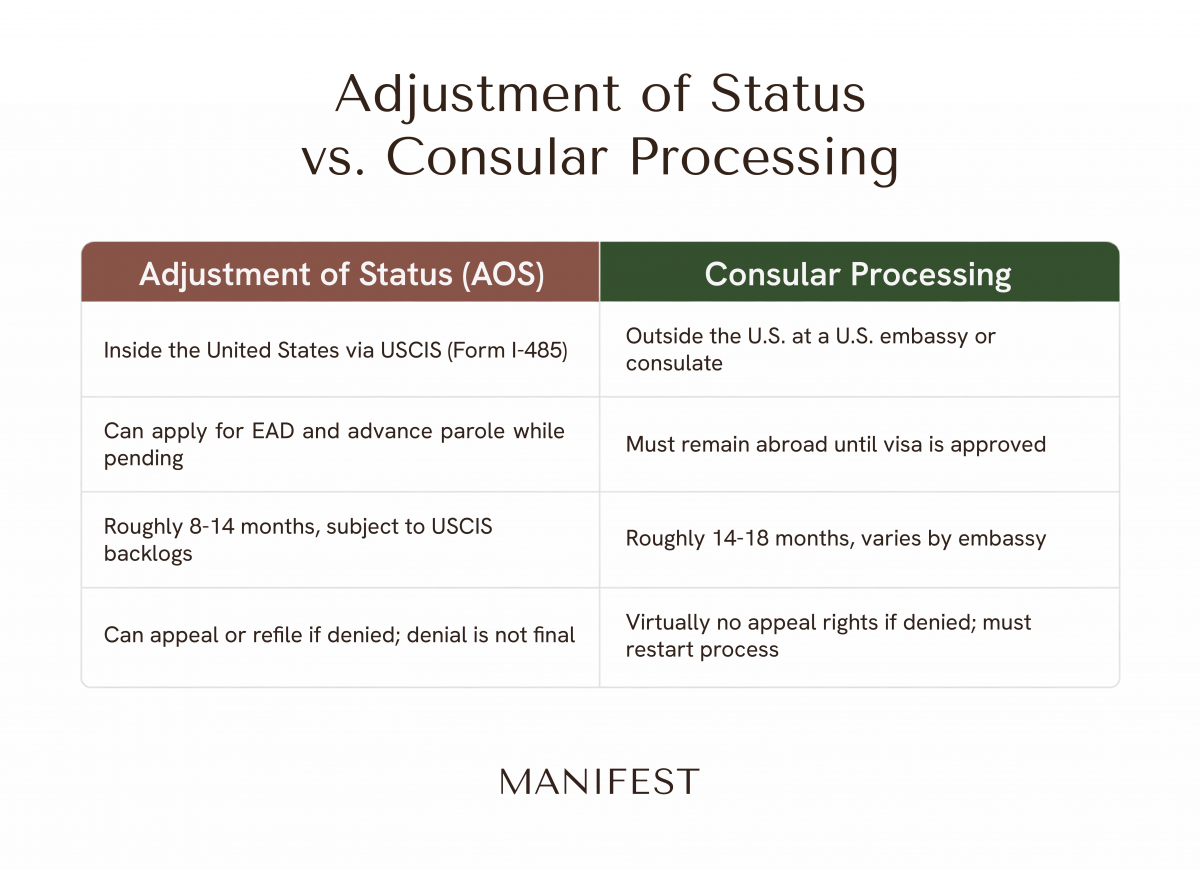
Adjustment of status vs. consular processing: key differences
While both adjustment of status and consular processing can lead to the same result—a U.S. Green Card—the experience of each can feel very different. The path you take will depend on your current location, visa history, and personal circumstances.
| Adjustment of Status | Consular Processing | |
| Location | Inside the US | Outside the U.S., at a U.S. embassy or consulate |
| Forms | Immigrant petition; Form I-485 | Immigrant petition |
| Interview | Biometrics appointment and potential interview at a USCIS office in the U.S. | U.S. embassy or consulate abroad |
| Travel restrictions | Allowed with Advance Parole, through Form I-131 | Must wait for visa issuance |
| Wait times vary depending on volume and case processing times | 8-38 weeks | Depends on the embassy/consulate |
| Agencies involved | USCIS | USCIS, consular officer, National Visa Center |
Adjustment of status or consular processing: which path is right for me?
Choosing between adjustment of status and consular processing largely depends on your location and your long-term plans. If you’re already in the U.S. on a valid visa and want to stay while your Green Card is processed, adjustment of status often offers more flexibility, and, in some cases, fewer travel risks.
Applicants living abroad will need to apply via consular processing, as will those who aren’t eligible to adjust their status domestically. It can typically be more straightforward for cases without complex immigration histories, but it does require you to complete your interview abroad and re-enter the country only after approval has been granted.
No matter which path you take, approval of your application is an essential step in the Green Card process. Because each applicant’s case is unique, it’s wise to consult with an experienced immigration attorney who can guide you through the forms and timelines.
Whether you’re just getting started or already working with a visa, understanding your options is key to making the right move. At Manifest, we can help your transition to permanent residence go as smoothly as possible.
👉 Ready to explore your options with an attorney? Request a consultation with Manifest Law and get the clarity you need to move forward.
Frequently Asked Questions
Can I travel during the Green Card application process?
You can likely travel during your adjustment of status if you get permission first by filing Form I-131 Application for Travel Document (Advance Parole), and you have an underlying nonimmigrant status like H-1B.
You can apply at the same time as or after filing Form I-485. Once approved, the Advance Parole document allows you to travel abroad and return to the United States legally while your Green Card application is pending.
Always remember that multiple government agencies are involved in the immigration process. A USCIS grant of advance parole does not guarantee re-entry. It is a pre-authorized permission to request re-entry at a port of entry, but the final decision rests with a CBP officer.
Can I work during the Green Card application process?
You may already have work authorization if you’re currently in the U.S. on a temporary worker visa, like the H-1B, when you apply for a Green Card.
Otherwise, if you want to work after you’ve applied for an adjustment of status, you need to apply for an Employment Authorization Document (EAD) using Form I-765. This document gives you work authorization in the U.S. while you wait for USCIS to make a decision on your Green Card application. You can file the I-765 together with your I-485 to save time.
Who is eligible to apply for Adjustment of Status in the U.S.?
To apply for AOS, you must be physically present in the U.S., have lawfully entered the U.S. (unless an exception applies), have a current priority date and be admissible under immigration law.
Is Adjustment of Status faster than consular processing?
Not always. AOS can take longer because USCIS handles biometrics, security checks, and interviews inside the U.S. Consular processing is often faster, but it requires international travel and depends on the scheduling availability of the specific embassy or consulate. Processing times vary widely based on location and workload.
Which option is safer if I have immigration violations or past issues?
Adjustment of Status (AOS) can sometimes be the safer route for individuals with prior overstays, unauthorized employment, or certain immigration violations because some waivers and exceptions are available only to applicants who remain inside the United States. These waivers are not automatic and apply only to very specific and truly eligible applicants.
Consular processing may carry more risk for individuals with past issues because departing the U.S. can trigger 3-year or 10-year unlawful presence bars or lead to additional inadmissibility findings at the consular interview.
Anyone with immigration complications should consult an experienced immigration attorney before choosing a strategy. Even small details can significantly change what is possible and whether a waiver applies.