Key Takeaways
- A standard Green Card is valid for 10 years and is also known as Form I-551 or a Permanent Resident Card.
- If your 10-year Green Card expires, you do not lose your permanent resident status.
- You may receive a 2-year conditional Green Card instead if you are newly married or applying through the EB-5 investor category.
A 10-year old Green Card is the official document U.S. Citizenship and Immigration Services (USCIS) issues for most permanent residents. With this document, you can prove to employers, law officials, and government agencies that you have become a permanent U.S. resident.
What is a 10-year Green Card?
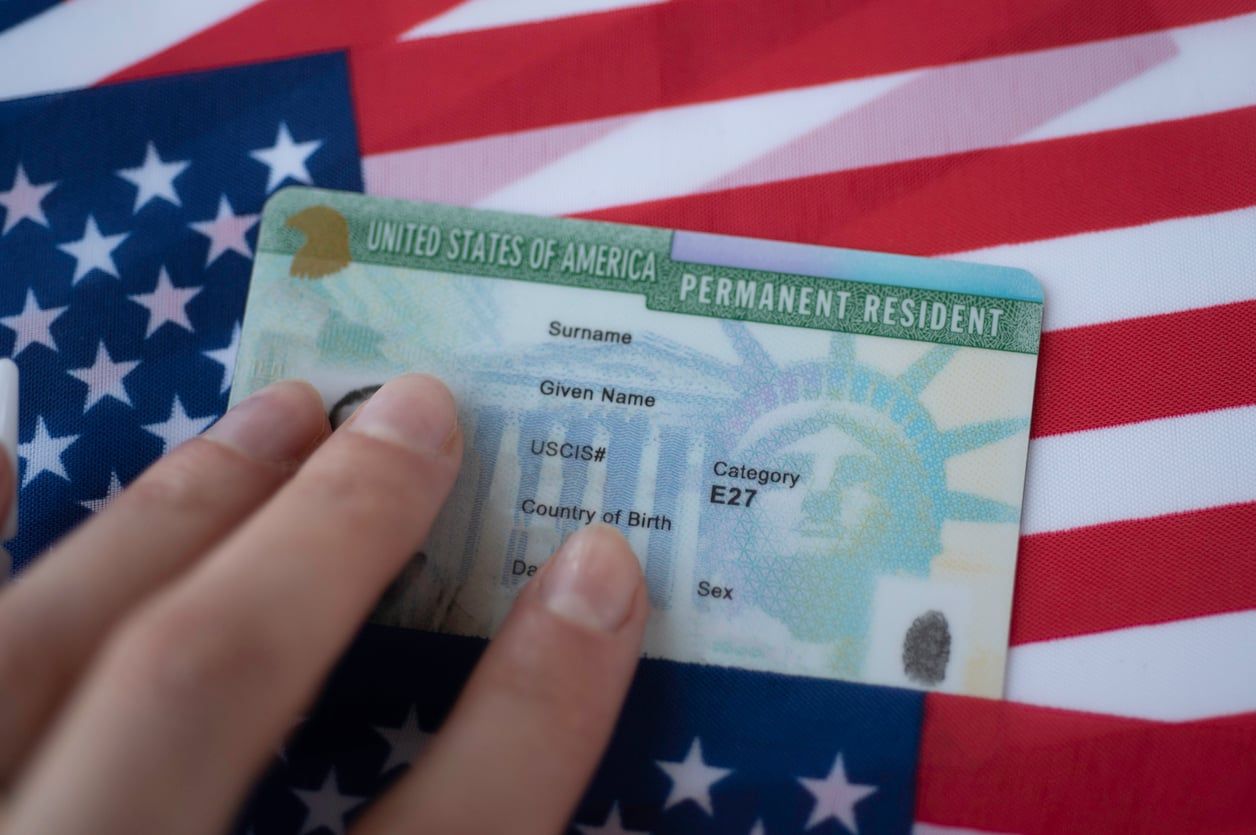
A 10-year Green Card is the standard document most people receive after they become permanent U.S. residents. Officially known as Form I-551 or a Permanent Resident Card, it serves as both a photo ID and proof of a foreign national’s current immigration status.
By default, most Green Cards expire 10 years after the date they’re issued. This does not mean a person loses their permanent resident status after 10 years. It only means the Form I-551—the physical card—will no longer be a valid identification document.
Who is eligible for a 10-year Green Card?
People who get permanent residence through family, employment, and humanitarian immigrant categories will receive a Green Card. A Green Card without conditions lasts for 10 years before the document needs to be renewed.
In some situations, USCIS issues a conditional Green Card that lasts two years instead of 10. These are typically given when you become a lawful permanent resident through a marriage that’s less than two years old, or through an EB-5 entrepreneur visa.
Many family-based categories are eligible for a 10-year Green Card (some with specific restrictions and requirements):
- IR-1 – Spouse of a U.S. citizen
- IR-2 – Unmarried child under 21 of a U.S. citizen
- IR-5 – Parent of a U.S. citizen (petitioner must be 21+)
- F1 – Unmarried sons and daughters (21 or older) of U.S. citizens.
- F2A – Spouses and unmarried children under 21 of lawful permanent residents
- F2B – Unmarried sons and daughters (21 or older) of lawful permanent residents
- F3 – Married sons and daughters of U.S. citizens (plus their spouses and minor children as derivatives)
- F4 – Brothers and sisters of U.S. citizens (petitioner must be 21+; spouses and minor children can come as derivatives)
Why some Green Cards don’t last 10 years
There are two main situations when you will get a 2-year Green Card instead of one that lasts 10 years, but you do have the ability to transition to a 10-year Green Card.
2-year marriage-based Green Cards
Whether a marriage-based immigrant receives a 10-year or conditional Green Card depends on how long they’ve been married to their partner. If a person receives their Green Card before their marriage’s second anniversary, they’ll receive the 2-year document. Those who’ve been married for more than two years by the time they become permanent residents will get a standard 10-year Green Card.
For the conditional Green Card, you must petition for USCIS to remove the conditions on your residence. That requires proving you still have a marriage and didn’t get married just for the immigration benefits.
2-year EB-5 Green Cards
EB-5 investors also receive a 2-year permanent residence card initially. To remove the conditions on their Green Card, they must submit proof that their commercial enterprise actively contributed to the U.S. economy.
Are you an entrepreneur interested in permanent residence? Our EB-5 visa guide breaks down each step in the application process, including how to remove conditions on a Green Card.
2-year vs. 10-year Green Card
A 2-year and 10-year Green Card offer the same basic benefits, but the 2-year version will expire unless you show USCIS that you qualify to change to the standard, 10-year version.
The table below covers the main differences, but if you’re unsure which version you’ll get, you can learn more in our breakdown of 2-year vs. 10-year Green Cards.
| 2-year Green Card | 10-year Green Card | |
|---|---|---|
| Who gets it | Conditional Permanent Residents | Lawful Permanent Residents |
| Most common reason | Marriage-based Green Card where the marriage is less than 2 years old at approval; EB-5 investor cases | Most family-based and employment-based Green Cards |
| Work authorization | Yes | Yes |
| Travel authorization | Yes | Yes |
| Can you renew? | No, you must remove conditions | Yes, after 10 years |
| Form required | Form I-751 (marriage-based) or I-829 (EB-5) | Form I-90 for renewal (if expiring) |
| Can you lose status? | Yes, if you don’t remove conditions before expiration | No, permanent residence doesn’t expire if a Green Card document does |
How do you get a 10-year Green Card?
To receive a 10-year Green Card, most people:
- Gather evidence that they qualify for an immigrant visa category.
- File a petition with USCIS.
- Receive a favorable decision.
- Wait for a visa number, if necessary.
- Apply for permanent residence.
- Attend a biometrics and interview appointment.
- Receive full or conditional permanent residence.
- Wait for their Green Card through the mail.
People can request a 10-year Green Card within or outside of the U.S. If you’re filing for permanent residence inside the country, you’ll go through a process commonly known as adjustment of status.
Those outside the country can petition for an immigrant visa through consular processing. This process involves filing an immigrant petition with USCIS, then going through a U.S. embassy or consulate for the final steps of the process. Once that’s done, a person can receive a visa stamp and enter the country.
Moving from a 2-year to a 10-year Green Card
If you’re on a conditional 2-year Green Card, you will not be able to renew or extend it. Instead, you must remove the conditions on your permanent U.S. residence, which will allow you to get a 10-year Green Card.
How to remove conditions on a 2-year Green Card
To remove conditions from your Green Card:
- Use Form I-751 if you got a 2-year Green Card through marriage.
- Use Form I-829 if you’re an EB-5 investor.
Once you have a 10-year Green Card, you can use Form I-90 to renew it once you get within six months of the expiration date on your I-551 card.
Benefits of a 10-year Green Card
With a 10-year Green Card, you’ll be able to prove to any U.S. employer or government agency that you have full permanent residence rights. That means you can:
- Travel freely in and out of the U.S.
- Work for any U.S. employer
- Pursue citizenship
Note that permanent residence and U.S. citizenship are not the same thing. If you’re a Green Card holder, you’ll need to explore naturalization to become an American citizen and gain exclusive rights such as voting.
Conditional permanent residents enjoy many of the same rights that legal permanent residents do, but with a big caveat. Because their status has a time limit, they are not able to file for citizenship or request that their Green Card document be renewed through Form I-90. Therefore, those under conditional permanent residence must be proactive to remove their conditions on their Green Card.
Speak with an immigration attorney about a 10-year Green Card. Whether you’re beginning to explore immigrant visas or trying to remove the conditions on your current Green Card, Manifest’s lawyers are here to help. Request a free consultation today to get your questions answered.
FAQs about 10-year Green Cards
Can I lose my 10-year Green Card?
Once you get a 10-year Green Card, you generally can’t lose your permanent resident status. Even if you lose your physical card or it expires, you don’t lose your status. (In both cases, you can file Form I-90 to get a new Green Card.)
Do I need to re-interview when renewing my Green Card?
Not always. An immigration officer has the jurisdiction to request an interview appointment if they feel it necessary.
How long can I stay outside the U.S. on a Green Card?
It depends. Generally speaking, international travel that doesn’t last over a year doesn’t pose a risk to a Green Card holder. However, USCIS may rule that your permanent residence is abandoned if they believe you are not holding ties to the U.S., even if your trip falls under 12 months.
About the Author

Staff Writer
Caryl Espinoza Jaen is a Nicaraguan-born staff writer for Manifest Law. As a writer, he strives to cover complex topics like immigration policy with clarity, accuracy, and precision.
Read bioReviewed By

Immigration Lawyer to Manifest Law
Ana Gabriela Urizar is an award-winning immigration attorney licensed in Arizona and New York. With nearly a decade of experience, she advises global corporations on complex U.S. immigration matters. Originally from Guatemala, Ana Gabriela previously spent close to ten years at the world’s largest immigration firm, managing business immigration matters for leading technology, science, and financial companies. She has been recognized by Best Lawyers: Ones to Watch and Negocios Now’s Tri-State 40 Under 40.
Read bioShare this article: