


Two-Year vs. 10-Year Green Card: What’s the Difference?

- Most Green Cards expire after 10 years, but the cardholder doesn’t lose permanent resident status even after the card expires.
- Conditional 2-year Green Cards are common for spouses of U.S. citizens who have been married for less than two years.
- Conditional Green Card holders must apply to remove conditions before they can receive a 10-year Green Card.
Although all Green Cards are commonly called permanent resident cards, they aren’t all valid for the same period. Some Green Card holders receive a two-year conditional Green Card, while others receive a 10-year Green Card. Understanding the difference is important because it affects your permanent resident status and the steps you’ll need to take to stay in the United States for the long term.
Does my Green Card type affect my lawful permanent resident status?
The most important thing to understand about the difference between two-year Green Cards and 10-year Green Cards is what these terms mean in relation to your lawful permanent resident status.
Many people use the term “Green Card” and “lawful permanent resident status” interchangeably. However, once you’ve become a lawful permanent resident, that status doesn’t expire except in rare circumstances that involve serious crimes. In that sense, the term “10-year Green Card” only means that the physical Green Card document itself must be renewed after 10 years; your status is unchanged even if the card expires.
This is different from the two-year Green Card. With a two-year Green Card, both your lawful permanent resident status and your Green Card document expire after two years. That’s because your status is conditional, so you’ll need to file a petition to remove conditions before the two years is up.
Subscribe to our newsletter for immigration resources and news, without the legal jargon.
What is a two-year Green Card?
A two-year Green Card is also called a conditional Green Card. It is issued to certain immigrants whose eligibility for permanent residence requires additional confirmation by U.S. Citizenship and Immigration Services (USCIS).
In most cases, the two-year Green Card is issued to people who are applying for a marriage-based Green Card with a marriage that is less than two years old at the time their application is approved. In these cases, USCIS adds the conditional status to confirm that the marriage is bona fide, meaning it was entered into in good faith and not solely for the Green Card.
Holders of a two-year Green Card are considered lawful permanent residents. But before the card’s two-year expiration date, they must file a petition to remove conditions (Form I-751) to remain in valid permanent resident status.
Applicants using the EB-5 Immigrant Investor visa pathway also receive conditional Green Cards. This type of Green Card is for foreign nationals looking to make significant investments in the U.S. or open a business that will create American jobs. The two-year condition is intended to allow USCIS to assess the credibility of the job-creation promises.
What is a 10-year Green Card?
A 10-year Green Card, also called a permanent Green Card, confirms full permanent residency. It is issued when USCIS has already verified long-term eligibility for permanent residence. Most Green Cards—including most employment-based and family preference Green Cards—are valid for 10 years.
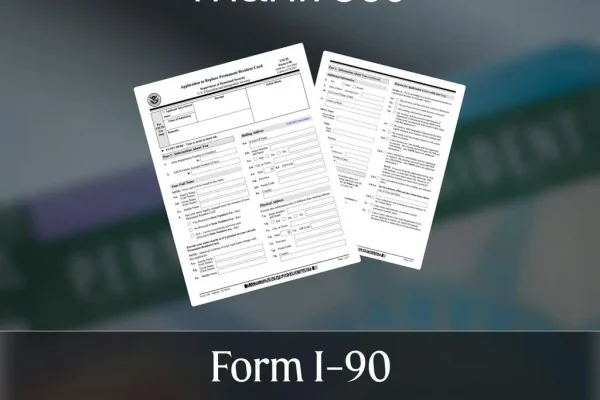
As the name implies, a 10-year permanent resident card must be renewed every 10 years using Form I-90. Renewal does not affect your underlying permanent resident status. Even if the card expires, you remain a lawful permanent resident unless USCIS formally revokes that status. However, you likely need an unexpired card for work authorization, travel, and licenses.
Many 10-year Green Card holders become eligible for naturalization and U.S. citizenship.
> Learn the difference between naturalization and citizenship.
| 🧑⚖️Clear guidance, without the legal jargon. This article is informed and reviewed by Manifest Law’s experienced immigration attorneys—and written to make the law make sense. Because you deserve to understand the system, not fight it. Check out our editorial policy for more info. |
Key differences between 2-Year and 10-Year Green Cards
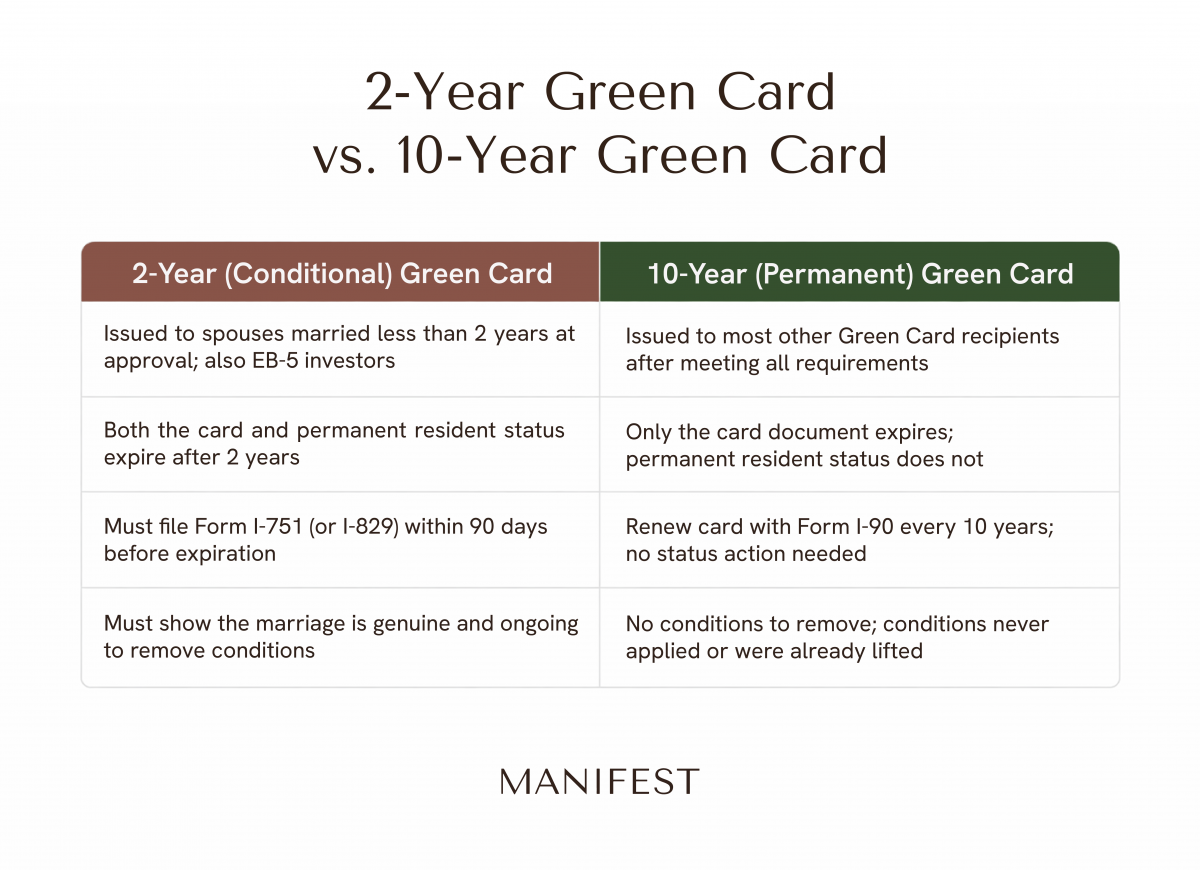
Here are the main differences between a 2-year Green Card vs. a 10-year Green Card:
| Category | 2-Year Green Card | 10-Year Green Card |
| Validity | Valid for 2 years | Valid for 10 years, but lawful status is permanent |
| Eligibility | Often issued in CR1 marriage-based petitions where the marriage is less than two years old, or for EB-5 immigrant investors | Most other Green Cards expire after 10 years |
| Evidence requirements | For CR-1, proof of a bona fide marriage like photographs, marriage certificates, and joint accounts; for EB-5, a business proposal to create at least 10 U.S. jobs | If USCIS approves your I-485 or consular processing, no additional evidence is required |
| Forms needed | Form I-751 to remove conditions | Form I-90 to renew |
| Rights | Same rights as 10-year, but conditional status known to invite extra vetting and scrutiny | All rights and privileges of permanent residency, including work authorization and freedom of travel |
| Consequences of not renewing or not removing conditions | Failure to remove conditions can result in termination of legal permanent residency status. | Failure to renew means Green Card expires, but not permanent residency; a valid Green Card is often needed for work, travel, driver’s licenses, and other privileges |
If you’re trying to decide which Green Card pathway is best for you and your family, reach out to Manifest’s experienced immigration attorneys today for assistance.
Who gets a two-year conditional Green Card?
You typically receive a two-year conditional Green Card if one of the following applies:
- You receive a marriage-based Green Card (CR1) and your marriage is less than two years old at the time of approval.
- You are an EB-5 Immigrant Investor Program applicant.
- You are under the age of 21 and are the unmarried child of a U.S. citizen parent whose marriage to your other parent is less than two years old when you enter the U.S. (CR-2 visa).
Conditional Green Card holders must file Form I-751 to remove conditions within 90 days before the visa expires.
Who gets a 10-year Green Card?
You may receive a 10-year Green Card if you qualify for residence through one of these categories:
- Marriage-based Green Card where the marriage is at least two years old (IR-1)
- Employment-based immigrant visas (EB-1, EB-2, EB-3, etc.)
- Immediate family of U.S. citizens, including parents, children, and adopted children (IR-2, IR-3, IR-4, IR-5)
- Family-based petitions (F1, F2A, F2B, F3, F4)
- Diversity visa lottery
- Asylum and refugee status
- U and T visa holders after holding status for three years
While the card must be renewed, your permanent residence status remains intact unless otherwise revoked by USCIS.
| 🧑💼 Curious about the green card process for families?Manifest Law’s experienced attorneys have helped thousands of immigrants and their families secure their future in the U.S. Learn more about family Green Card lawyer options. |
How to remove conditions from a two-year Green Card
If you hold a conditional permanent resident card, you will need to remove the conditions using Form I-751 to remain in the U.S. for more than two years. Follow these steps to remove conditions:
- Before filing, gather evidence showing you have a bona fide, good-faith marriage (children, joint finances, shared lease, photographs, etc.).
- Pay attention to the filing window. File Form I-751 within 90 days of the two-year expiration date. Some applicants may qualify for waivers due to factors like a good-faith marriage ending in divorce or evidence that removal from the U.S. would result in extreme hardship.
- After filing, attend a biometrics appointment and respond to any USCIS requests for evidence (RFEs). Processing times vary.
Understand whether you should get a two-year or 10-year Green Card
The deciding factor for your marriage-based Green Card is not when you filed, but how long you were married at the time USCIS approved your case. While every situation is different, the experienced immigration lawyers at Manifest can help you navigate your Green Card case. Request a consultation today.
Two-year Green Card vs. 10-year Green Card FAQs
Do rights and benefits change between the two-year and 10-year Green Card?
No. Both allow you to live and work in the U.S. as a lawful permanent resident. You can also travel domestically and internationally.
Can I get a 10-year Green Card if I’m married for less than two years?
No. In these cases, USCIS issues a conditional Green Card.
Why did I only get a two-year Green Card?
USCIS needs additional confirmation that your marriage is bona fide or that your commercial investment is legitimate.
How do I change from a two-year to 10-year Green Card?
File Form I-751 and complete the removal-of-conditions process before your Green Card expires.