



Form I-526 Guide for EB-5 Investor and Entrepreneurs
- Form I-526 is the EB-5 immigrant petition for standalone investors. (Regional center investors typically file I-526E.)
- Your evidence must prove a qualifying investment, a lawful source and path of funds, and a plan to create 10 full-time U.S. jobs.
- TEA claims require strong location evidence and, for high-unemployment areas, census-tract documentation with a weighted unemployment calculation.
- I-526 filing doesn’t grant status by itself. Some investors can file I-485 concurrently only if a visa is available and they’re eligible to adjust.
An EB-5 visa is designed to create a pathway to lawful permanent resident status for someone who invests in an U.S. business. It’s the first major filing form in the EB-5 process and it asks U.S. Citizenship and Immigration Services (USCIS) to classify you as an EB-5 immigrant investor and a Green Card candidate.
What is Form I-526?
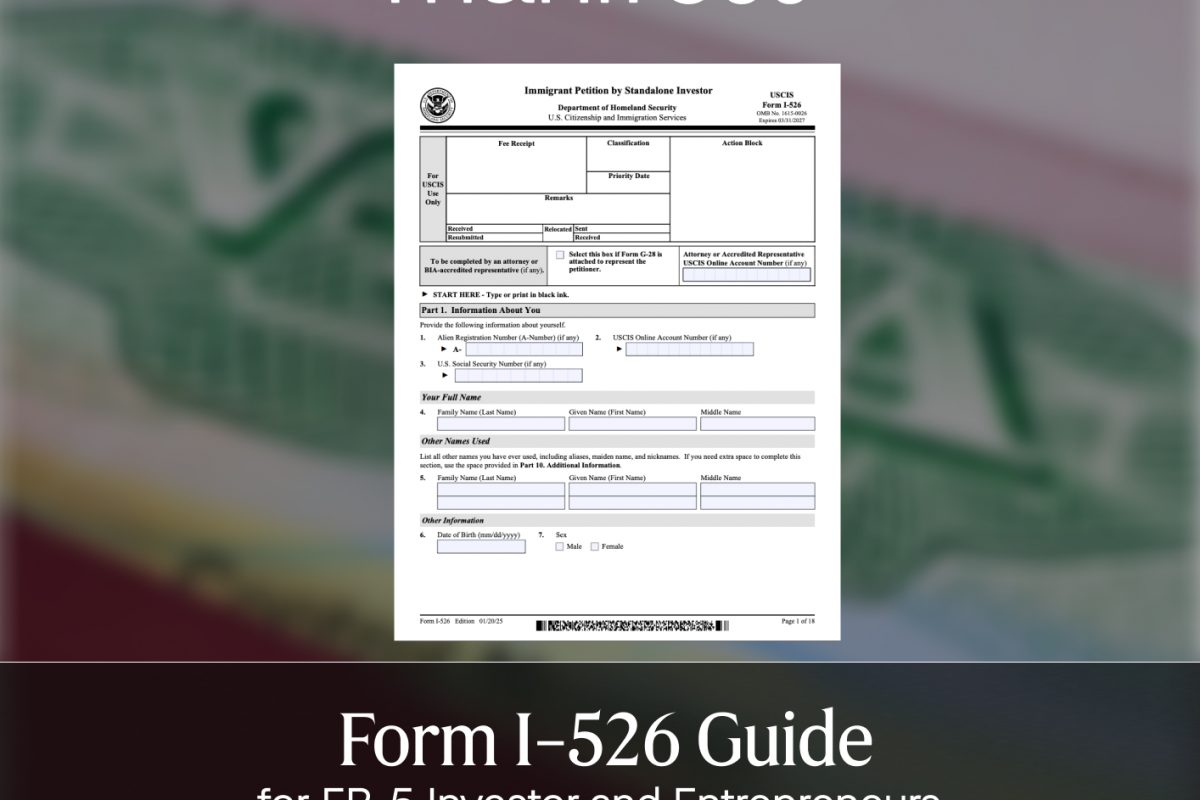
Form I-526, officially called the Immigrant Petition by Standalone Investor is where you submit evidence showing that your investment qualifies under the EB-5 (employment-based, fifth preference) immigrant category.
An individual investor can file Form I-526 on their own when their EB-5 investment is not tied to a regional center project. Through this petition, you must show that you have invested—or are actively in the process of investing—the required amount in a qualifying commercial enterprise and that the investment is structured to create the necessary U.S. jobs.
| 💡 If the investment is associated with a regional center, USCIS directs investors to file Form I-526E instead, and warns it will reject I-526 filings that indicate a regional center investment. |
Eligibility requirements for the Form I-526 petition
Unlike other employment-based categories, such at the EB-3, the EB-5 visa doesn’t require a petitioner to prove an extraordinary ability or have an employer sponsor. You’ll use Form I-526 to show you plan to invest your capital, demonstrating the legal source of investment funds, and that the investment creates jobs. It’s not tied to any industry accomplishments or working in a specific role.
Subscribe to our newsletter for immigration resources and news, without the legal jargon.
Invest in new business
Under EB-5, your investment generally must be in a new commercial enterprise (NCE). This requirement can be met in several ways, which include:
- Investing in a newly formed business
- Buying and restructuring an existing business (formed on or before November 29, 1990) so it becomes a new commercial enterprise
- Expanding an existing business (formed on or before November 29, 1990) in a way that results in a qualifying increase—specifically, at least a 40% increase in either net worth or number of employees
Create jobs
The business investment must also do one of the following:
- Create a minimum of 10 full-time jobs
- Maintain jobs, if the investment is in a troubled business
Meet the EB-5 minimum investment amount
All new petitions filed on or after March 15, 2022, require $1,050,000, or $800,000 if the investment is in a targeted employment area (TEA) or a qualifying infrastructure project.
A TEA is a rural area or one experiencing high unemployment, which is defined as at least 150% of the national average unemployment rate.
How and where to file Form I-526
Form I-526 is a paper-filed immigrant petition that you mail to USCIS with a supporting evidence packet (it’s not an online form).
Confirm you’re using the right petition
File Form I-526 for a standalone (direct) EB-5 investment. If your investment is tied to an approved regional center project, USCIS generally expects Form I-526E instead.
Prepare the evidence packet
It’s best to keep your documents tabbed and organized. You’ll need to submit your evidence packet with Form I-526.
For EB-5 applicants, USCIS is usually looking for documentation (listed in more detail in the section above) showing:
- the new commercial enterprise and your role/investment,
- the lawful source and path of funds,
- and a credible plan/evidence for 10 full-time U.S. jobs
Pay the filing fee (and confirm the correct amount on the day you file)
After a federal court decision in November 2025, multiple EB-5 fees reverted to the lower pre-April 2024 amounts.
Because EB-5 fees have been in flux, be sure to check the USCIS fee schedule/fee calculator right before mailing.
| 💲Fee check: USCIS periodically updates Form G-1055 (Fee Schedule). Confirm the current I-526 filing fee before submitting. As of December 2025, the fee for an I-526 was $3,675. |
Assemble your filing package
Include the signed, completed form, fee, and all supporting evidence. Many filers also include Form G-1145 (optional) to request e-notification of acceptance.
Note that if an immigrant visa number is immediately available in the visa bulletin, you can apply for adjustment of status (Form I-485) at the same time as your I-526. This is called concurrent filing.
Mail the petition to the correct USCIS lockbox address
USCIS lists the EB-5 petition lockbox, and you can check their submission address page for the latest details to be sure your packet goes to the correct address.
Track your receipt, and respond to any USCIS requests
After USCIS accepts the packet, you’ll receive a receipt notice. EB-5 may sometimes involve follow-up requests (RFEs/NOIDs) depending on how USCIS views the project documents, investment details, fund history, job methodology, or TEA evidence.
Process times for Form I-526
USCIS processing times fluctuate by workload and case type. Check USCIS’s current processing-time estimate for Form I-526. As of December 2025, 80% of I-526 forms are processed within 29.5 months.
Learn more about USCIS processing times.
Get help with your Form I-526 submission right away
Filing Form I-526 is document-heavy and detail-sensitive, especially regarding the source of funds and job-creation evidence.
If you want help evaluating whether your investment qualifies under EB-5 rules and building a clear, well-organized I-526 filing strategy, our experienced attorneys at Manifest can guide you from petition preparation and beyond.
Request a consultation to connect with an experienced immigration attorney.
Form I-526 FAQs
Is I-526 an immigrant petition?
Yes. USCIS describes Form I-526 as the petition a standalone investor uses to request classification as an immigrant under the EB-5 category.
Who is the petitioner, and who is the beneficiary?
For the EB-5, the investor is both the petitioner and the beneficiary.
What is the difference between Form I-526 and Form I-526E?
Form I-526 is the immigrant petition for a standalone (direct) EB-5 investor. Form I-526E is for an investor whose EB-5 investment is made through a regional center structure.
What happens after I-526 approval?
After approval, an investor typically moves to the Green Card application stage. That means they can apply for an adjustment of status, if eligible, and a visa number is available, or for consular processing if they’re outside the U.S.
EB-5 Green Cards are generally conditional at first, and investors later file to remove conditions and obtain full permanent resident status.
Can I stay in the U.S. while my I-526 is being processed?
Filing I-526 by itself does not give you immigration status or permission to remain in the U.S. You generally must maintain separate lawful status unless you’re eligible to file Form I-485 (and keep it pending) based on visa availability and other requirements.