Key Takeaways
- An immigration recommendation letter is a third-party written statement submitted as supporting evidence in an immigration application.
- It is written by someone with direct, firsthand knowledge of the applicant — an employer, expert colleague, community leader, family friend, or religious leader, depending on the case type.
- Letters are used in naturalization (N-400), adjustment of status, employment-based visa petitions (EB-1A, O-1, EB-2 NIW), family-based petitions (marriage green cards, I-751, fiancé visas), and immigration court proceedings.
- An effective letter establishes the writer's credentials, describes the relationship, provides specific examples or observations, and includes the writer's full contact information.
- Letters should be 1–2 pages, signed and dated, and written within the past 6–12 months.
- Notarization is generally not required unless specifically requested by the immigration process or your attorney.
An immigration recommendation letter is a written statement from a third party (such as an employer, community member, or expert in the field) submitted as supporting evidence in a visa or Green Card application.
Oftentimes, they are used to tell a reviewing immigration officer something about the applicant that official forms cannot: who they are, what they have contributed to the U.S., and why the application deserves to be approved.
What is an immigration letter of recommendation?
An immigration recommendation letter is a piece of third-party written evidence that adds human context that official paperwork cannot provide.
USCIS forms capture facts: dates, addresses, employment history, criminal records. A recommendation letter can provide a testimonial for the legitimacy of a relationship, the significance of someone's professional contributions, or an affidavit of someone’s good moral character over time.
When written well and grounded in specific, firsthand knowledge, these letters can significantly strengthen a case.
This YouTube video is hidden until you accept functional cookies.
What is the difference between a reference letter, letter of support, and letter of recommendation?
| Attribute | Reference Letter | Letter of Support | Letter of Recommendation |
|---|---|---|---|
| Purpose | Confirms facts about the applicant's qualifications, employment, or background | Expresses support for the application and vouches for the applicant's character or contributions | Attests to the applicant's extraordinary ability, expertise, or standing in a professional field |
| Who Writes It | Employers, supervisors, academic institutions | Community members, religious leaders, family friends | Peer experts, researchers, professionals in the applicant's field |
| Primary Use Case | Employment-based visas, credential verification | Family-based petitions, naturalization, character evidence | EB-1A, O-1, EB-2 NIW extraordinary ability petitions |
| Tone | Formal, factual | Personal, attesting to character and conduct | Professional, field-specific, evaluative |
| Key Requirement | Accuracy and verifiable facts | Direct personal knowledge of the applicant | Writer's independent credibility in the field |
When Is a Recommendation Letter Used?
Recommendation letters appear across nearly every category of immigration application. For instance, in a naturalization petition filed through Form N-400, a recommendation letter supports the good moral character requirement. In a family-based application (such as an initial I-130 filing, petitions to remove Green Card conditions, or even a fiancé visa application), they help establish the bona fide nature of a relationship or family ties.
In employment-based categories such as the O-1, EB-1A, or EB-2 NIW, recommendation letters function as supplementary evidence of achievements. In most other application types, the letter is optional, but a well-written, specific letter from a credible source can be a strong addition to a case’s evidence.
Recommendation Letters by Immigration Case Type
Family-Based Letters (Green Cards, Fiancé Visas, I-751 Petitions)
For family-based cases, immigration officers are looking for evidence that relationships are genuine, not arrangements formed to obtain immigration benefits. The most effective writers are people who have spent time with the couple or family, attended events with them, or witnessed the relationship in everyday settings.
The difference between a useful letter and a useless one often comes down to specificity.
Compare:
"I have known Maria for 10 years and she is a wonderful person."
versus:
"I have spent time with Maria and James together frequently since they met in 2021. I attended their engagement dinner in March 2022, hosted them at my home for Thanksgiving that same year, and have seen them interact as a couple on dozens of occasions. Their relationship has every appearance of a committed, genuine partnership."
The first letter adds nothing an officer doesn't already assume. The second provides something an officer can weigh.
Employment-Based Letters (EB-1A, O-1, EB-2 NIW)
For extraordinary ability and national interest waiver petitions, the independence of the writer matters significantly. A letter from a direct supervisor or co-author at the same institution will carry less weight than a letter from an expert in the field who has no professional relationship with the applicant.
Strong letters in this category often share two characteristics: the writer explains their own credentials and standing in the field, and describes specific contributions the beneficiary made. Note that a simple employment verification letter (which confirms an applicant worked at a company from one date to another) is not the same as an expert recommendation letter, and therefore does not serve the same evidentiary function.
Character Reference Letters for Naturalization (N-400)
The N-400 application for naturalization requires applicants to demonstrate good moral character, typically over a statutory period of three to five years. The most credible writers for naturalization character letters are people who have known the applicant over a sustained period and can speak to specific conduct: a long-term employer, a religious leader who has observed the applicant's community involvement, a neighbor who has known the applicant for years, or a community organization leader.
How to Write an Immigration Recommendation Letter (Step by Step)
Step 1: Establish Your Credentials and Your Relationship
Open by identifying yourself, including your full name, your professional title, and your immigration status if relevant. Then explain how you know the applicant and for how long.
Specificity here sets the credibility of everything that follows. Compare:
"I know Maria well and have for many years."
versus:
"I have supervised Maria Chen for three years as her direct manager at our marketing firm. As a U.S. citizen and professional in the same industry, I am writing in strong support of her application."
Sample introduction:
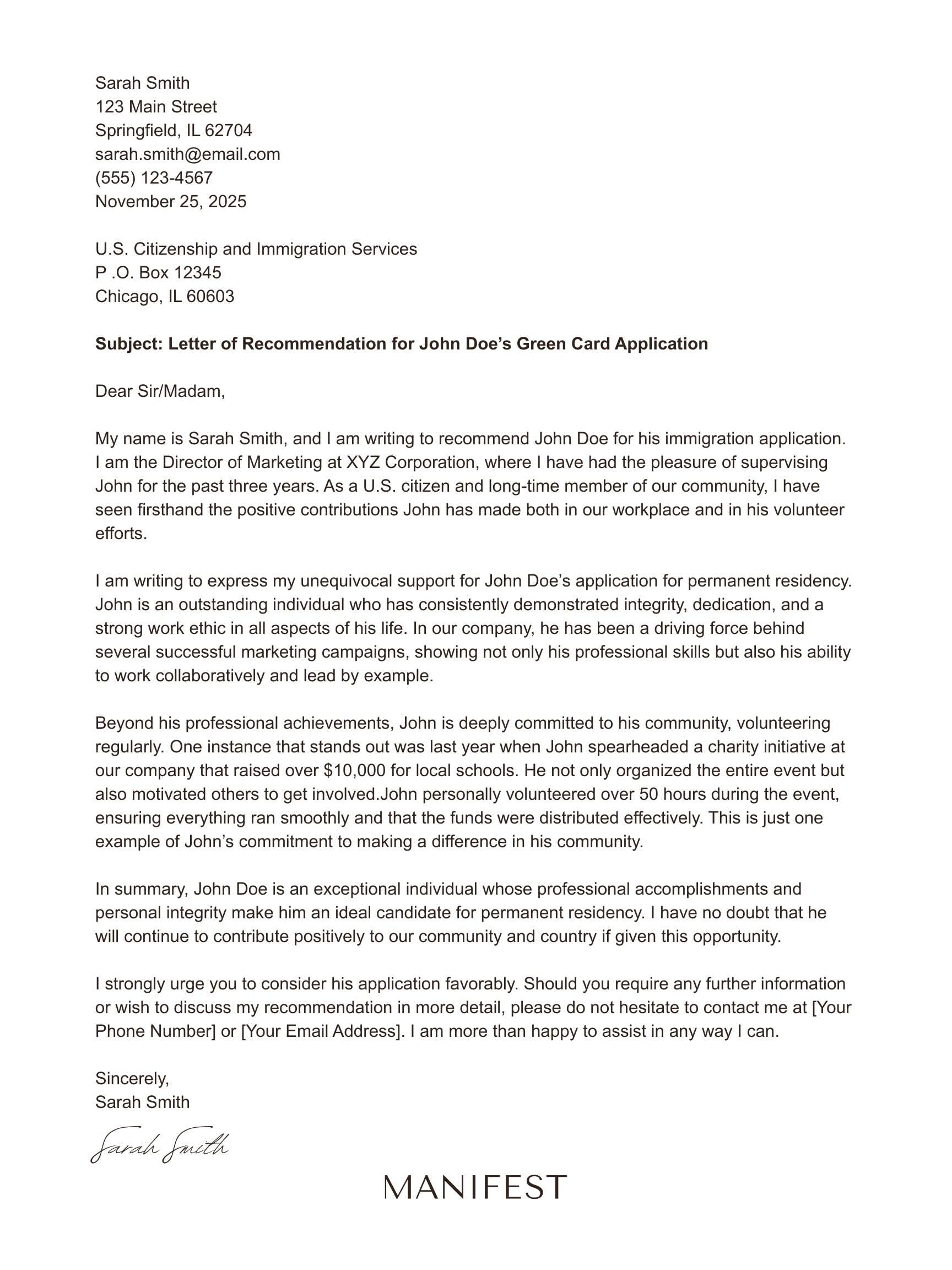
My name is Sarah Johnson. I am a United States citizen and have worked as a Senior Project Manager at ABC Corporation for the past eight years. I am writing to recommend John Doe, who has worked under my direct supervision as a Marketing Specialist for the past three years. During this time, I have had the opportunity to closely observe John's professional skills, character, and contributions to our organization.
Step 2: State Your Support Clearly
In the second paragraph, state plainly that you endorse this application and explain why. The endorsement should come early, not as a conclusion after several paragraphs of buildup.
Sample statement of support:
I wholeheartedly recommend John for permanent residency in the United States. Throughout his time at ABC Corporation, John has consistently demonstrated exceptional skill, professionalism, and integrity. His contributions to our team have been substantial and his dedication to his work is evident in everything he does.
Step 3: Provide Specific Examples
General praise is the weakest part of most recommendation letters. If you have supporting documentation, such as a performance review or a commendation from a community organization, reference it. The letter is part of a larger record.
Sample evidence paragraph:
One example that stands out: last year, John led a complete overhaul of our client communication system, developing a new protocol that reduced response time by 40% and improved client satisfaction scores by 25%. This project required him to coordinate across five departments, manage conflicting priorities, and bring it in under budget. The results were measurable and significant, and they would not have happened without his specific initiative.
Step 4: Close with a Clear Summary and Offer to Follow Up
The closing paragraph should briefly restate your support and offer to be contacted for follow-up. Include your full contact information — a phone number and email address where you can actually be reached. An officer who cannot verify the letter has less reason to credit it.
Sample conclusion:
I have complete confidence in John Doe's ability to contribute positively to this country. He is a person of exceptional character and professional ability, and I believe his permanent residency would benefit both him and the United States. I would welcome the opportunity to provide any additional information that may be helpful. Please feel free to contact me at [phone number] or [email address].
Sincerely, Sarah Johnson Senior Project Manager, ABC Corporation
Step 5: Format, Sign, and Submit
Use professional letterhead where applicable, as a business letter from an employer should come on company letterhead. Sign and date the letter; a handwritten signature is standard, and a scanned signature is acceptable for digital submission.
Notarization is generally not required. The letter must be signed and dated, but unless your attorney or the specific immigration process requests a notarized statement, a standard signature is sufficient.
If the letter is not written in English, a certified translation must accompany it. USCIS does not accept foreign-language documents without a corresponding certified English translation.
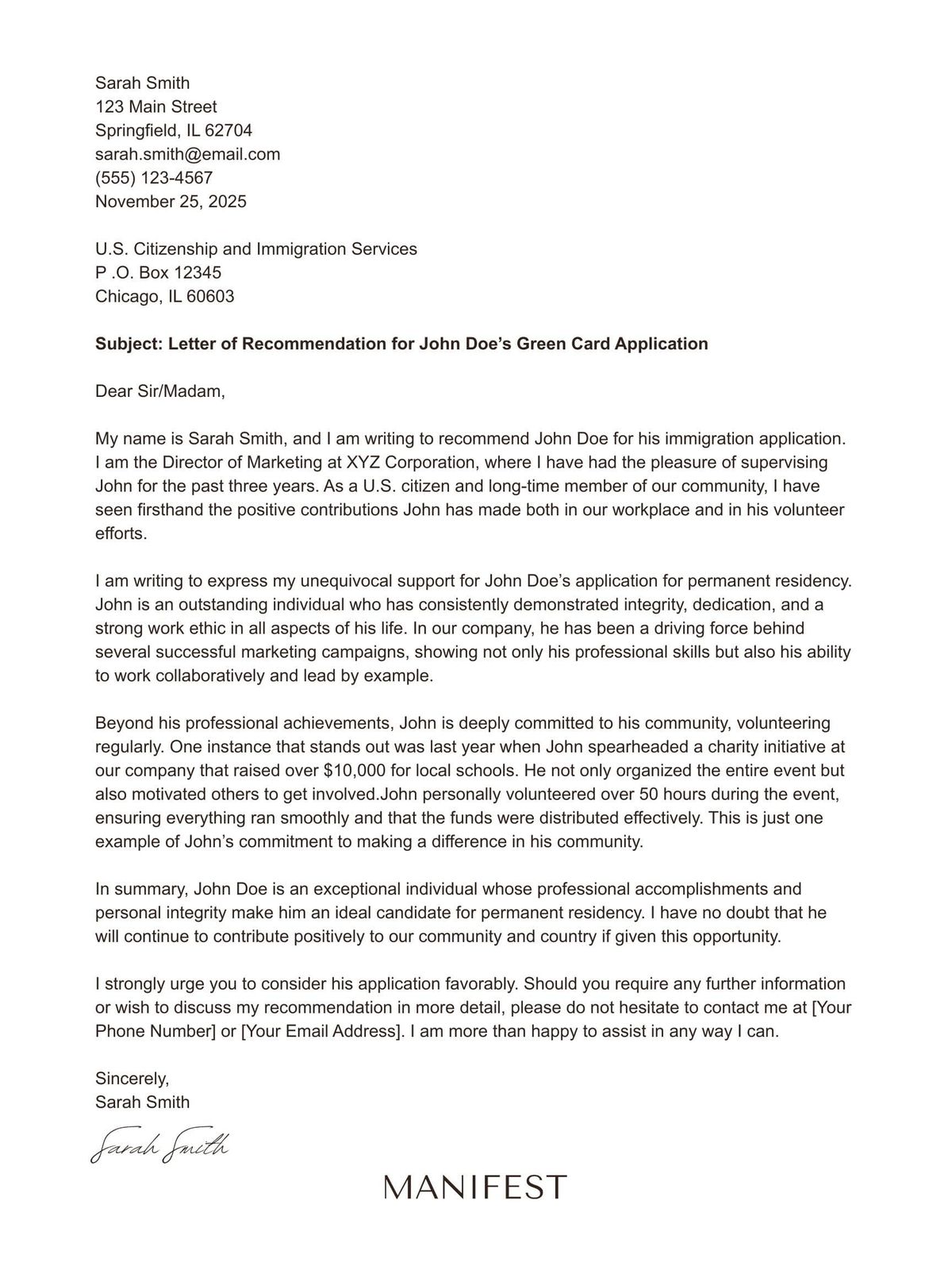
Download sample immigration letter
How to Brief the Person Writing Your Letter
The applicant's job is to give the letter writer everything they need to write a useful letter.
- Context about the case: Tell the writer what type of application this is and what question the letter is helping answer. "We're filing a marriage green card and the letter should help show the relationship is genuine" gives the writer a target. A letter written without that context often misses it.
- What they specifically know: Ask the writer to focus on what they've personally observed, not on general impressions or reputation. If they attended your wedding or have spent time with you as a couple, that's what the letter should describe.
- What to include and what to avoid: No legal conclusions ("she clearly qualifies for this visa"). No overclaiming. No praise they can't back up with specifics. Experienced adjudicators recognize when letters are being inflated, and it undermines the letter's credibility.
- Format basics: Typed, 1–2 pages, signed and dated, with the writer's full contact information included.
Don't draft the letter yourself and ask someone to sign it. Experienced adjudicators can often tell when a letter was written by the applicant, and it undermines the letter's value as independent evidence.
What Mistakes Can Hurt Your Application?
| Mistake | Why It Hurts | How to Fix It |
|---|---|---|
| Inconsistencies with the record (e.g., letter says 5 years of employment, records show 4) | USCIS notices even small discrepancies, which can raise credibility questions across the entire file | Verify all factual claims against official records before the letter is finalized |
| Overclaiming ("one of the most important professionals in the field") when the record doesn't support it | Adjudicators are experienced readers. Exaggeration reads as self-serving and undermines the letter's credibility | Use specific, defensible language grounded in what the writer personally observed |
| Too many generic letters that say the same thing | After a certain point, volume signals the absence of quality. Twelve letters all calling the applicant "hardworking and kind" don't add twelve times the value of one | Submit the letters with the most specific, credible content. Cut duplicative submissions. |
| Letters from writers with no real standing | A letter from someone with an impressive title who barely knows the applicant carries less weight than a letter from someone with direct, firsthand knowledge | Prioritize writers who have genuine, ongoing knowledge of the applicant's conduct or work |
| Missing contact details | Immigration officers cannot verify the letter if there's no way to follow up | Always include the writer's full name, title, phone number, and email address |
Sample Immigration Recommendation Letters
These templates are starting points. Adapt each one to your specific circumstances — immigration officers read many letters, and the ones that carry weight reflect real, specific knowledge of the applicant.
Employment-Based Letter Template (EB-1A, O-1, EB-2 NIW)
[WRITER NAME]
[TITLE]
[INSTITUTION / ORGANIZATION]
[ADDRESS]
[EMAIL] | [PHONE]
[DATE]
To Whom It May Concern:
I am [WRITER NAME], [TITLE] at [INSTITUTION]. I hold [DESCRIBE CREDENTIALS: e.g., a Ph.D. in molecular biology from X University and have worked in the field of gene therapy for 22 years]. I have published [X] peer-reviewed papers, served on the editorial board of [JOURNAL], and been invited to present at [CONFERENCE]. I am writing in support of [APPLICANT NAME]'s petition for [visa/green card classification].
I became familiar with [APPLICANT NAME]'s work through [DESCRIBE HOW: e.g., their 2021 publication in Nature on CRISPR-based delivery mechanisms / their presentation at the Annual Symposium on Gene Editing / their citation of my work in their foundational paper on X]. I have followed their research independently for [X] years and have relied upon their findings in my own work.
[APPLICANT NAME]'s contribution to [FIELD] centers on [DESCRIBE SPECIFIC CONTRIBUTION OR FINDING: e.g., their development of a lipid nanoparticle delivery system that improved uptake efficiency by 60% in in vitro models, as published in [JOURNAL] in [YEAR]]. This work addressed a specific problem that had constrained the field for more than a decade: [DESCRIBE THE PROBLEM]. [APPLICANT NAME]'s approach was distinct from prior attempts because [DESCRIBE WHAT WAS NEW OR DIFFERENT]. I implemented a version of their methodology in my own lab's research in [YEAR], and the results were consistent with their published findings.
The significance of this work is not limited to our laboratory. [DESCRIBE IMPACT: e.g., the paper has been cited 140 times since publication; the methodology has been adopted by at least three other research groups I am aware of; it was recognized with the X Award in Y year]. This level of uptake reflects genuine influence on the field, not simply academic interest.
[APPLICANT NAME] is among the researchers whose contributions have meaningfully advanced [FIELD]. I support their petition without reservation and would welcome any questions about my assessment. I can be reached at [EMAIL] or [PHONE].
Sincerely,
[WRITER NAME]
[TITLE], [INSTITUTION]
Family / Friend Character Letter Template
[WRITER NAME]
[ADDRESS]
[EMAIL] | [PHONE]
[DATE]
To Whom It May Concern:
My name is [WRITER NAME]. I am a [U.S. citizen / lawful permanent resident] and have known [APPLICANT NAME] for [X] years. We [DESCRIBE RELATIONSHIP: e.g., met through our children's school and have maintained a close friendship since / have been neighbors for six years / worked together at X organization]. I am writing to attest to [APPLICANT NAME]'s character in support of their application for [immigration benefit].
Over the course of knowing [APPLICANT NAME], I have had the opportunity to observe them in a range of circumstances. [SPECIFIC OBSERVATION 1: e.g., When my mother was ill in 2022, [APPLICANT NAME] brought meals to our family on three separate occasions without being asked. That kind of attentiveness to others is consistent with how I have seen them act throughout our friendship.] [SPECIFIC OBSERVATION 2: e.g., [APPLICANT NAME] has volunteered regularly at [ORGANIZATION] for the past two years — I have attended several of those events alongside them and have seen firsthand how they show up consistently and contribute meaningfully.] [SPECIFIC OBSERVATION 3: e.g., They are a dependable presence in our community. In the six years I have known them, their behavior toward others has been consistently honest and respectful.]
Based on my personal knowledge, I have full confidence in [APPLICANT NAME]'s character and integrity. I believe they are a genuine asset to this community and fully support their application. Please do not hesitate to contact me with any questions.
Sincerely,
[WRITER NAME]
[RELATIONSHIP TO APPLICANT]
[CONTACT INFORMATION]
Marriage-Based Relationship Letter Template
[WRITER NAME]
[ADDRESS]
[EMAIL] | [PHONE]
[DATE]
To Whom It May Concern:
My name is [WRITER NAME]. I am a [U.S. citizen / lawful permanent resident] and have known [PETITIONER NAME] for [X] years [and/or have known [BENEFICIARY NAME] for X years]. I came to know [BENEFICIARY NAME] when [DESCRIBE HOW: e.g., [PETITIONER NAME] introduced us shortly after they began dating in [YEAR]]. I am writing in support of their marriage-based green card application.
Since [APPROXIMATE DATE], I have had frequent opportunity to observe [PETITIONER NAME] and [BENEFICIARY NAME] together as a couple. [SPECIFIC OBSERVATION 1: e.g., I attended their wedding in [MONTH, YEAR] at [LOCATION] along with approximately [X] guests, and I have photographs from that day if they would be helpful.] [SPECIFIC OBSERVATION 2: e.g., I have spent time with both of them on [X] separate occasions since they married — including [DESCRIBE EVENT: e.g., Thanksgiving dinner at their home in November 2024 and a weekend trip to [LOCATION] in March 2025].] [SPECIFIC OBSERVATION 3: e.g., In my interactions with them, I have observed a relationship that appears fully consistent with a genuine, committed marriage — they make decisions together, are attentive to each other, and have built a shared life that is apparent to anyone who spends time around them.]
Based on everything I have observed directly, I have no doubt that the marriage between [PETITIONER NAME] and [BENEFICIARY NAME] is genuine and authentic. I support their application fully and would be glad to speak with anyone reviewing this letter. I can be reached at [EMAIL] or [PHONE].
Sincerely,
[WRITER NAME]
[RELATIONSHIP TO COUPLE]
[CONTACT INFORMATION]
Frequently Asked Questions
Who should write an immigration recommendation letter?
The letter should be written by someone with direct, firsthand knowledge of the applicant — not just a general acquaintance or someone with an impressive title who hasn't spent meaningful time with them. Depending on the case type, appropriate writers include employers, academic supervisors, community leaders, religious leaders, neighbors, longtime friends, or expert colleagues in the applicant's professional field. In all cases, what matters most is whether the writer can speak from personal knowledge, not simply how credentialed they are.
How long should an immigration recommendation letter be?
One to two pages is the standard length. Long enough to establish the writer's relationship, describe specific observations, and state a clear endorsement — short enough to stay focused and not dilute the most credible content. Letters that run longer rarely add more value; they typically repeat themselves or pad with generalities. A tight, specific one-page letter will almost always outperform a meandering three-page one.
Does an immigration recommendation letter need to be notarized?
No — notarization is generally not required. The letter must be signed and dated, and a handwritten signature is standard (a scanned signature is acceptable for digital submissions). Notarization is only needed if explicitly requested by your attorney or by the specific immigration process you're involved in. When in doubt, ask your attorney rather than assuming it's required.
How many letters should I submit with my application?
There's no set number, but quality matters considerably more than quantity. As a general guide: EB-1A and NIW petitions typically benefit from 5–8 independent expert letters; family-based petitions typically call for 2–4 letters from people with direct knowledge of the relationship; and naturalization applications typically include 2–4 letters from credible community members. When complicating factors are present — a criminal record, prior immigration issues — additional letters that speak directly to those factors can be valuable. Submitting 15 letters that all say the same thing does not multiply their value; it signals to the adjudicator that quality letters weren't available.
Can an employer write a recommendation letter for an O-1 or EB-1A petition?
Yes, but an employer letter carries the most weight when the writer can speak to specific accomplishments and has standing in the applicant's field. There is a meaningful difference between an employer letter that confirms job title and dates of employment and an expert letter that explains why the applicant's work matters in their field. For extraordinary ability petitions, independent letters — from experts who have no direct professional relationship with the applicant and know their work through its impact in the field — generally carry significantly more evidentiary weight than letters from direct supervisors or colleagues at the same institution.
Can a recommendation letter be used for multiple immigration applications?
Yes, if the letter is relevant to each application. A letter written to support one petition can be resubmitted in a subsequent case if the facts it describes remain accurate and current. That said, tailoring the letter to each application's specific criteria — and to the specific legal questions the officer will be evaluating — makes it more effective than a generic letter submitted unchanged across cases.
How recent does the letter need to be?
Letters dated within the past 6–12 months are standard as of 2026. The letter should reflect the applicant's current status, qualifications, and circumstances. An employer letter from five years ago describing a position the applicant no longer holds doesn't tell the officer what they need to know. If a letter is being reused from a prior application, verify that the facts are still accurate and that the timeframe is still within a reasonable range.
How should the letter be submitted?
Include the letter with your application materials, following the submission format specific to your case. For applications filed online through the USCIS portal, letters are uploaded as PDF attachments. For paper-filed applications, they are included as physical documents in the application packet. If you're filing through an attorney or legal representative, they will advise on the correct submission format. Do not send letters separately from the rest of the application unless specifically instructed to do so.
About the Author

Contributing Writer
Chelsea Spinos is a contributing writer for Manifest Law. She covers all topics related to U.S. visas and Green Cards. She is passionate about helping people navigate their immigration journey with clarity and confidence.
Read bioReviewed By

Senior Immigration Attorney at Manifest Law
Henry is an Estonian American attorney licensed in Arizona with broad experience in employment-based immigration. He handles EB-1A, EB-2 NIW, O-1, and E-2 cases for founders, professionals, and creatives across industries worldwide, and has helped hundreds of clients achieve successful outcomes.
Read bioShare this article: