



Green Cards vs. Visas: What’s the Difference?
- A visa is used to travel to the United States, while a Green Card indicates permanent resident status in the country.
- There are two main types of visa—immigrant and nonimmigrant—and several subcategories within those that depend on your purpose for traveling to the country.
- To obtain a Green Card, you will need a valid visa, which can be an immigrant or nonimmigrant type.
For immigrants looking to enter the United States, there are a lot of immigration law forms and documents to keep track of. Two common documents are a visa and a Green Card.
A visa allows you to travel to the United States, while a Green Card indicates that you’re a permanent resident of the country. While they serve similar purposes, visas and Green Cards have different application processes and requirements.
Below, we’ll discuss further the differences between a visa and a Green Card, including different types of visas and how having a visa is a crucial part of becoming a Green Card holder.
| 🧑⚖️Clear guidance, without the legal jargon. This article is informed and reviewed by Manifest Law’s experienced immigration attorneys—and written to make the law make sense. Because you deserve to understand the system, not fight it. Check out our editorial policy for more info. |
What’s the difference between a visa vs. a Green Card?
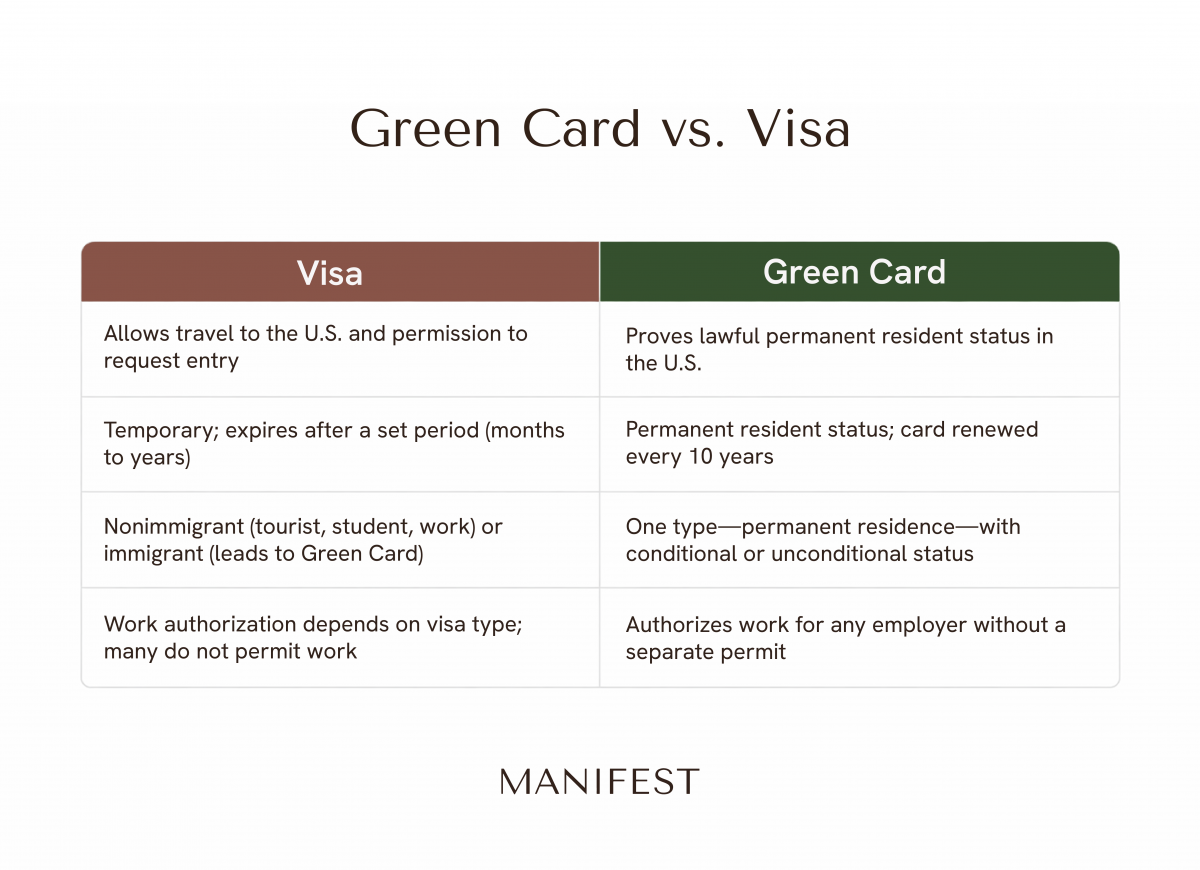
A visa is a document that allows you to travel to the United States and request entry for a specific purpose or period of time, such as work, study, or tourism.
A Green Card is proof of lawful permanent resident status, allowing you to live and work in the U.S. permanently.
Here’s a closer look at the key differences between a U.S. visa and a Green Card:
| Visa | Green Card |
| Applied for before travel | Obtained after arrival |
| Grants entry for a limited purpose or time | Grants permanent residence |
| Can be non-immigrant or immigrant | Always immigrant |
| Usually has an expiration date | Valid for 10 years (renewable) |
| Does not equal citizenship | Can lead to citizenship after 3–5 years |
What is a visa?
A visa is a travel document issued by the U.S. government that lets you apply to enter the country. If you’re getting a visa for the first time, you usually receive it before coming to the U.S., and it’s stamped into your passport.
There are two main categories of U.S. visas:
- Non-immigrant visas: For temporary stays, like tourists (B-2), students (F-1), or certain types of workers (for example, the H-1B for skilled workers or the O-1 for extraordinary ability).
- Immigrant visas: For people planning to live in the U.S. permanently, often sponsored by an employer or family member. For example, the EB-1A visa or the EB-3 PERM visa.
Note that having a visa doesn’t guarantee entry to the United States. A Customs and Border Protection (CBP) officer makes the final decision at the airport or border.
| 💡 You can also change or extend your visa status while already in the United States. For example, switching from an H-1B to an O-1 work visa. You can do this by filing a new petition (as long as you’re still in valid status) with U.S. Citizenship and Immigration Services (USCIS). |
What is a Green Card?
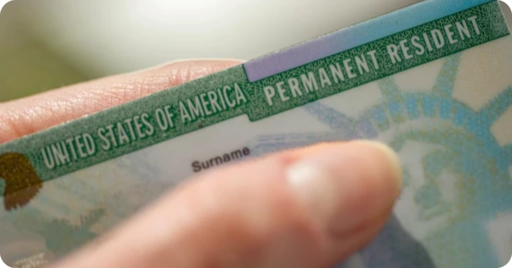
A Green Card (officially a Permanent Resident Card) proves you’re a lawful permanent resident of the U.S. It allows you to live and work in the country indefinitely and eventually apply for citizenship through naturalization.
You usually get a Green Card after entering the U.S. with an immigrant visa or by adjusting your status from a valid visa while already in the country.
If you’re outside the U.S., you apply through consular processing at a U.S. embassy or consulate before traveling. If you’re already in the U.S., you can apply for adjustment of status through USCIS.
Common paths to a Green Card include:
- Family-based: Spouses, parents, or children of U.S. citizens.
- Employment-based: Workers sponsored by U.S. employers or investors.
- Humanitarian: Refugees, asylees, or victims of crime or abuse.
How long does it take to get a Green Card vs. a visa?
Processing times vary widely depending on the visa or Green Card type, your country of origin, and U.S. government backlogs.
- Visas (especially nonimmigrant ones like B-1/B-2, F-1, TN, or J-1) are usually processed within a few weeks to several months, depending on interview scheduling and documentation.
- Green Cards often take many months to several years, since they require an approved immigrant petition, a visa number to become available, and in some cases, background checks or additional review.
If you’re applying through family or employment sponsorship, wait ti
Find support for your immigration journey to the U.S.
Now you know the difference between a Green Card and a visa. But that’s just the start—there’s a whole application and approval process ahead, whether you’re seeking a nonimmigrant visa or a Green Card via an immigrant visa.
Manifest’s experienced immigration attorneys can help you choose the visa or Green Card path that aligns with your goals, whether you’re planning a short stay or a long-term move to the U.S. Request a consultation with Manifest Law today.
Frequently Asked Questions (FAQs)
Sometimes, but it depends on your current visa and eligibility. If you entered the U.S. lawfully and meet all requirements, you may be able to apply for adjustment of status through USCIS when a visa becomes available in your category. Otherwise, you’ll apply for your Green Card through consular processing at a U.S. embassy or consulate abroad.
Yes, many employers do. If you’re already in the U.S. on a valid work visa like H-1B or L-1, your employer can file a petition to sponsor you for an employment-based Green Card in the appropriate preference category.
Dual intent means you can hold a temporary (nonimmigrant) visa while also planning to apply for permanent residency in the U.S. later. Most nonimmigrant visas require you to show that you intend to return to your home country, but dual intent visas, like the H-1B or L-1, allow you to pursue a Green Card without violating your visa status. This flexibility makes dual intent visas especially popular among professionals who hope to stay in the U.S. long term.