

Checklist: U.S. Travel Visa Documents (B-1/B-2 Visa)
- You must have your valid passport, the DS-160 confirmation page with the barcode, your visa fee receipt, and a photograph for your interview.
- Successfully obtaining a B-1/B-2 visa depends on providing evidence of your financial stability and ties to your home country.
- Applicants for F-1 (student) or J-1 (exchange ) visas require extra forms, including the Form I-20 or DS-2019.
Checklist: U.S. Travel Visa Documents
The U.S. travel visa process starts with the B-1 (business) or B-2 (tourist) application, which requires an interview. You’ll need documents like your passport and DS-160 confirmation, plus supporting evidence to help prove you have strong ties to your home country and that you’ll return there after your trip.
| 🧑⚖️Clear guidance, without the legal jargon. This article is informed and reviewed by Manifest Law’s experienced immigration attorneys—and written to make the law make sense. Because you deserve to understand the system, not fight it. Check out our editorial policy for more info. |
Documents needed for a travel visa application
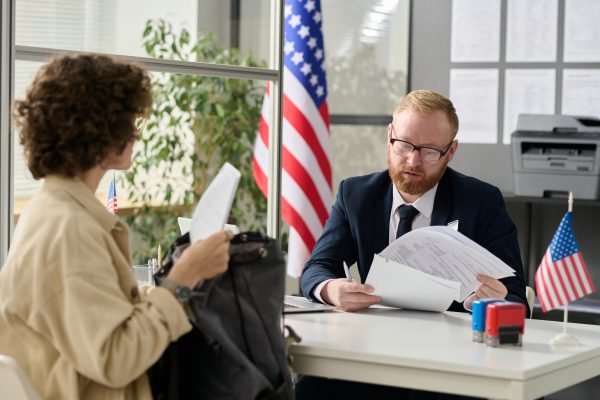
A travel visa most often refers to the B-1 (business visitor) or B-2 (tourist visitor) visa, the most common nonimmigrant categories for temporary stays. The application process for a B-1 or B-2 visa begins when you complete Form DS-160, the nonimmigrant visa application (you can do this online). After you submit it, you’ll schedule an interview at a U.S. Embassy or Consulate, where you must present the following documents:
- Passport: Your passport must be valid for at least six months beyond your intended period of stay, unless your country is exempt from this requirement.
- Form DS-160 confirmation page: The printed confirmation page is generated after submitting your online application. Make sure it includes the barcode.
- Photo: You’ll upload a photo as part of the DS-160 application.If doesn’t work, you’ll have to bring a current, color 2×2 photograph meeting the U.S. visa requirements.
- Fee receipt: Proof of payment for the nonrefundable visa application fee, if you’re required to pay before the interview. The nonimmigrant application processing fee—also called the machine-readable visa (MRV) fee—is $185 for B visas. Starting in 2026, most applicants will also have to pay a new Visa Integrity Fee of $250.
| 📘As soon as you start filling out the DS-160, write down your Application ID number. If the system logs you out, which happens often, the only way to recover your saved application and avoid starting over is by entering that exact number when you log back in. |
Supporting documents
Part of the application is demonstrating your intent to depart the U.S. after your temporary visit. You can accomplish this by presenting evidence of strong ties to your home country.
This can include evidence of:
- Financial stability: Documentation that shows you can pay for all the costs of your trip, such as bank statements or pay stubs.
- Ties to your home country: Evidence of employment, family connections, or property ownership. This can include a letter from your employer confirming that you’ll come back to work, or property records.
- Purpose of the trip: Documents that confirm the nature of your visit, like an invitation to a business conference or a detailed travel itinerary.
Documents needed for other types of travel visas
The F-1 (student) and J-1 (exchange visitor) visas are also common categories for temporary stays. In addition to the documents above, they require specific forms issued by the educational institution or organization sponsoring your visit.
F-1 student visa documents:
- Form I-20, certificate of eligibility for nonimmigrant student status: The school where you plan to study will issue this form to you.
- SEVIS I-901 fee receipt: Proof of payment for the Student and Exchange Visitor Information System fee. The amount is $350 for F-1 visa holders.
- Financial evidence: Documentation, such as bank statements or scholarship letters, showing you have the funds to cover your tuition and living expenses.
- Academic documents: Transcripts, diplomas, degrees, certificates, and standardized test scores.
J-1 exchange visitor visa documents:
- Form DS-2019, certificate of eligibility for exchange visitor status: Your program sponsor will issue this form to you.
- SEVIS I-901 fee receipt: Proof of payment for the Student and Exchange Visitor Information System fee. The full amount is $220 for J applicants, but it may be subsidized.
- Financial evidence: Documentation, such as bank statements or pay slips, confirming your ability to meet program expenses.
- Proof of English proficiency: Documentation to show you have the language skills to participate in your program.
Printable travel visa document checklist
Required documents:
- Passport (must be valid six months beyond your intended stay)
- DS-160 confirmation page: Printed page with barcode
- MRV fee receipt
- 2×2 photo
Supporting documents
- Employment/study: Letter from an employer or enrollment verification
- Financial: Bank statements, tax returns, pay slips
- Home country ties: Property records, vehicle registration, or evidence of family ties
- Purpose of trip: Detailed itinerary with documentation, such as invitations or appointments
Gathering and organizing your documents for a travel visa
The U.S. travel visa process requires two kinds of documents. The first are mandatory official forms, like your passport, DS-160 confirmation, and fee receipts. The second is compelling evidence that you have strong ties to your home country, such as stable employment, finances, and property, to show that you’ll return home after your visit.
A Manifest Law immigration attorney can help you organize and present the strongest possible evidence for your application.
👉 Request a consultation with Manifest Law’s experienced immigration lawyers now.
Subscribe to our newsletter for immigration resources and news, without the legal jargon.
Frequently asked questions
Which documents should I carry when traveling on a visa?
When entering the U.S. you must carry your valid passport with the visa stamp and any specific entry forms (such as an I-20 for F-1 students). Keep these documents with you, not in your checked luggage.
Which documents should I bring to my B-1/B-2 visa interview?
Bring the four mandatory items: Your valid passport, the DS-160 confirmation page (with barcode), the MRV fee receipt, and a 2×2 photo (if the online upload failed). Also bring evidence of ties to your home country.
Which documents are required for minors applying for a travel visa?
Minors need the standard visa application forms (passport, DS-160, fees, photo). They must also provide their birth certificate. If the child is traveling with only one parent or guardian, a notarized letter of consent from the non-traveling parent is a good idea.