Key Takeaways
- Invitation letters are not required, but they can strengthen B-1/B-2 or J-1 visa applications by providing helpful context.
- The most effective letters are written by someone with a close personal relationship to the applicant, such as a U.S. citizen, Green Card holder, or visa holder.
- Clear, honest details matter most—include the purpose of the visit, travel dates, accommodation plans, financial support, and reasons the visitor will return home.
A visa invitation letter isn’t required, but it can be a helpful supporting document for B-1/B-2 tourist visas, as well as J-1 visas. The letter should be submitted alongside the visa application form and other required documents.
This guide is for U.S. citizens, permanent residents, and visa holders who want to help family members, friends, or colleagues secure a visitor visa.
Maybe you're helping your parents fly in from India. Or a colleague from Colombia wants to visit you in New York. Whatever your situation, we’ll walk you through how to write an invitation letter that’s aligned with current U.S. immigration guidance.
This guide is informed by real visitor visa cases handled by Manifest Law’s immigration attorneys, but this article is for general information only and is not legal advice. If you need help understanding the visa process, we recommend talking to an immigration attorney.
What is a U.S. visa invitation letter?
A U.S. visa invitation letter (also called a letter of invitation) is a simple letter you write to help someone apply for a visitor visa.
Usually, it’s written by someone already living in the U.S., like a U.S. citizen or Green Card holder.
As mentioned earlier, the letter isn’t an official government form. And according to the U.S. Department of State (DOS), it’s not required by the U.S. Citizenship and Immigration Services (USCIS) or the DOS.
But for many applicants, especially those from countries that don’t qualify for the Visa Waiver Program, a strong letter of invitation can provide added context and clarity for the consular officer reviewing the case.
You won’t see it listed on the usual visa application checklist.
But it can still make a difference if your guest needs to show the following:
- Why they’re visiting
- Where they’ll stay, and
- When they plan to return home
This letter can be important when someone’s immigration status, purpose of the visit, and travel dates need to be clearly communicated.
A well-written invitation letter can help reduce questions around financial support, eligibility, and the intent to return home before the departure date.
Subscribe to our newsletter.
*By clicking Submit and subscribing to our newsletter, you agree to the Manifest Terms and Privacy Policy.
Example of an invitation letter for a U.S. tourist visa
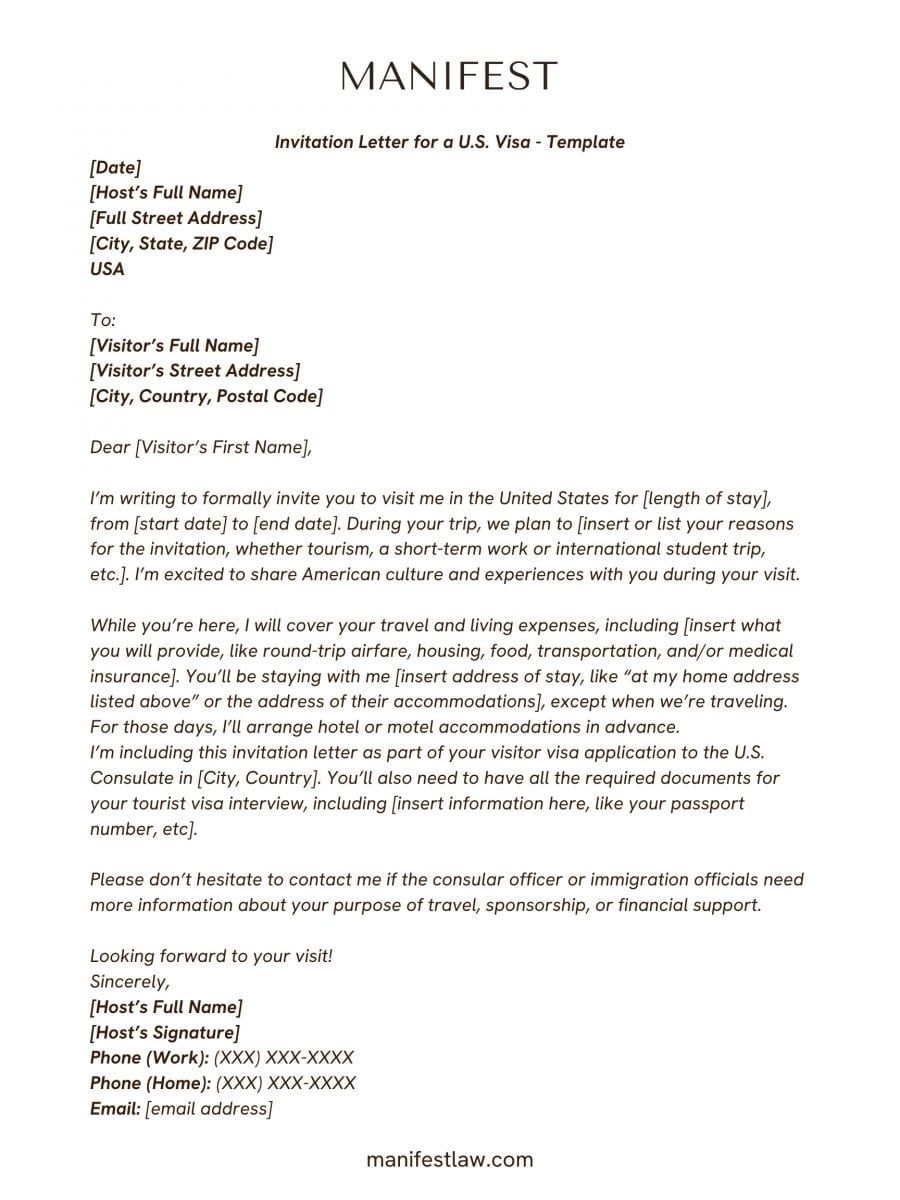
Here's an example of what an invitation letter looks like. You can access the full copy and paste template here.
Which US visa types might benefit from an invitation letter?
Although it’s not required, an invitation letter could be helpful for people planning to visit the US for various personal, business, or academic reasons.
Invitation letters are particularly beneficial for the following visa types:
- A tourist visa, visitor visa for medical treatment, or a visa for special events (B-2 visa)
- A business visa (B-1 visa), or
- An academic or exchange visitor visa (J-1 visa)
These visas are intended for short trips, like visiting family, a week visit for a business or company meeting, or an academic conference.
We recommend checking the specific requirements for your US visa application and consult with the embassy or consulate if you’re unsure what type of visa you (or the person you’re writing an invitation letter for) needs.
Who should (and shouldn’t) write a visa invitation letter
Not everyone is the right person to write a visa invitation letter—and that’s okay.
What matters most is the strength of the relationship, accuracy of the information, and the clarity of the visitor’s travel plans.
Who can write a visa invitation letter
You should write one if:
- You’re a U.S. citizen or a permanent resident (Green Card holder)
- You have a close, personal relationship with the person applying—like a family member, longtime friend, or trusted work colleague
- You know exactly why they’re visiting, how long they’ll stay, and where they’ll go
For example: If your parents want to come to the USA for a few months to visit you in New York, and you’re planning to cover their airfare and housing while they visit, that’s an excellent reason to write one.
Did you know there are multiple types of visas, and they all require specific documentation and processes? You should make sure your visitor is pursuing the correct visa for their situation. Here is a quick guide to some of the most common visas below. Nonimmigrant visas: The B-2 visa is a tourist visa, visitor visa for medical treatment, or a visa for special events. The B-1 visa is for individuals traveling to the U.S. temporarily for business-related activities, such as attending meetings, conferences, or negotiating contracts. The J-1 visa is for individuals participating in approved exchange academic or scholarly visitor programs in the U.S. The O-1A visa is for professionals in science, education, business, and athletics. The O-1B visa is for those in the arts, motion pictures, or television. Immigrant visas: The EB-1 visa is an immigrant visa for individuals with extraordinary ability, outstanding professors or researchers, or multinational executives, offering a fast-track to a Green Card without needing employer sponsorship in some cases. The EB-2 visa is an immigrant visa for professionals with advanced degrees or exceptional ability, and includes the National Interest Waiver (NIW) option for those whose work benefits the U.S. and want to self-petition without employer sponsorship. There are dozens of different types of visas, and this is not an exhaustive list. An experienced immigration attorney can help you choose the right path.
Who shouldn’t write a visa invitation letter
You shouldn’t write a visa invitation letter if:
- You don’t know the person very well (perhaps they’re a distant friend, a coworker you just met, or someone you’re connected with online but don’t know in real life)
- You’re unclear on their visa type, purpose of the trip, or whether they actually plan to return home
- You’re being asked to sign a letter just as a favor—without fully understanding their situation
Why? Because a vague or weak letter won’t help—and it could even raise red flags for a consular officer. And if you do not know the person very well, it’s unwise to put your own name on the line.
Tip: The stronger your relationship and the clearer the travel plans, the more helpful your letter of invitation will be during the visitor visa application process.
What to include in your U.S. visa invitation letter
This is where most people mess up: They write something too vague, too short, or too casual.
If you plan on writing an invitation letter to invite someone to the U.S. from another home country, it needs to include specific, verifiable details—things a consular officer can clearly match to the rest of their visitor visa application.
Think of this letter as your chance to back up your guest’s story.
Who they are, why they’re coming, where they’ll stay, and when they’ll leave—it all needs to line up.
This table provides a quick snapshot of what you should include:
| Your personal details | Full nameAddressContact information (phone and email)Your status in the U.S. (e.g., citizen, lawful permanent resident) |
|---|---|
| Invitee’s details | Full nameAddressDate of birthContact information |
| Relationship | Clearly state your relationship with the invitee (such as friend, family member, business associate, etc.) |
| Purpose of the Visit | Describe why the invitee is coming to the U.S. (such as attending a wedding, visiting for tourism, business meetings)Include specific activities and events they will participate in |
| Dates of stay | Include their intended arrival and departure dates |
| Accommodation details | Where the invitee will stay during their visit (such as your home address, a hotel, or Airbnb)Confirm if you will cover their expenses |
Keep in mind, you should give specific, verifiable details—this is where many people go wrong.
In your letter, you’ll need to be truthful, specific, and avoid exaggeration. Don’t promise more than you can document. And the letter doesn’t need fancy language—it just needs to make sense and show that the visit is real, short-term, and well thought out.
Think about drafting your letter with four primary intents that clearly explain:
- About you (the person inviting the visitor)
- About the person you’re inviting
- What support you’re providing your visitor
- When and why they’ll return home
1. About you: The person based in the U.S. extending the invitation
You’ll need to include your full legal name, your own citizenship status (or immigration status, if you are awaiting U.S. citizenship) in your letter.
Make sure to include your U.S. address and full contact details.
2. About the person you’re inviting to the U.S.
Include your visitor’s full legal name, date of birth, country of citizenship or residence, and their relationship to you.
Are they a visiting international student, your overseas family member, a friend or colleague? This should all be outlined in your letter.
You’ll also need to include the purpose of the visit and their trip duration, including the start date and end date.
3. Detail what support you’re providing
Your support for the visitor could look like housing your family members in your guest room, offering an international student temporary student accommodations on a college campus, or providing a hotel room for a colleague near the location you’ll be doing business.
You should outline who will pay for their travel, accommodation, and daily expenses, and make sure to include any important plans or itinerary details if you have them.
Curious how others in made it work? Manifest Law’s experienced attorneys have helped thousands of immigrants and their families secure their future in the U.S. Explore our visa approval notices and success stories to learn how we helped founders, researchers, and artists turn their stories into winning petitions.
4. Share why they’ll return home
In this portion of your letter, you’ll need to include information about the intent to leave the U.S. at the end of their trip to clearly demonstrate there are no plans for an overstay.
If the letter is for an international student or business colleague, this might include information about the end of paid-for accommodations, the finalization of a work project or academic coursework, or the end of enrollment.
If the letter is being written for family or friends, perhaps it includes the date they have to return back home because of their job, strong ties to their community, or before or after a special event (like a wedding).
Sample U.S. visa invitation letter (copy + paste template)
You can use this sample invitation letter template below (simply copy and paste it in order to modify and make it your own).
However, this is a generic guideline and not intended to be official legal advice.
If you need help with the visa process—or guidance on how to get visa approval—make sure to speak with an experienced immigration attorney.
[Date]
[Host’s Full Name]
[Full Street Address]
[City, State, ZIP Code]
USA
To:
[Visitor’s Full Name]
[Visitor’s Street Address]
[City, Country, Postal Code]
Dear [Visitor’s First Name],
I’m writing to formally invite you to visit me in the United States for [length of stay], from [start date] to [end date]. During your trip, we plan to [insert or list your reasons for the invitation, whether tourism, a short-term work or international student trip, etc.]. I’m excited to share American culture and experiences with you during your visit.
While you’re here, I will cover your travel and living expenses, including [insert what you will provide, like round-trip airfare, housing, food, transportation, and/or medical insurance]. You’ll be staying with me [insert address of stay, like “at my home address listed above” or the address of their accommodations], except when we’re traveling. For those days, I’ll arrange hotel or motel accommodations in advance.
I’m including this invitation letter as part of your visitor visa application to the U.S. Consulate in [City, Country]. You’ll also need to have all the required documents for your tourist visa interview, including [insert information here, like your passport number, etc].
Please don’t hesitate to contact me if the consular officer or immigration officials need more information about your purpose of travel, sponsorship, or financial support.
Looking forward to your visit!
Sincerely,
[Host’s Full Name]
[Host’s Signature]
Phone (Work): (XXX) XXX-XXXX
Phone (Home): (XXX) XXX-XXXX
Email: [email address]
Common mistakes to avoid in invitation letters
Even though invitation letters are informal, they still need to hold up under the scrutiny of a consular officer.
And the truth is, a poorly written or overly dramatic letter can actually hurt a visitor visa application.
Here are some of the biggest mistakes people make with invitation letters (and how to avoid them):
- Exaggerating your role or the visitor’s plans
- Being vague or inconsistent
- Sounding desperate or overly emotional
- Forgetting to sign and date the letter
Curious about what makes a successful visa application? If you’re ready to stop guessing and start planning, our immigration attorneys are here to help. Move forward with confidence. Request a consultation with Manifest Law now.
Don’t exaggerate your role or the visitor’s plans
Don’t claim things you can’t back up.
If you’re not actually covering the visitor’s airfare, don’t say you are. If they’re staying for two weeks, don’t say “for as long as they want.”
The U.S. embassy or consulate will notice these red flags, and it can delay or derail the visa process.
Don’t be vague or inconsistent
Your letter should match what the visitor says in their visa interview and on their visa application form.
If your letter says they’re visiting for tourism but their SEVIS record shows attempted enrollment as a J-1 exchange visitor (a type of international student), that creates confusion.
Same goes for mismatched travel dates or missing contact information.
Avoid sounding desperate or overly emotional
It’s okay to show that the visit matters to you, but don’t make it sound like someone’s life could fall apart without this trip.
Avoid phrases like “it would destroy our family if the visa is denied” or “we’re begging for approval.”
That won’t build trust with a consular officer. If anything, it could raise doubts about the purpose of the trip or the visitor’s intent to return home.
Don’t forget to sign and date the letter
This one’s simple—but it happens all the time.
If you’re sending a formal letter to support someone’s U.S. visa application, it needs to be signed, dated, and include your full name, phone number, and email.
Without those details, your letter may be ignored entirely.
Do invitation letters actually help with visitor visa approval?
A well-written invitation letter won’t make or break a visa decision—but in certain situations, it can tip the scales.
Here’s what Henry Lindpere, an experienced immigration attorney at Manifest Law, has to say:
“What we want sponsors to know is that vague or emotional letters can do more harm than good. The strongest letters are clear and backed by real plans, including where the visitor will stay, how long they’ll be here, and exactly why and when they’re returning home.”
They’re not required—but they can help in close-call decisions
While the U.S. Department of State doesn’t require a letter of invitation as part of the visitor visa application process, consular officers make judgment calls every day.
If an applicant seems borderline—if their visa status or purpose of the trip isn’t 100% clear—then a strong, clear invitation letter can help provide that missing context.
You may not find an invitation letter listed on the application form or in the official required documents for a B-1/B-2 visa, but they still can be of help if additional information is needed.
Why consular officers look for context
Visa officers are trained to look for signs of intent:
- Is this person really just visiting, or planning to overstay?
- Do they have strong ties to their home country?
- Do they have a clear reason to come and a clear reason to leave?
A good invitation letter helps answer those questions. It won’t override weak documentation or missing supporting documents in a visa application, but it may help give a clearer picture to why the person is visiting the U.S.
When an invitation letter is most helpful
Here’s where invitation letters can make a difference:
- Elderly parents visiting their adult children in the U.S., especially if the host is a U.S. citizen or Green Card holder
- Cases with clear financial sponsorship and confirmed housing where the visitor won’t be a burden on public resources or working “under the table”
- Short-term visits—like visiting a new baby or attending a wedding, baby shower, or graduation
Need help inviting someone to the U.S.?
Whether you're inviting a parent, sibling, friend, or colleague, your invitation letter should tell a clear, honest story that supports the visa application—not confuse it.
At Manifest Law, we help people navigate the visa process every day.
We work with U.S. citizens, Green Card holders, and visa holders who want to bring loved ones to visit—whether for a short-term business stay or a special family event.
We don’t just review your application materials; we make sure your entire supporting document packet makes sense to a consular officer.
And if your guest’s visitor visa was denied in the past? We can help with that too.
Our team handles complex visa application strategies, appeals, and reapplications with clarity and care.
Request a consultation, check out our free live virtual events, or learn more about our visitor visa services to get clear information before you send that letter along.
That way, you have confidence you’re moving forward the right way.
FAQs on visa invitation letters
Are visa invitation letters for travel visas and family members the same?
If someone is trying to get a B-1/B-2 travel visa, a visa invitation letter serves the same function whether or not they’re your family member. The contents of your letter would be different for family and non-family members, but goals and key elements are the same.
About the Author

Content Lead
Haley Davidson is Manifest Law's Content Lead, covering all topics related to U.S. visas and Green Cards. She's passionate about making complex topics easy to understand, like immigration law.
Read bioReviewed By

Senior Immigration Attorney at Manifest Law
Henry is an Estonian American attorney licensed in Arizona with broad experience in employment-based immigration. He handles EB-1A, EB-2 NIW, O-1, and E-2 cases for founders, professionals, and creatives across industries worldwide, and has helped hundreds of clients achieve successful outcomes.
Read bioShare this article: