



- The H-1B visa supports specialty occupations with dual intent, while the J-1 visa is for temporary cultural and educational exchange programs.
- Employers facing H-1B caps or high filing fees sometimes use J-1s, but placement must be through a designated sponsor program.
- J-1 visas carry limits: no dual intent, potential two-year home residency, and barriers to converting to permanent U.S. employment.
- For workers and employers seeking long-term employment and Green Card pathways, the H-1B remains the stronger, more viable option.
The H-1B has long been a cornerstone visa for bringing skilled professionals to the United States. But in recent years, that path has become increasingly difficult. Between strict annual caps, a competitive lottery, and new proposals like the $100,000 filing fee for certain H-1B petitions, both employers and workers are facing higher barriers than ever before.
In certain cases, the J-1 visa can serve as an alternative to the H-1B, especially for research, training, or academic programs. However, it’s not a one-to-one replacement. The J-1 comes with its own requirements and restrictions, including potential home-residency obligations and limited flexibility for long-term employment.
In this guide, we’ll break down the key differences between the H-1B and J-1 programs, when employers might consider the J-1 as an alternative, and how workers can evaluate whether a transition from H-1B to J-1 makes sense for their goals.
What’s the difference between the H-1B and J-1?
The H-1B visa is a nonimmigrant visa that allows U.S. employers to hire foreign professionals in specialty occupations like technology, engineering, or healthcare. The H-1B allows visa holders to live and work in the U.S. for an initial period of three years. H-1B holders have the potential to extend their visas another three years, for a total of six years. For H-1B positions, workers are sponsored by their employer.
The J-1 visa is a nonimmigrant visa for cultural and educational exchange. It grants foreign nationals temporary residency in the U.S. while they complete an approved exchange program—for example, an internship, training, or research program. J-1 visas are sponsored by approved exchange visitor programs.
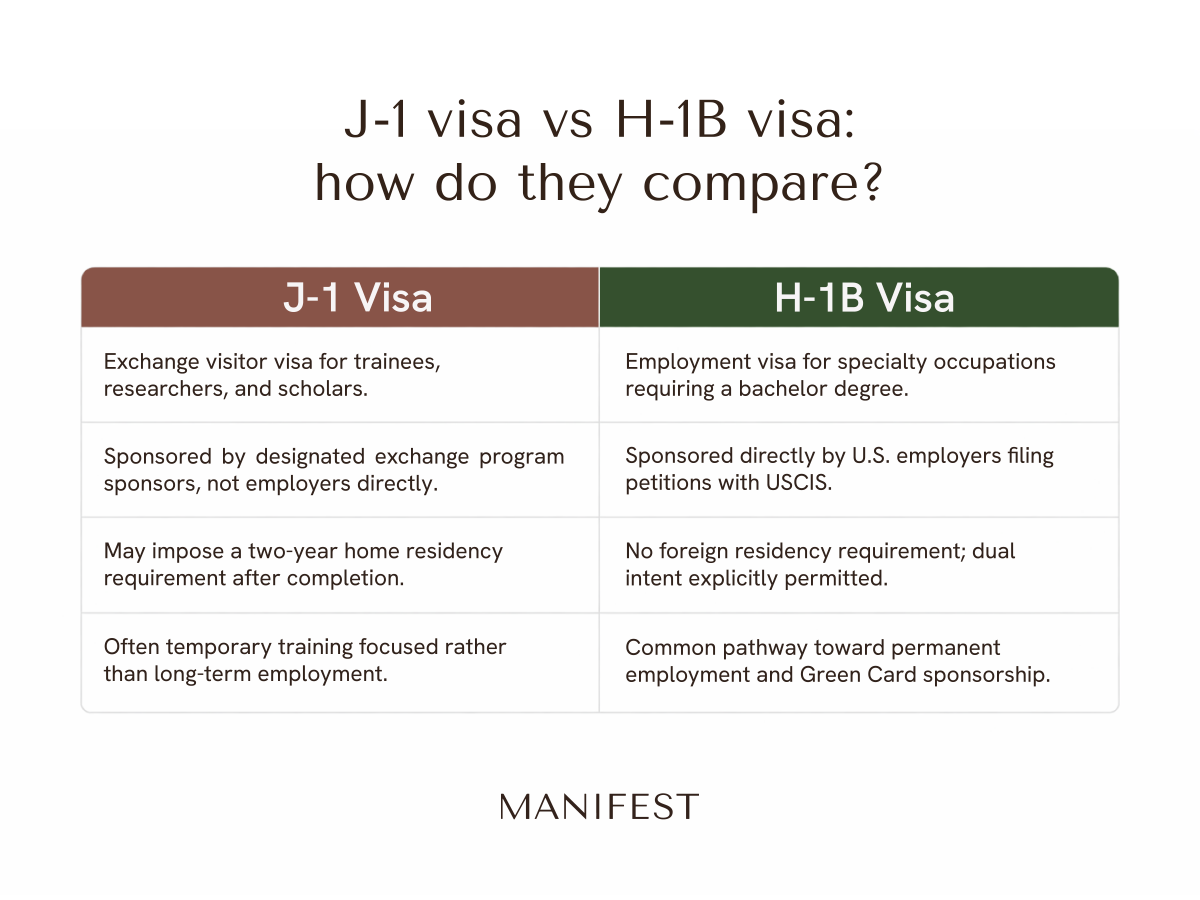
While there may be some overlap between the two visas, there are major differences between the H-1B and J-1. Let’s compare the two:
| Category | H-1B visa | J-1 visa |
| Who it’s for | Foreign professionals in specialty occupations requiring at least a bachelor’s degree or its equivalent (for example, technology, finance, engineering, or law). | Visitors accepted into pre-approved exchange programs, including interns, trainees, researchers, au pairs, camp counselors, and other categories. |
| Dual intent? | Yes | No |
| Dependent visa availability? | Yes | Yes |
| Duration | Initial valid period of 3 years, renewable for a maximum of 6 years (only physical presence in the USA counts) | Duration of stay varies by program and exchange category |
| Costs | Vary | Vary |
| Sponsorship requirements | Requires U.S. employer sponsorship and a full-time job offer in a qualifying specialty occupation. | Requires sponsorship through an approved exchange visitor program in the U.S. |
| Annual limits | 85,000 annual visa cap (65,000 + 20,000 advanced degree holder from a U.S. Institution) | No fixed cap; availability varies by program category and sponsoring organization. |
| Home residency requirements | Are dual intent, and therefore do not have to return to their home country if they request permanent residency | Subject to a two-year home residency requirement after program ends, unless they qualify for a waiver or the applicant belongs to a country that is exempt |
| Extension limits | An additional three years, with no further extensions, unless the applicant has time to recapture due to travel abroad during the H-1B period. H-1B holders with approved or pending Green Card cases may qualify for an extension if their visa number is not yet available or over a year has passed since filing. | Under exceptional or unusual circumstances, a program officer may request an extension from the State Department. Most of these only last up to five years, although exceptions can be granted. |
| Work authorization for dependents | H-4 spouses can request work authorization if the H-1B holder has an approved I-140 petition. H-4 children cannot. | J-2 dependents can request an EAD from USCIS by filing Form I-765. |
| Who pays the fees | The employer pays the fees. | The applicant pays the fees. |
| Processing times | Approximately 7 months if abroad and 4 months if changing status within the U.S. Within 15 business days with premium processing. However, this service may be suspended for some H-1B cases during high-volume cap periods. | Institutions can take as little as a few business days or several months before issuing DS-2019. Embassy appointment wait times vary by country, but can take as little as two weeks or up to eight months. Premium processing can only be requested from those adjusting to J-1 status. If they qualify, this can expedite wait times to up to 30 business days. |
When to use the J-1 vs. H-1B visa
The J-1 can be a practical option for employers and professionals when the H-1B route is too costly, competitive, or simply backlogged by processing delays. J-1 subcategories like Research Scholar, Specialist, and Trainee allow qualified individuals to work, collaborate, and share expertise in the U.S. without entering the H-1B lottery or paying the new $100,000 filing fee (which, as of November 2025, applies to all new H-1B petitions filed for workers outside the United States).
| 💡 Did you know? Not all H-1B applications are subject to the annual cap. If you’re sponsored by a U.S. university or nonprofit research organization, you may not go through the lottery and qualify for an H-1B cap-exempt visa. |
That said, the H-1B remains the stronger option for long-term, specialized employment. It can be renewed for up to six years and provides a clear path toward permanent residence. The $100,000 fee does not apply to H-1B petitions or changes of status filed within the United States that do not require consular notification, though the lottery process and annual cap continue to present challenges for both employers and applicants.
Ultimately, the choice between J-1 and H-1B comes down to intent—whether the position is short-term and developmental or designed for ongoing, career-based employment. Because each case depends on timing, eligibility, and long-term goals, consulting an immigration attorney early in the process is the best way to chart the right course forward.
Subscribe to our newsletter for immigration resources and news, without the legal jargon.
Get the support you need to move forward with confidence
At Manifest Law, our experienced immigration attorneys are here to help you weigh your options and create a tailored visa strategy that aligns with your long-term goals.
👉 Whether you’re hiring skilled foreign workers or pursuing your own individual immigration journey, Manifest Law’s lawyers are here to help. Request a consultation today.