Key Takeaways
- An immigration letter of support is personal evidence that can strengthen cases like Green Cards, waivers, or deportation defenses.
- USCIS and immigration judges prioritize specific, truthful examples over vague praise or emotional statements.
- The strongest letters come from people who know the applicant well and can clearly describe their character or hardship.
A strong immigration letter of support can help convince a USCIS officer or an immigration judge that you deserve the immigration benefit you’re seeking. Good letters include specific examples and explanations of your honesty, work ethic, community involvement, or good moral character.
Letters that are generic or overstate how great you are won’t help your case and in some situations, they may hurt you.
Whether you’re writing a letter to show support for someone’s bona fide marriage, to help your friend or family member apply for a Green Card, or to help anyone else seeking immigration benefits, we’ll cover everything you should include and what you should avoid to write the best possible letters of support.
Clear guidance, without the legal jargon. This article is informed and reviewed by Manifest Law’s experienced immigration attorneys—and written to make the law make sense. Because you deserve to understand the system, not fight it. Check out our editorial policy for more info.
What is a letter of support for immigration?
A letter of support for immigration is a personal statement submitted to USCIS or an immigration judge to support someone’s case. It’s a written statement (usually from a family member, close friend, or community member) submitted as part of someone’s application.
It’s designed to help immigration officials understand the applicant’s character, relationships, background, work ethic, and overall credibility.
This YouTube video is hidden until you accept functional cookies.
But it’s important to keep in mind that an immigration letter of support is not just offering a kind word.
Your letter could be read by a USCIS immigration officer, a consular official abroad, or even an immigration judge.
Although this type of letter isn’t always required, it is commonly included in:
- Family-based immigration cases
- Applying for a Green Card through marriage
- An immigration petition for a family member (Form I-130), like a parent or sibling
- Cases involving waivers, adjustment of status, or even deportation defense in immigration court
- Asylum and humanitarian cases were additional community or expert support could be helpful (for instance, from doctors, therapists, nonprofit or community organizations, etc.)
And it’s important to understand that an immigration letter of support is different from the I-864, Affidavit of Support, which is a USCIS form to verify the applicant has adequate financial support.
This letter might help you prove good moral character, show the strength of a relationship with a U.S. citizen or lawful permanent resident, or highlight the hardship faced if an applicant is forced to return to a home country.
Is a letter of support the same as an affidavit letter of support?
An affidavit letter of support is often a type of letter submitted alongside Form I-751, to strengthen your petition to remove conditions from a Green Card. This type of letter of support can affirm that you had a bona fide marriage, and may be especially important if you have since divorced or separated from your citizen spouse.
How is an immigration letter of support different from a letter of recommendation or an invitation letter?
These three types of letters are often confused, but they serve different purposes in the immigration process.
Here's a simple breakdown to help you quickly understand how they’re different:
| Type of letter | Goal | Usually written by |
|---|---|---|
| Recommendation letter for immigration | Support an employment-based visa or Green Card | Expert, colleague, or professional in your field |
| Letter of support for immigration | Support a family-based case, waiver, or deportation defense | Family, friends, community |
| Invitation letter for a U.S. visa | Support a visitor visa request (B-1/B-2) | U.S.-based host |
When are letters of support used in immigration?
Letters of support aren’t required in every immigration case—but when they’re used strategically, they can make a difference.
In some case types, a strong support letter can help USCIS or an immigration judge better understand the applicant’s character or the hardship they’d face if denied an immigration benefit.
Here are the most common scenarios where support letters are used:
| Case type | How this letter can support your case |
|---|---|
| I-130: Family-Based Petitions | A letter of support can help establish that the personal or family relationship is real. Letters from friends, relatives, or community members who’ve observed your relationship firsthand can support a petitioner’s claim. |
| I-485: Adjustment of Status | An adjustment of status might benefit from character references that demonstrate your ties to the country, good moral character, and positive contributions to your community. Support letters may also help if there are concerns about your immigration status or prior immigration history. |
| I-751: Removal of Conditions on Residence | If you're a conditional permanent resident who received a Green Card through marriage, you'll need to file Form I-751 to remove those conditions. If you're no longer with your spouse, a support letter can be crucial—especially to help prove that your marriage was entered in good faith, even if it ended. |
| I-601: Waivers of Inadmissibility or I-601A: Provisional Waivers | If you’re applying for a waiver due to unlawful presence or another ground of inadmissibility, you’ll need to show that your qualifying U.S. citizen or lawful permanent resident family member would suffer extreme hardship if your application were denied. |
| Asylum and humanitarian cases or Violence Against Women Act Petitions (VAWA) | Letters of support can help confirm your experience, character, and efforts to rebuild your life. Supporters may include friends, therapists, shelter staff, or community members who’ve witnessed the applicant’s situation. |
| Cancellation of Removal / Immigration Court Cases | In immigration court, support letters can be submitted directly to the honorable immigration judge as part of a defense against deportation. |
Who should write a letter of support for immigration?
A strong immigration support letter doesn’t need to come from a professional or public figure.
What matters most is that the letter writer knows the applicant well, can speak honestly about their character, and provides specific examples that help the reader (whether a USCIS officer or immigration judge).
Ideal immigration support letter writers include:
- Close family members, such as a spouse, sibling, parent, or adult child—especially in family-based immigration cases
- Friends who’ve known the applicant for many years and can attest to their good moral character, relationships, or contributions to society
- Community members (like religious leaders, school officials, mentors, or neighbors), especially if they’ve witnessed hardship or supported the applicant during a crisis.
Who should not write this type of letter:
- People who don’t know the applicant well
- Individuals who can’t confidently speak to an applicant’s character, relationship, or immigration situation
- Writers who were asked to “sign off” on someone else’s template without adding their own personal insights
Immigration officials can spot generic letters a mile away, and a generic letter without substance won’t help your case. If the letter lacks depth, it may be disregarded—or worse, do more harm than good.
Does the letter writer’s citizenship or immigration status matter?
While it’s not required, it can help if the letter writer is a U.S. citizen or lawful permanent resident. A letter from someone with stable immigration status, especially if they’ve known the applicant in the U.S. for a long time, can add credibility.
If the letter comes from a respected source (like a teacher, pastor, or long-term employer), that can also carry weight.
Reminder: The writer should always include their full name, job title (if relevant), phone number, contact information, and a clear explanation of how they know the applicant. That level of detail shows transparency—and trustworthiness.
What should be included in an immigration letter of support
You don’t need fancy language or legal jargon—just honesty and the right details.
Here’s what every strong immigration support letter should include:
- Your identity and relationship to the applicant
- Your immigration or citizenship status
- How long you’ve known the person
- Specific character examples
- The reason they should be granted the immigration benefit they’re seeking
- Your contact information
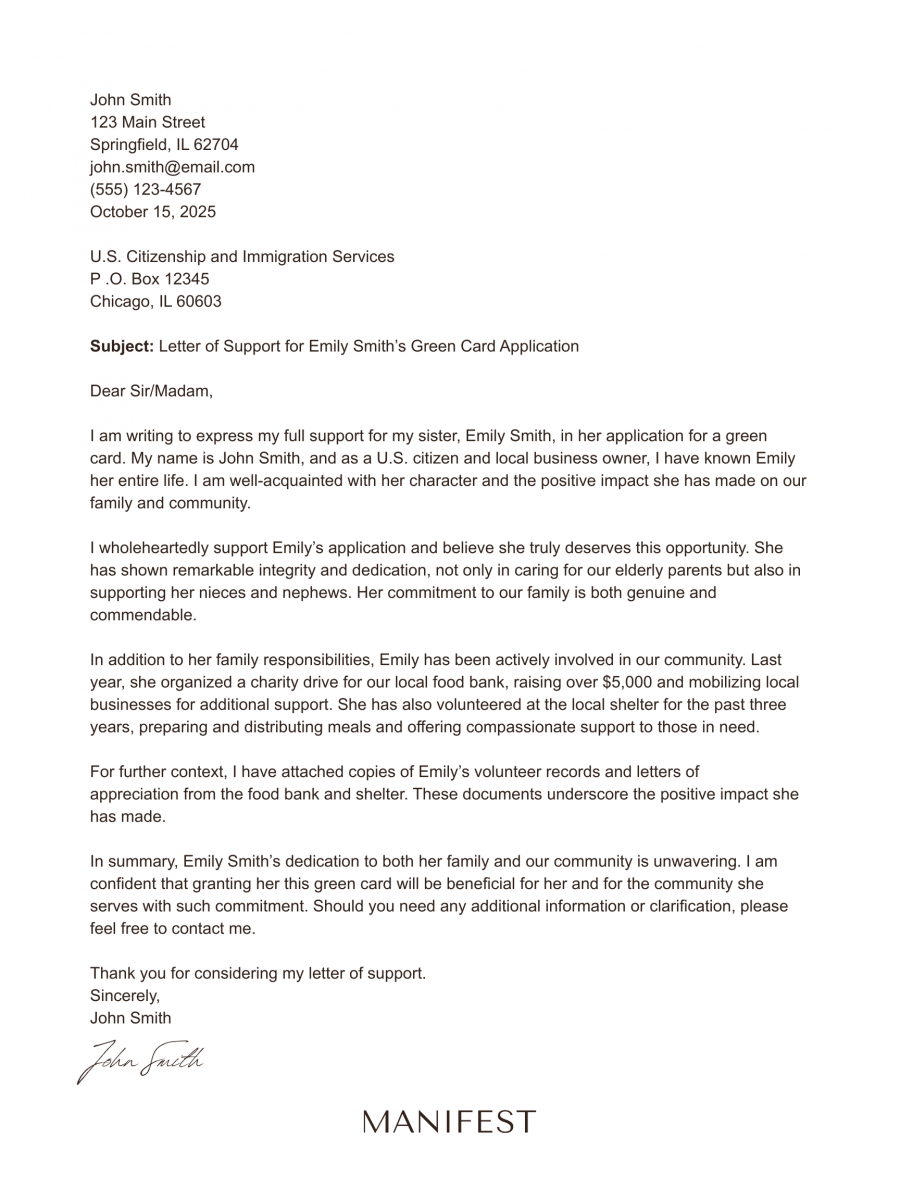
We’ll look at each of these components below, along with some guidance about what to include. But before we dive in, here’s a sample immigration letter of support (an I-130 example of written statement) that you can download as an example if needed.
One last important point, you need to make sure the accounts of different letters are consistent with each other. USCIS officers also check for consistency of the facts across letters.
Sample immigration letter of support for a family member
Feel free to download the sample immigration letter of support PDF below to see a practical example and get a clearer idea of how to frame your own letter. This sample includes sections on how to introduce yourself, express your support, provide evidence and examples, and wrap up your letter effectively.
Key components of a strong letter of support
Your identity and relationship to the applicant
State your full name, where you live, and how you know the person. Be clear about your connection: Are you writing in support of a spouse, sibling, friend, or mentor? Make sure to add details about how you know one another.
Your citizenship or immigration status (optional, but helpful)
If you're a U.S. citizen or lawful permanent resident, include that. It adds weight and context, but it’s not mandatory.
How long you’ve known the person
Mention how many years you’ve known them and in what context (e.g., family, work, school, community).
Specific examples of their character, family ties, and/or hardships
This is the heart of the letter. Share specific, verifiable stories or experiences that show the applicant’s good moral character, their role in the family, or the hardship they (or you) would face if their immigration case were denied.
Why they should be granted the immigration benefit they’re applying for
Tie everything back to the point of the letter: Why should this person be granted the immigration benefit they’re seeking?
Your contact information and willingness to be contacted
Include your phone number, email, and a simple line offering to provide additional information if needed. Immigration officials may need to follow up. If you are a U.S. citizen or legal permanent resident and you feel comfortable, including a copy of your identification can also be helpful.
Common mistakes to avoid in letters of support
A letter that’s too weak, or too generic, can get ignored by USCIS or the immigration judge reviewing the case. Here’s what to steer clear of:
- Being too vague
- Repeating generic language from other letters
- Forgetting to include details about yourself, the letter writer
- Making unverified claims, inaccurate statements, or overpromising
Being too vague
Saying “They’re a great person” doesn’t help. Share specific examples of their character, family role, or community involvement.
Repeating generic language from other letters
If every letter says the same thing, it starts to look scripted. Avoid copy-paste jobs—each letter should feel personal and original.
Forgetting to include your full name, signature, and contact details
Immigration officials need to know who you are and how to reach you. Always include your full name, phone number, email, and a signature.
Making unverified claims or overpromising
Don’t exaggerate. Don’t guess. Stick to what you know and can speak to honestly. Overstating facts can raise red flags—and hurt the applicant’s case.
Tips for writing different letters of support
Letter of support for a marriage
When USCIS looks to confirm a bona fide marriage, they want evidence that the married couple has built a life together. Share specific examples of the couple’s joint life, which could include events they’ve done together, hobbies or activities they share, and proof of their plans for the future. Try to give concrete evidence of their genuine relationship without generalizing or exaggerating about how great they are together.
Letter of support for a family member
A letter of support for family members should focus on the positive attributes you can see that people who aren’t as close to them may not recognize. For example, instead of talking about something like their great work, give specific examples of how their good character has benefited you or how their contributions have helped your neighborhood or community. Don’t get carried away though, and remember to bring the point of your letter back to why your family member is deserving of the immigration benefit they’re seeking.
Letter of support for a friend
When writing a letter of support for a friend, highlight how they have made a positive impact or supported you and your life. That could include examples demonstrating their good character, personal strengths, accomplishments, or contributions to your life. Also remember to bring the focus of your letter back to why they deserve the immigration status they’re applying for and the positive impact they could continue to have if approved.
Need help with your or your family member’s immigration case?
A powerful letter of support can make a real difference. But it’s just one part of a strong, well-prepared immigration case.
Request a consultation with our legal team to get personalized help from experienced immigration attorneys who know how to build winning cases. Move forward—confidently—with the right legal support.
FAQs about immigration support letters
Do letters of support need to be notarized?
No, notarization isn’t required, but it can help add credibility, especially in immigration court or cases involving sworn testimony.
At a minimum, make sure the letter is signed, dated, and includes your full name and contact information. That’s standard practice and shows you’re willing to stand behind your words.
How do I submit a letter of support?
How you submit the letter depends on the immigration process you're supporting:
- Include the letter with the Form I-130 or Form I-485 application packet
- Attach to the Form I-601 or I-601A as supporting evidence in waiver cases
- Submit with the case file or as part of your immigration court defense
Always type the letter, format it clearly, and proofread it before submitting. Include it with the other supporting documents, not as a standalone email or attachment.
How do I write a supportive letter for immigration?
Be clear, honest, and specific. Share who you are, how you know the applicant, and why they deserve the immigration benefit. Include personal examples—and your contact info.
Review the What to Include in an Immigration Letter of Support section of this article for detailed best practices. You can also use the sample for above (Form I-130 example of written statement) as a guide).
How can a letter of support impact an immigration case?
It can help prove good moral character, family relationships, or hardship—especially in family-based, waiver, or deportation cases. A strong letter gives your loved one’s story a human voice.
Can my letter of support hurt the immigration case if I say the wrong thing?
Yes. Vague, exaggerated, or inconsistent letters can raise red flags. Stick to facts you know—and don’t overpromise. Seek the guidance of an immigration lawyer if you need help understanding any part of the immigration process.
How recent should a letter of support be when submitting it to USCIS?
Ideally, your letter should have been written within the last 6-12 months. It should reflect the applicant’s current situation and immigration process.
Can a non-citizen write a letter of support for someone applying for a Green Card?
Yes. While a U.S. citizen or lawful permanent resident writer can carry more weight, what matters most is credibility and firsthand knowledge of the applicant’s character.
What is a character reference letter for immigration?
A character reference letter can be written for family, friends, others who are going through the Green Card process and need to show good moral character. There is no single set of qualifications as having good character, but immigration officials need to confirm that Green Card holders will uphold American values.
About the Author

Content Lead
Haley Davidson is Manifest Law's Content Lead, covering all topics related to U.S. visas and Green Cards. She's passionate about making complex topics easy to understand, like immigration law.
Read bioReviewed By

Senior Immigration Attorney at Manifest Law
Henry is an Estonian American attorney licensed in Arizona with broad experience in employment-based immigration. He handles EB-1A, EB-2 NIW, O-1, and E-2 cases for founders, professionals, and creatives across industries worldwide, and has helped hundreds of clients achieve successful outcomes.
Read bioShare this article: