Key Takeaways
- Adjustment of Status (AOS) lets eligible applicants apply for a Green Card from inside the U.S. by filing Form I-485.
- AOS can take several months, so maintaining valid status while it’s pending can help you preserve work and travel options.
- AOS requires extensive supporting documents, so review USCIS requirements carefully to avoid delays, RFEs, or denials.
Adjustment of Status (AOS) is the process by which people apply for lawful permanent residence from inside the United States. Applicants submit Form I-485, Application to Register Permanent Residence or Adjust Status, also known as the “Green Card application,” along with evidence to a United States Citizenship & Immigration Services (USCIS) facility.
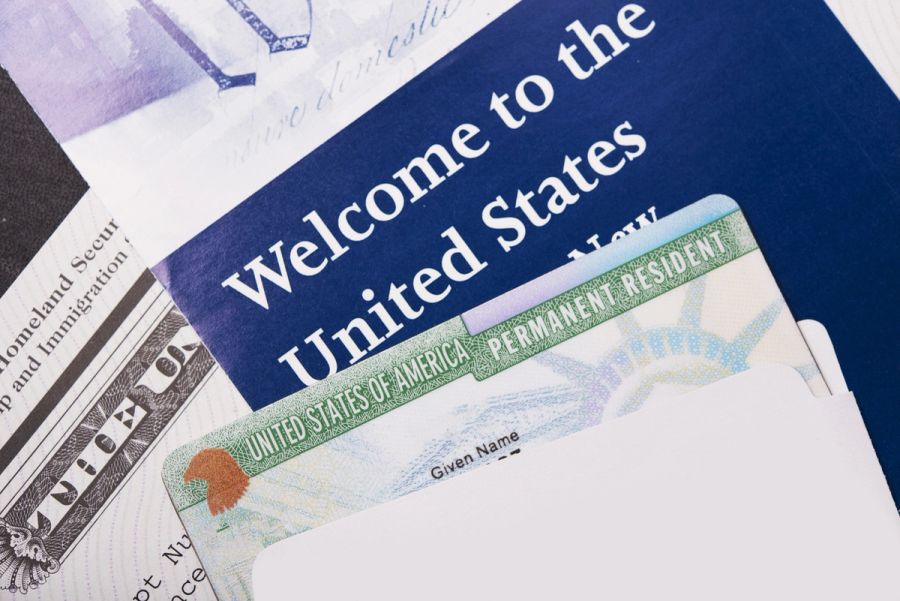
The Green Card functions as a residency card as well as work authorization and travel documentation.
If you’re outside the U.S., you can’t apply via adjustment of status. Instead, legal permanent resident status can be obtained abroad by applying at a U.S. embassy or consulate. Though consular processing is often faster than USCIS processing, you must remain outside of the United States until the application is approved and with AOS you can also apply for a work permit and travel document while your AOS application is pending.
Who can apply for adjustment of status?
To apply for a Green Card, you must be eligible under one of eight different Green Card categories. You must be the beneficiary of an approved immigrant petition, and you must be in the U.S. at the time you apply.
Immigrant visa petitions for a Green Card include:
- Family-based (Form I-130) - spouses, parents, widows, fiancés, or children of U.S. citizens.
- Employment-based (Form I-140) - workers sponsored by U.S. employers or investors.
- Humanitarian (Form I-730) - refugees, asylees, victims of crime or abuse.
Applicants may be ineligible for a Green Card due to criminal history, immigration violations, certain health issues, national security concerns, or relying on government assistance. Other common causes of ineligibility include filing an incomplete or incorrect application, filing within a category for which you are not eligible, filing too early or insufficient financial resources from a sponsor.
Adjustment of status timeline
The total adjustment of status process can take several years, depending on your visa category and USCIS’s current workload. That said, the current average USCIS processing time for Form I-485 is between 10 and 26.5 months, as of November 2025.
Note that USCIS processing times only cover the time it takes for an officer to review your I-485 and make a decision. It doesn’t account for the time it takes you to schedule an interview, respond to potential Requests for Evidence, or complete your biometrics appointment.
An approved I-485 also doesn’t mean you’ll get your Green Card right away—your priority date must be current on the Final Action Dates chart in the Visa Bulletin first, which is why applicants usually also apply for an I-765 Employment Authorization Documents and I-131 Travel Document.
Adjustment of status: step-by-step process
Step 1: Determine eligibility
Make sure that you satisfy all requirements, including qualifying for either I-130 or I-140 (if not already have a pending/approved one), a current priority date, and lawful entry.
A priority date is the day the underlying petition (I-140 or I-130) is received, and functions as a ticket in line to apply for a Green Card. Currency can be determined by reviewing the Visa Bulletin, which is released monthly by USCIS.
The I-130/I-140 petition may be filed before or concurrently with the I-485 application package.
Step 2: Prepare and file the application (Form I-485)
Prepare Forms I-485, I-693, any other forms (I-765, I-131, etc) and all required evidentiary documents for all applicants and submit them to USCIS.
Step 3: Receive receipt notices
These can be used to track the progress of all forms with USCIS.
Step 4: Attend biometrics appointments
Go to the specified Application Support Center at the designated day and time to provide fingerprints, photos, and signatures to start background checks.
Step 5: Respond to any requests for evidence (RFEs) if needed
If USCIS requires additional documentation—known as a request for evidence (RFE)—to issue a decision, respond promptly and as completely as possible.
Step 6: Attend your visa interview
Appear for your Green Card interview to verify eligibility and confirm information.
Step 7: Receive your Green Card
The physical Green Card will arrive in the mail, so it is important to ensure your mailing address on record is correct and to track the parcel once the information is provided.
What is the 90-day rule?
The “90-day rule” is a USCIS guideline used to determine whether an AOS applicant misled government officers when they received visas. Unless their visa is considered “dual intent”, such as an H-1B or an L-1, if someone holding a temporary visa engages in immigrant activities during their first 90 days in the U.S., they may raise a red flag to officers.
Examples include applying for AOS, marrying a U.S. citizen or engaging in unauthorized work or study. This can result in Green Card application denial or visa revocation.
What to expect after adjustment of status?
After filing your AOS, you will receive several notices, attend appointments, and await a decision.
Within two to four weeks of filing, USCIS will issue a receipt notice for your case, which includes the receipt number for tracking purposes.
Within one to three months, USCIS will schedule you a biometrics appointment. At the appointment, they will collect fingerprints, verify your identity, and run background checks. You will be notified with a paper notice, but the status online will also update when the biometrics notice is sent. So it is important to regularly check both your mail and case status for updates.
Within six to 12 months, you will be scheduled to appear for an interview. It is important to fill out the second page of the interview notice and bring it with you to the interview. Punctuality and preparedness are essential.
It generally takes 10 to 12 months for the AOS to get approved, after which you’ll receive your Green Card.
How do I check the status of my adjustment of status application?
Once USCIS has issued a Receipt Notice (Form I-797, Notice of Action) for your Green Card application, you can use the 13-digit Receipt Number to check the status of your application online. Simply type the Receipt Number into the Check Case Status field and click ‘Check Status’ to review the last action taken on your application.
How much does adjustment of status cost?
The filing fees (as of January 2026) associated with the I-485 depend on your age, and are listed below:
- Ages 14-78 - $1,440 (by mail) or $1,390 (online)
- Under 14 - $950
- 79 or older - $1,140
The initial petition that you have to file before you can adjust your status:
- Form I-140, Immigrant Petition for Alien Workers - $715, plus additional fees if applicable
- I-130, Petition for Alien Relative - $675, but is reducible to $625 if filed online
You can also opt to file Form I-907, Request for Premium Processing, which reduces processing time for the above immigrant petitions to 15 business days. Premium processing costs $2,965.
Filing fees may change based on the method of filing (paper or online), as well as what forms are being filed together or within a certain period of time. The government often updates the filing fees, and its accepted methods of payment. So it is important that you double-check all filing fees and read instructions for each form before filing. Failure to include the correct filing fees will most likely result in rejection of your petition.
File your Adjustment of Status with confidence
Adjustment of Status is an exciting step on your Green Card journey—it means you’re that much closer to a Green Card and permanent residency in the United States.
If you need help getting started, request a consultation with Manifest Law’s experienced immigration attorneys today.
Frequently asked questions
Can I travel while my AOS is pending?
While waiting for a decision, the applicant may not leave the United States without maintaining status that permits travel (such as H-1B) or obtaining an Advanced Parole document to travel and return. Traveling without proper documentation while Form I-485 is pending results in abandonment of the I-485.
Can I work while I wait for my Adjustment of Status?
You can only work in the United States if you have status that permits work, or an approved Employment Authorization document (Form I-765). You can file this form with the I-485. It is usually approved well before the I-485, allowing applicants to work while they continue waiting for the I-485 decision.
Can my spouse/children apply for an Adjustment of Status with me?
Yes, generally your spouse and children (if under age 21) can apply for AOS with you, so long as they are in the U.S. with lawful entry. Be sure to list them as dependents where indicated on your I-485 form and list yourself as the principal applicant on their forms.
Each applicant will need to submit their own application package with the required documents. You also must document familial relation to each derivative applicant (e.g. a marriage certificate to verify legal marriage to your spouse).
What happens if I move during the process?
You must notify USCIS of your new address within 10 days of moving by submitting Form AR-11 online. Keeping your address current in the USCIS system is critical, as it determines where case updates are sent. If you apply with derivative applicants, they need to submit their own AR-11s as well.
What if my application is denied?
If your AOS is denied, there are several possible next steps. If you believe USCIS made a mistake or you have new evidence, you can file a Motion to Reopen or Reconsider within 30 days of denial with Form I-290B. If you can correct the issue that led to the denial, you can reapply for Adjustment of Status.
In some cases, appealing the decision may be possible. If you are outside of the U.S. or forced to immediately leave upon denial, you have the option to reapply through consular processing.
How does financial stability affect my Adjustment of Status approval?
Financial stability is a major factor in the approval of AOS applications. You need to demonstrate to USCIS that you are unlikely to rely on the government for financial support because you have your own source of income, or because you have enough support from your spouse.
Can I reschedule my biometrics or interview appointments?
If you are unable to attend one of your appointments as scheduled, you can reschedule them. However, availability may be limited and could lengthen your processing time. It is best to attend all appointments as initially scheduled if possible.
About the Author
Contributing Writer
Anneliese Aberg Scalzo is a contributing writer at Manifest Law.
Read bioReviewed By

Immigration Lawyer to Manifest Law
Ana Gabriela Urizar is an award-winning immigration attorney licensed in Arizona and New York. With nearly a decade of experience, she advises global corporations on complex U.S. immigration matters. Originally from Guatemala, Ana Gabriela previously spent close to ten years at the world’s largest immigration firm, managing business immigration matters for leading technology, science, and financial companies. She has been recognized by Best Lawyers: Ones to Watch and Negocios Now’s Tri-State 40 Under 40.
Read bioShare this article: