


Form I-907: How to Request Premium Processing in 2025
- Form I-907 allows petitioners to request premium processing, guaranteeing a USCIS decision in 15 calendar days for certain visa categories.
- Costs for premium processing vary by visa type, ranging from $1,780 and $2,965.
- While premium processing can expedite USCIS decisions, it doesn’t guarantee approval. It’s best used for time-sensitive situations like job offers or travel.
Understanding Form I-907: Premium Processing for Faster USCIS Decisions
Form I-907 is the official request for premium processing. For eligible applicants, it offers a fast-track option to significantly shorten USCIS processing times, reduce uncertainty, and receive a decision on a petition in as little as 15 calendar days.
This guide explains how Form I-907 works, which visa and green card categories qualify, and the key factors to consider when deciding whether premium processing is the best approach for your case.
What Is Form I-907?
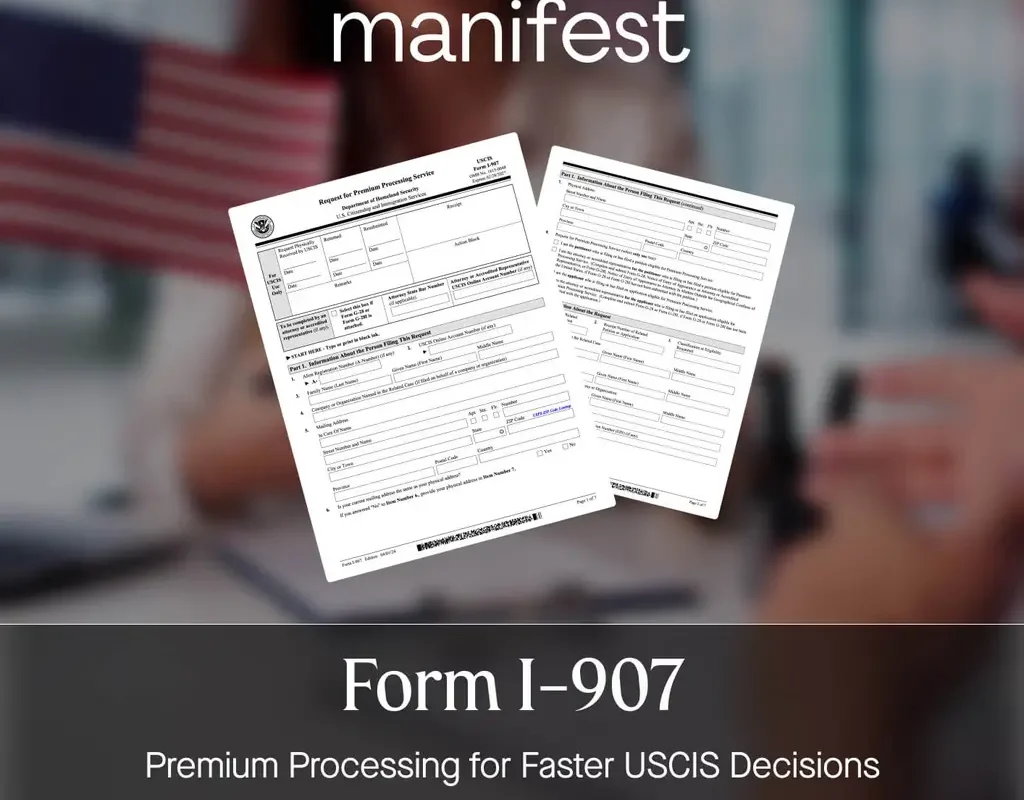
Form I-907, Request for Premium Processing Service, is the official application for premium processing, a service offered by U.S. Citizenship and Immigration Services (USCIS) that guarantees expedited processing for certain visa and immigration petitions. Premium processing allows applicants to bypass standard processing times and get a significantly faster decision on their petition.
What is premium processing, and how fast is it?
For most visa and green card categories, premium processing guarantees a decision on your application within 15 business days. While USCIS used to offer premium processing in 15 calendar days, the timeline shifted to 15 business days in 2024.
However, there are certain classifications with slightly longer premium processing wait times, including:
| Classification | Timeframe for Premium Processing |
| Form I-765 | 30 business days |
| Form I-539 applicants requesting a change of status to F-1, F-2, M-1, M-2, J-1 or J-2 nonimmigrant status | 30 business days* *once all prerequisites have been met |
| Form I-140 E13 multinational executive and manager | 45 business days |
| Form I-140 E21 national interest waiver | 45 business days |
What are the Form I-907 filing fees in 2025?
Filing fees for premium processing vary by filing category, ranging between $1,780 and $2,965. Fees can be paid by money order, personal check (made payable to the U.S. Department of Homeland Security), cashier’s check, or by credit or debit card (using Form G-1450, Authorization for Credit Card Transactions). Certain filing categories also have the option of paying their filing fees online.
Which USCIS forms are eligible for premium processing?
USCIS currently offers premium processing for the following forms:
- Form I-129, Petition for a Nonimmigrant Worker
- Form I-140, Immigrant Petition for Alien Worker
- Form I-765, Application for Employment Authorization
- Form I-539, Application to Extend/Change Nonimmigrant Status
These USCIS forms are used to petition for many common work vias and green card categories, including:
| Visa/Green Card Type | Form | Premium Processing Available? | Premium Processing Fee |
| H-1B (Specialty Occupation) | I-129, Petition for a Nonimmigrant Worker | Yes | $2,965 |
| TN (NAFTA Professionals) | I-129, Petition for a Nonimmigrant Worker | Yes | $2,965 |
| O-1 (Extraordinary Ability) | I-129, Petition for a Nonimmigrant Worker | Yes | $2,965 |
| E-1/E-2 (Treaty Trader/Investor) | I-129, Petition for a Nonimmigrant Worker | Yes | $2,965 |
| EB-1A (Extraordinary Ability) | I-140, Immigrant Petition for Alien Worker | Yes | $2,965 |
| EB-1B (Outstanding Professor/Researcher) | I-140, Immigrant Petition for Alien Worker | Yes | $2,965 |
| EB-2 NIW (National Interest Waiver) | I-140, Immigrant Petition for Alien Worker | Yes | $2,965 |
| EB-1C (Multinational Executive or Manager) | I-140, Immigrant Petition for Alien Worker | Yes | $2,965 |
Which USCIS applications and forms do not allow for premium processing?
While premium processing is an option for many types of applicants, there are certain visa and green card types that do not offer premium processing, including but not limited to:
- I-485 adjustment of status form
- Family-based green card applications
- B-1 or B-2 tourist visas
Who fills out Form I-907?
Only the petitioner (or the petitioner’s attorney, if authorized) can file Form I-907. In many situations, the petitioner is the employer sponsoring the visa (for example, for H-1B visas)—which means the employer would be responsible for filing Form I-907. But in categories that allow self-petitioning, the beneficiary may act as the petitioner, and in those cases, the applicant themselves would file Form I-907.
Where to download Form I-907
You can fill out Form I-907 online, via your myUSCIS account, or by downloading the Form I-907 PDF on the USCIS website. If you’re filling out a paper copy, always ensure you have the most up to date version from the official USCIS page.
You can access Form I-907 in two main ways:
- Online through your USCIS account:
- Go to my.uscis.gov and log in or create an account.
- You can fill out the form online and submit it right there.
- Download the paper form from the USCIS website:
- Visit the official USCIS Form I-907 page: uscis.gov/i-907
- Scroll down to the “Forms and Document Downloads” section.
- Click the PDF link to download the latest version.
- Tip: Always download immigration forms directly from the USCIS site so you’re using the most up-to-date form. Using an old version could cause unnecessary delays.
If you can’t find or download the form online, you can call the USCIS Contact Center at 800-375-5283 (TTY: 800-767-1833) and ask them to mail you the form.
Subscribe to our newsletter for immigration resources and news, without the legal jargon.
How to fill out USCIS Form I-907, step-by-step
Filing Form I-907 is extremely straightforward, especially compared to more complicated USCIS forms like the DS-160.
Part 1: Information About the Person Filing This Request
This section is about you, the person asking for Premium Processing.
- Alien Registration Number (A-Number): If you have one, write it here. It starts with an “A” and is on official immigration papers you’ve received. If you don’t have one, write “N/A”. Need more help? Read more about how to find your alien registration number here.
- USCIS Online Account Number: Only if you’ve used the USCIS online system before. If you don’t have one, write “N/A”.
- Full Name: Write your legal name.
- Company or Organization Name: Fill this in if you’re filing for a company.
5–6. Mailing Address – Where you want USCIS to send letters about this request. - Physical Address: If it’s different from your mailing address.
- Request Type: Check the box for the Premium Processing Service you want.
Part 2: Information About the Petition or Application
This links your request to the main immigration form it’s connected to (like Form I-129, I-140, I-539, or I-765).
- If you’re upgrading a pending case, fill out all items 1-8.
- If you’re filing together with the main form, you usually only fill out items 1, 3, 4, and 5 (you won’t have a receipt number yet)
Part 3: Your Statement, Contact Info, and Signature
This section confirms that you understand the form, provides USCIS with your contact details, and gives your official signature to authorize the request. Without this part completed, USCIS will reject your form.
- Say if you filled it out yourself or had help.
- Provide your daytime phone number, mobile number (if any), fax (if any), and email.
- Sign and date the form. No signature = automatic rejection.
Part 4: Interpreter’s Info (If Used)
This section is only required if someone translated the questions for you. If you used a translator, they’ll fill out this section with:
- Their name
- Business or organization (if any)
- Address, phone number, and email
- Signature and date
Part 5: Preparer’s Info (If Someone Else Completed the Form)
If another person filled out the form for you (like an immigration attorney or accredited representative), they’ll need to provide their contact information here.
- Their contact info
- Signature and date
- If they’re an attorney or accredited representative, they might also need to submit Form G-28
Part 6: Additional Information
If you ran out of space in earlier sections:
- Use this space or attach extra sheets.
- On each extra sheet, write your name, A-Number (if you have one), and the page/part/item numbers you’re adding to.
- Sign and date any extra sheets.
Final Steps Before Sending Form I-907
Make sure to double and triple-check your work before submitting or mailing Form I-907:
- Confirm that you’ve signed everywhere you need to.
- Include a check or money order to pay the Premium Processing fee.
- If mailing, send it to the right USCIS address listed for Form I-907 at uscis.gov/i-907.
- Keep copies of everything for your records.
When to use premium processing
Now that you understand what Form I-907 is, who qualifies, and how to file, let’s jump into when it makes sense to utilize premium processing.
Premium processing can be beneficial in a variety of scenarios, including:
- Job offer deadlines. A U.S.-based job offer is a requirement for many employment-based visas (for example, H1-B). And if your offer has a start date that’s quickly approaching, premium processing can expedite the decision-making process and ensure you’re ready for work on Day 1.
- Travel needs. If you need to travel outside of the U.S. for personal or business reasons—and you need your petition approved to do so—premium processing can ensure you secure your visa in time for your trip and have all the documents you need to travel.
- EAD renewal. If long wait times could push your Employment Authorization Document (EAD) renewal or extension past the deadline—and threaten your ability to legally work in the process—premium processing can help you stay current.
How to decide if premium processing is worth it
Not sure about premium processing and whether it’s right for you? Here are some tips for evaluating your options and determining if premium processing is actually worth it for your case:
- Assess the urgency: If your case has an urgent deadline, whether personal or professional, premium processing can help ensure USCIS reviews your application in time to meet it.
- Evaluate the cost: Before you decide to move forward, it’s important to review the fees review your budget, and decide whether investing in expedited processing makes sense for your specific case.
- Consult an attorney: If you’re unsure about premium processing and how it might apply to your case, consider consulting with an immigration attorney. An immigration lawyer can answer your questions, explain the potential benefits and drawbacks of premium processing for your specific visa or green card category, and help you decide the best way forward for your case.
Common mistakes to avoid when filing Form I-907
Form I-907 is designed to expedite your visa or green card application. But mistakes on the form can actually cause delays, which is why it’s important to understand where mistakes could happen and, more importantly, how to avoid them.
Common mistakes on Form I-907 include:
Not completing the entire form
USCIS needs a complete Form I-907 to expedite your application processing; if information is missing, they may not be able to move forward. Before you submit your Form I-907, go through the entire application to ensure all fields are complete and that you didn’t miss any questions or requirements.
USCIS also can’t process your Form I-907 without a signature, so before you submit, double-check to make sure you’ve signed the form.
Sending the completed form to the wrong address
As mentioned, the correct mailing addresses for Form I-907 vary by filing type. If you send your form to the wrong address, it can cause serious processing delays. Before you submit your Form I-907 through the mail, confirm that you’re sending it to the correct address.
Assuming premium processing impacts your approval chances
Premium processing guarantees a faster decision on your application, but it has absolutely no bearing on what that decision will ultimately be. USCIS uses the same eligibility criteria to evaluate your application, regardless of processing times, and if they determine you don’t meet those criteria, they may issue a denial.
Subscribe to our newsletter for immigration resources and news, without the legal jargon.
The bottom line on Form I-907 and premium processing
Premium processing offers a fast-track option for certain immigration petitions, significantly reducing processing times and guaranteeing decisions within 15 to 45 business days. While premium processing definitely comes with a premium price tag, it can be a worthwhile investment for applicants who need a decision—and need it fast.
How Manifest Law Can Help
Evaluating whether you should file Form I-907 and expedite processing for your case is a complex process. An immigration attorney can help you better understand how premium processing might impact your specific case, weigh the pros and cons, and develop a strategy that helps you meet your immigration goals, whether that involves premium processing or not.
At Manifest, we don’t just file paperwork—we help you build a strategy that works. Our legal team has guided founders, creatives, and researchers through both O-1 and EB-1A pathways with clarity, care, and 97% approval rate.* ✅
👉 Ready to explore your options with an attorney? Request a consultation with Manifest Law and get the clarity you need to move forward.
*Historical approval rates are provided by Manifest’s Co-Counsels, and is for 2024 petitions and across all visa categories. These numbers include cases handled by co-counsel in connection with their work at Manifest and at other firms. Past case approvals and approval rates do not guarantee success in your case.