



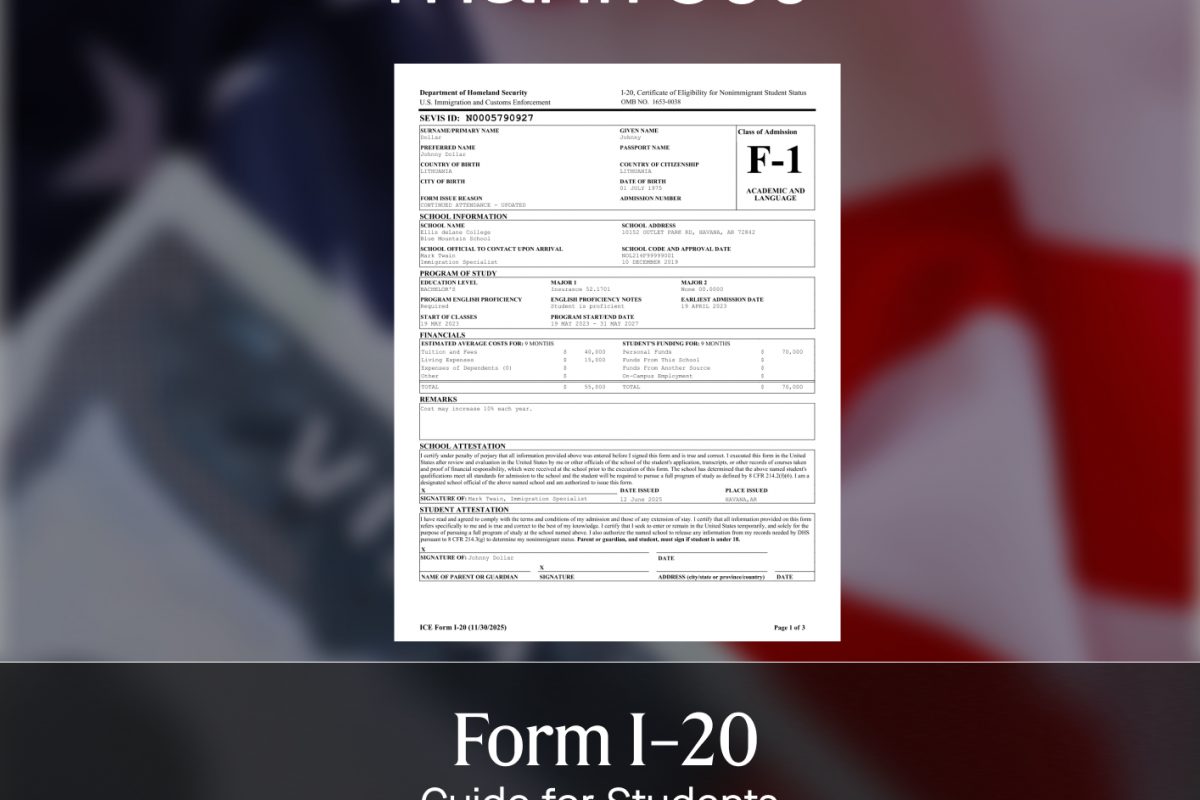
Form I-20 Guide for Students
- Form I-20 is not a visa application—it’s proof of your status as an international student.
- Form I-20 contains essential information about the student, their school, and their DSO.
- Students need Form I-20 to apply for an F-1 visa, extend their visa, travel or re-enter the U.S., and get certain types of employment.
- Form I-20 is free, but there are other costs related to getting a student visa.
Before you can study in the United States as an international student on an F-1 visa, you’ll receive one of the most critical documents in the entire process: Form I-20. Your school issues it, your visa depends on it, and you’ll use it throughout your academic program, from your visa interview to every time you travel and return to the U.S.
What is Form I-20?
Form I-20, officially called the Certificate of Eligibility for Nonimmigrant Student Status, is the document that proves you qualify to study in the United States as a student on an M-1 or F-1 visa.
Every international student receives an I-20 before applying for their student visa, and you must keep it for the duration of your time in the U.S. However, Form I-20 is not a student visa or a visa application.
Subscribe to our newsletter for immigration resources and news, without the legal jargon.
What’s on Form I-20
- Your SEVIS Identification number
- Your personal details, including name, date of birth, and citizenship
- Your school information, including the school code and approval date
- Your parent or guardian’s name and signature
- Your program details, including major, start date, and the earliest you can enter the U.S.
- Your English proficiency level
- The cost of tuition and fees, and how much you have in personal funds
- Your designated school official’s contact information and signature
- Employment authorizations
- Travel endorsements
Form I-20 previously had a barcode but was redesigned in July 2016. Anyone who had a form should have received an updated physical copy from their DSO.
What can you do with Form I-20?
F-1 students need the I-20 form at several points during their time studying in the United States, including any time they interact with immigration officials or apply for benefits tied to their status.
Apply for an F-1 student visa or other benefits
Getting a Form I-20 is a key part of the process for obtaining a student visa. You have to pay the I-901 SEVIS fee to enter the U.S., and to do so, you will need the school code listed on your Form I-20. That same code is needed again when you submit your DS-160, your non-immigrant visa application.
You also need to bring your original I-20, signed by you and your DSO, to your visa interview at the U.S. embassy or consulate in your home country.
Enter the United States, including during travel
You need to show an I-20 form to Customs and Border Patrol (CBP) at the port of entry when you arrive for studies or return from traveling abroad. To travel as an F-1 student, your Form I-20 must have a valid travel signature from your DSO. Signatures are usually valid for 12 months.
Work on or off-campus
Certain types of employment require updated I-20 forms, like curricular practical training (CPT) or optional practical training (OPT). Talk to your DSO, who will add the work authorization to the form and make sure it is reflected in SEVIS.
Where do you get Form I-20?
Students do not fill out Form I-20 themselves. An SEVP-certified school issues it after the student has been accepted.
Here’s how the process usually works:
- You apply and are admitted to an SEVP-certified school.
- You submit your passport.
- The school enters you into the SEVIS system.
- The school sends you Form I-20 electronically.
- Print a physical copy of Form I-20 for your records.
How much does Form I-20 cost?
There is no charge for the Form I-20. It is issued to you free of charge, but you may need to pay other fees before or related to it. For example, you will pay the SEVIS fee, an F-1 or M-1 visa application fee (MRV fee), and any school enrollment fees.
How international students can get help applying for a visa
If you’re hoping to study in the U.S., working with an experienced immigration attorney can help you receive a visa. Manifest works with both foreign national students on preparing F-1 visa applications, ensuring that the right documents are included and that timelines are met so you can start your semester with confidence.
Request a consultation with Manifest today.
FAQs about Form I-20
Who issues Form I-20?
SEVP-approved schools issue Form I-20 up to 365 days before you’re supposed to start your studies.
Does Form I-20 expire?
Yes. Your Form I-20 is valid until your academic program ends and while you’re maintaining F-1 status. The date is listed on your form.
How do I update Form I-20?
Any time you need to get a travel endorsement or your status changes, you need to update your Form I-20. Updates are handled through your DSO, who issues a new I-20 that you and the school must sign. Common reasons include changing your major, extending your program, renewing your F-1 visa, adding or changing CPT/OPT, or updating funding information.
What happens if I lose my Form I-20?
If you misplace your physical form, tell your DSO right away so they can issue you a replacement. You likely also have access to your digital form, which you can print yourself. It is best to get a new copy as soon as possible, especially if you need it for travel or upcoming immigration applications.
Where should I keep my Form I-20?
You might not need to carry it around campus or to work every day, but make sure you keep it somewhere safe. When you’re travelling, keep your I-20 form easily accessible, either on your person or in your bag. Do not put it in your checked luggage since you’ll need to show it at the port of entry.