


H-1B News: 2026 update on Trump’s $100K fee on H-1B applicants, USCIS guidance, FAQs
President Trump’s proposed $100,000 H-1B visa fee is one of the most closely watched developments in U.S. immigration policy, with significant potential implications for employers, international talent, and startup founders.
Manifest’s attorneys keep a record of every major development in the $100,000 H-1B fee story, from President Trump’s initial proclamation through every update since. Use the timeline below to find the information you need, and check back as new rulings and guidance are released.
Our team closely monitors developments and will continue updating this page as more information is released.
| 🤔 Trying to figure out if the $100K fee applies to your situation? See our full exemption guide to learn whether your case is affected. |
LATEST UPDATE: March 2026 — Ongoing legal challenges to $100K H-1B Fee
Below is a chart with all the major ongoing court cases challenging the $100,000 H-1B fee.
| Active Legal Challenges for the Trump $100K H-1B Fee | ||
| Case | Link | Status |
| State of California v. Noem | https://www.courtlistener.com/docket/72031571/state-of-california-v-noem/ | Ongoing |
| Chamber of Commerce v. DHS | https://www.courtlistener.com/docket/72095497/chamber-of-commerce-of-the-united-states-of-ameri-v-dhs/ | Appealed |
| Global Nurse Force v. Trump | https://www.courtlistener.com/docket/71541425/global-nurse-force-v-trump/ | Ongoing |
December 23, 2025 — Federal judge upholds $100K H-1B fee
A federal court in Washington, D.C., has officially upheld the government’s new $100,000 fee for H-1B visa petitions for people currently living outside the United States.
In a decision issued on December 23, 2025, Judge Beryl A. Howell ruled that the President has the legal authority to impose significant financial requirements on foreign workers entering the country if it is deemed in the national interest.
The Chamber of Commerce and various universities sued the President and various federal agencies, arguing that the fee would prevent talented individuals from coming to the U.S.
In her decision, the judge emphasized that the President has the authority to manage the border and regulate the entry of non-citizens. For now, this means the $100,000 payment remains a mandatory requirement for any new H-1B petition for a worker currently abroad.
Subscribe to our newsletter for immigration resources and news, without the legal jargon.
December 12, 2025 — Twenty attorneys general sue against the $100K H-1B Fee
A coalition of 20 attorneys general filed a separate lawsuit over the $100K H-1B fee on December 12, 2025. Led by California AG Rob Bonta, the complaint argues the Trump administration violates the Administrative Procedure Act by bypassing the required notice-and-comment rulemaking process.
October 20, 2025 — USCIS issues formal guidance on Trump’s $100K H-1B fee
USCIS has released long-awaited implementation guidance for President Trump’s September 19 Proclamation, “Restriction on Entry of Certain Nonimmigrant Workers.” The new rule officially took effect at 12:01 a.m. ET on September 21, 2025, and it represents the most sweeping change to H-1B filings in over a decade.
Under the guidance, any new H-1B petition filed on or after September 21 for a beneficiary outside the United States without a valid H-1B visa must include proof of a $100,000 payment made through pay.gov before filing. Applicants within the U.S. can also be subject to this fee if USCIS approves them as consular processing. Petitions that lack payment proof will be denied.
| ➡️ Important: The listed filing fees here are accurate as of November 2025 and are subject to change. We always recommend checking USCIS’s official Filing Fees page or consulting with your immigration attorney for the most up-to-date information on filing fees. |
How USCIS plans to implement the $100K H-1B fee (Oct. 20, 2025)
- In-U.S. filings remain exempt if approved. Most amendments, extensions, or H-1B changes of status filed and approved inside the U.S. are not subject to the $100K payment. Subsequent travel is also allowed without risk of the $100k fee. If USCIS finds the petition requires consular processing, the fee will likely apply.
- Pending petitions carry a new travel risk. If an H-1B worker leaves the country while a change of status, amendment, or extension is still pending, USCIS may find them ineligible for that benefit and convert the case into one that does require the $100K payment.
- Previously filed cases and valid visas are unaffected. H-1B petitions filed before September 21, and individuals with valid H-1B visas can continue traveling and working normally.
- Exceptions will be rare. The Secretary of Homeland Security may waive the fee only in extraordinary national-interest cases. Employers and individuals should not plan on qualifying.
What the Oct. 20 update means for H-1B employees and companies
For now, routine H-1B transfers, extensions, and amendments inside the U.S. can proceed normally and, subsequent to an approval, travel. But any new or consular-processed H-1B petitions will require the $100K payment upfront. Employers should review filing plans immediately, update internal workflows to include pay.gov verification, and delay non-essential international travel while an H-1B petition is pending.
For H-1B beneficiaries in the United States, the key takeaway is simple: if your H-1B is already approved and you have a valid visa stamp, you can travel. If it’s still pending, stay put.
Full H-1B news timeline: Trump’s $100K H-1B fee and beyond
October 16, 2025: Chamber of Commerce files lawsuit against $100K H-1B fee
Breaking: As of October 16, 2025, the U.S. Chamber of Commerce has filed a federal lawsuit challenging the Trump administration’s new $100,000 H-1B visa fee.
The legal challenge marks the first major pushback from businesses since the policy’s announcement last month. The Chamber of Commerce argues that the $100K fee could negatively impact startups, small firms, and tech companies that rely heavily on skilled foreign workers.
October 6, 2025: Lawsuit filed to block Trump’s $100K H-1B fee
On October 3rd, 2025, a coalition of labor unions, hospitals, schools, and faith organizations filed a federal lawsuit in the Northern District of California challenging President Trump’s September 19 executive action imposing a $100,000 H-1B application fee. The case, Global Nurse Force et al v. Trump et al, argues that the order is unconstitutional and violates the Administrative Procedure Act.
The plaintiffs have requested a temporary injunction, a fast-track order that could pause the policy while the case moves forward.
- If granted, the injunction would suspend the $100,000 fee nationwide, allowing normal H-1B filings to resume, at least temporarily.
- If denied, the fee remains in effect unless overturned by a higher court.
What the lawsuit argues
The plaintiffs say the $100K fee makes it “prohibitively expensive or impossible” for employers to hire doctors, nurses, teachers, and researchers and endangers healthcare, education, and local economies nationwide. The suit asks the court to immediately block the order and restore predictability for employers and workers.
According to the 65-page complaint, the proclamation:
- Defies Congress, which has exclusive authority to set immigration fees;
- Creates arbitrary exemptions through a vague “national interest” loophole;
- Threatens hospitals, schools, and churches that rely on H-1B professionals to serve underserved communities; and
- Harms the U.S. economy by driving talent and innovation abroad.
What happens next
A hearing on the injunction could happen within the next two to three weeks, though the timeline depends on how quickly the court schedules arguments and how the government responds. In similar immigration cases, such as the 2017 travel ban and the 2020 DACA rescission, judges have ruled on emergency motions within 10 to 30 days.
If the court moves quickly, a decision could arrive before the end of October. Until then, the $100,000 fee technically remains in effect, though many employers may choose to hold off on new filings while the case is pending.
October 1, 2025 – Federal government shuts down, halts new H-1B visa filings
Today, October 1, the federal government officially shut down, effectively freezing new H-1B visa filings.
The first step in the H-1B process—securing a Labor Condition Application (LCA) from the Department of Labor—is unavailable while the agency is closed. Until federal funding is restored, employers cannot file new H-1B petitions, transfers, or changes of status unless the LCA was already certified before October 1. Although USCIS remains open, H-1B cases cannot move forward without that DOL step.
Read more about the U.S. government shutdown and implications for workers and employers here. You can also watch the video below from Manifest Law’s Principal Immigration Attorney, Nicole Gunara, for the latest H-1B news updates.
September 30, 2025, 9:26PM EST – $100K H-1B Fee implications remain unclear
Over the past ten days, the White House, USCIS, and CBP have tried to clarify the scope of the new $100,000 H-1B fee.
Officials have confirmed that it is a one-time charge for new petitions, not annual, and that previously filed or currently valid visas are unaffected. Renewals with the same employer appear to be the only clear exemption so far.
The most recent shift came on September 21, when USCIS released formal FAQs spelling out that the fee applies to all new petitions filed after that date, including 2026 lottery filings. Below, we break down the latest news on Trump’s $100K H-1B fee and what it means if you’re planning to file a new H-1B petition soon.
What we know for sure about Trump’s $100K H-1B fee
While some things remain uncertain, multiple government agencies have confirmed the following:
- Pending petitions filed before Sept 21 at 12:01 a.m. EST are unaffected and should move forward without retroactive fees.
- Currently approved, valid petitions and H-1B visas remain eligible for travel and re-entry; no fee is charged at the border.
- Straightforward extensions with the same employer have been accepted for filing and is the conservative interpretation of a renewal as carved out as an exemption to the proclamation by USCIS in their H-1B FAQ guidance.
- Treaty-based visas such as the E-3 and H-1B1 remain outside the scope of the Proclamation and continue to be processed normally.
Key questions about the $100K H-1B fee remain unresolved
The government has not yet provided clear guidance on the following:
- Whether H-1B transfers, amendments, or changes of status inside the U.S. will be considered “renewals” exempt from the $100K fee.
- What, if any, exemptions will be allowed for occupations considered to be in the “national interest,” such as physicians.
- Whether domestic filings or future lottery entrants where the candidate/beneficiary does not leave the country (or will ever leave the country) are exempted from the proclamation. There is a slight conflict between CBP’s guidance and USCIS’ guidance on this part.
Until these points are clarified in writing by the relevant government agencies, the most prudent course is to assume the fee applies broadly and to plan conservatively.
$100K H-1B fee: Should you file a new H-1B petition now, or later?
For companies considering new H-1B filings after September 21, the reality is that it is still in the earliest days of implementation. While some attorneys report online that their petitions have been received without the $100,000 fee, to the best of our knowledge, none have yet been adjudicated, considering that even with premium processing, the timeline for adjudication is up to 15 business days.
For any companies considering filing a new H-1B petition, Manifest’s Principal Immigration Attorney, Nicole Gunara, says, “We know we take a conservative approach, and we understand that some firms may take a different approach. But until the first post-September 21 petitions are adjudicated, we hold firm that the safest course is to wait and see how USCIS applies the new fee.”
“The safest course is to wait and see how USCIS applies the new fee.”
Nicole continues, “Within the next two weeks, those decisions should give us much clearer guidance. Until then, if companies have the option, we believe it’s better to hold off rather than risk becoming the test case.”
We will continue to provide updates here as additional information becomes available.
| 📝 Our FAQs about the new $100K H-1B fee and proposed H-1B lottery changes are being frequently updated as new information becomes available. Click here to jump to the FAQs about the H-1B $100K fee, answered by immigration lawyers. Jump to an FAQ here: • When will Trump’s proposed H-1B lottery changes be implemented? • Does the $100K H-1B fee apply to H-4 dependents? • Does Trump’s $100K H-1B fee apply to H-1B renewals (AKA extensions)? • Does Trump’s $100K H-1B fee apply to H-1B transfers (changing employers)? • Does the $100K fee apply to a change of status to H-1B within the U.S.? • Does the $100K fee apply to cap-exempt H-1B? • I have a valid and approved H-1B petition, and I am out of the US for visa stamping. Am I allowed to go back to the US? • My H-1B visa starts on October 1st. Can I go to my home country for visa stamping? • Can H-1B holders travel right now? |
September 23, 2025 at 11:55am EST – DHS proposes new weighted lottery
The Department of Homeland Security has officially unveiled its long-anticipated proposal to reshape the H-1B lottery. While the shift toward a wage-based selection system has been expected for months, the Notice of Proposed Rulemaking published for the Federal Register on September 24 makes it clear how the policy would work in practice: applicants will still be chosen through a lottery, but their odds will now scale with the wage level offered, from one entry at Level I to four at Level IV.
Henry Lindpere, Manifest Law’s Senior Counsel, says, “The new H-1B lottery system essentially gives four times better odds to someone offered a Level IV wage, like a senior engineer at a tech giant, compared to an entry-level graduate making $60-80K. That means early-career professionals will find it much harder to win the lottery. The big question now is how binding the wage level will be: if a petition is filed at a high salary but the worker changes jobs or pay before October, does that invalidate their lottery spot? The rule’s enforcement on these scenarios will be critical.”
Read more about the proposed H-1B lottery changes here.
September 22, 2025 at 12:15pm EST: USCIS releases FAQ sheet explaining $100K fee
USCIS has released an FAQ sheet about Trump’s $100K H-1B fee. It states that the $100,000 fee applies to all new H-1B petitions filed after September 21, 2025, including 2026 lottery filings.
Nicole Gunara, Manifest’s Principal Immigration Attorney, says, “Though CBP’s guidance from the weekend states that it only applies to petitions made from outside the U.S., the only carve-out mentioned by USCIS is for what the government calls ‘renewals.’ USCIS has not yet defined whether transfers or changes of status fall into that category. Out of caution, employers should assume the fee applies to most filings – within and outside the U.S. – other than straightforward extensions with the same employer as it is the most conservative interpretation of a renewal.”
Until more guidance is issued, employers should assume the fee applies to most filings other than straightforward extensions with the same employer.
In addition, a White House spokesperson told a Bloomberg reporter that physicians may be exempt from the $100,000 fee, but no new policy guidelines have been posted. We will continue to provide updates here as new information becomes available.
Below, Nicole provides a Monday update on H-1B news that broke over the weekend and this morning:
September 21, 2025: Update on Trump’s $100K H-1B fee
As new information is being shared by the White House and USCIS, some parts are unclear about how it changes or impacts the statements in the President’s original Proclamation. We are continuing to wait for further clarification from official sources.
In this video, Manifest Law’s Principal Immigration Attorney, Nicole Gunara, explains the most recent updates to Trump’s $100K H-1B policy and answers the most pressing questions asked by those impacted:
September 20, 2025, 6:03PM: USCIS releases implementation guidance on Trump’s $100K fee
USCIS has released implementation guidance for the President’s September 19 proclamation restricting H-1B entry without a supplemental $100,000 payment.
The guidance states that the proclamation does not apply to applicants with petitions filed before the effective date (September 21, 2025 at 12:01AM), currently approved petitions, or individuals holding validly issued H-1B visas.
Note that the USCIS guidance does not directly address whether the fee is one-time or recurring, nor whether it applies to extensions or renewals filed inside the U.S. For now, what is officially confirmed by USCIS is that valid H-1B visa holders may continue to travel internationally without being subject to the new fee requirement.
September 20, 2025, 5:07PM EST: Press Secretary clarifies Trump’s $100K H-1B fee
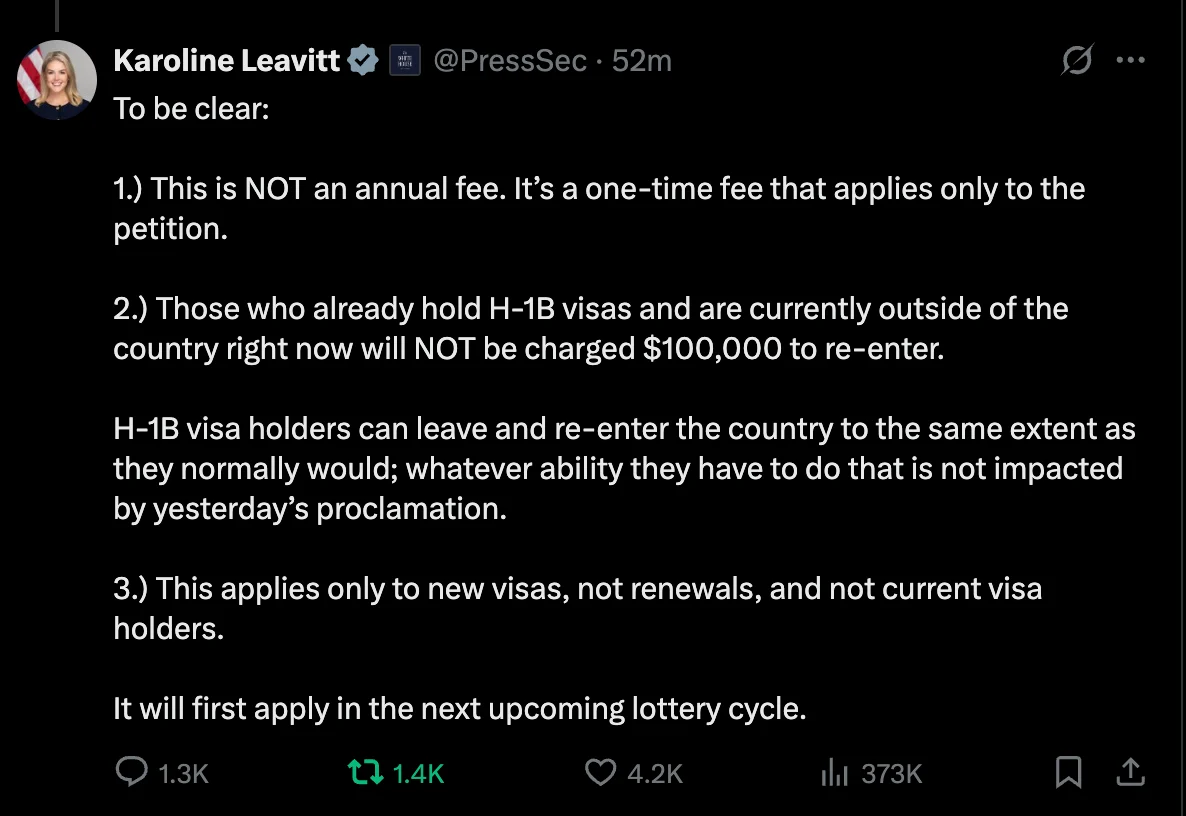
Press Secretary Karoline Leavitt confirmed on X that the $100K H-1B fee is a one-time fee, not annual, and only applied to new H-1B visas, not renewals. She also confirmed that current valid H-1B holders outside the country will not need to pay the fee to re-enter.
That said, it is important to keep in mind that this is a statement by a White House Official and not written in the actual proclamation itself. We still encourage H-1B visa holders to return to the United States as early as possible and proceed with caution.
| 📝 Our FAQs about the new $100K H-1B fee are being frequently updated as new information becomes available. Click here to jump to the FAQs about the H-1B $100K fee, answered by immigration lawyers. |
September 20, 2025, 1:21PM EST: Implications for H-1B travel unclear
Breaking: as of 1:21pm on September 20, there are conflicting reports on whether or not the $100K H-1B fee will apply to current H-1B holders returning to the United States, or if it will only apply to new applicants. We will continue to update here as new information is released.
September 19, 9:30PM EST: President Trump signs executive action on H-1B
The White House has just published the Proclamation “RESTRICTION ON ENTRY OF CERTAIN NONIMMIGRANT WORKERS” limiting the entry of H-1B visa holders unless their employer has paid a $100,000 payment to the United States.
The first and most important thing for you to know is that this Proclamation becomes effective 12:01 a.m. eastern daylight time on September 21, 2025. That means anybody who is currently outside of the US and has a valid H-1B visa stamp in their passport should immediately book a flight and return to the United States before this time.
Second, the Proclamation directs the Department of Homeland Security to not approve H-1B petitions for people outside of the United States, unless this $100,000 payment has been made. It also directs the Department of State to limit issuance of B visas to people who have approved H-1B petitions.
This is a developing story. We will continue publishing updates as new information becomes available.
September 19, 2025, 6:29PM EST: President Trump announces H-1B program changes
Major program changes may be coming for H-1B applicants. On Friday, September 19th, President Donald Trump signed an executive action during a livestream event announcing his intention to implement a $100,000 application fee for first-time and renewing H-1B visa applicants.
The executive action has not yet been released in writing, but it directs the Department of Homeland Security to work towards imposing a $100,000 fee on future applicants. It may also instruct the Department of Labor to draft new rules that would change how wage levels are determined for H-1B workers.
What happens now that President Trump signed the executive action?
Now that President Trump has signed the executive action, the proposal does not take effect immediately. Instead, it will move into a rule-making process as outlined by the Administrative Procedure Act.
The process involves drafting a proposed rule and publishing it in the Federal Register. This opens a notice-and-comment period, where the public, advocacy groups, and employers can provide feedback. Any agencies involved (in this case, likely USCIS) must review those comments and issue a formal response before finalizing any changes.
Only after this process concludes could the new fee and policy be formally added to the H-1B program. Depending on how quickly the agencies act, the outcome could still affect the FY2026 H-1B lottery.
Who will this H-1B executive action impact?
Analysts say that this initiative could affect the technology industry the most, as its workforce heavily relies on H-1B holders. According to a fact sheet seen by Bloomberg News, the Trump administration claims that companies are replacing American workers with lower-paid foreign labor through the H-1B visa program, going as far as to call it a national security threat.
According to Nicole Gunara, Principal Immigration Attorney at Manifest Law: “It seems that the administration is pushing for a way to encourage domestic STEM training and education. Per the September 19 live stream event, the administration also believes that this initiative will allow the H-1B to focus more on the most extraordinary of technical talents rather than providing such visas to the general market of talent.”
H-1B visas are currently based on a lottery system, but previous reports by Bloomberg note that flaws in the system create loopholes for employers to exploit by flooding the lottery with entries. In a post published by USCIS on January 24, 2025, this results in “decreasing wages and opportunities” for U.S. citizens as employers opt to import more foreign workers.
What does the potential executive action mean for current and upcoming H-1B applicants?
As one of the latest immigration policy reforms put forth by the Trump administration, the executive action will primarily affect the tech industry, which heavily relies on H-1B holders as a labor force. According to Bloomberg, companies often utilize the H-1B visa program to hire lower-paid foreign workers. This practice primarily occurs within certain tech firms and happens indirectly through staffing and outsourcing companies. Of the 85,000 new H-1B visas that are allotted yearly, around half come from these staffing and outsourcing agencies.
Costs currently required for H-1B visa applicants include a $215 registry fee for the lottery and a $780 fee to submit Form I-129, a petition filed by an immigrant’s employer sponsor. Additional fees can run up to $4,000, depending on several factors such as the number of employees at a company and the percentage of foreign employees within a workforce.
As of now, it remains unclear if the upcoming $100,000 fee will be an addition to existing fees, although in the Sept 19 livestream discussing the executive action, it was stated that this would be an annual fee that could apply to renewals/extensions as well.
H-1B alternatives and what those impacted should do next
There are several alternatives to working in the U.S. beyond the H-1B pathway. Options include the O-1 and J-1 visas, as well as more country-specific visas like the E-3 for Australian nationals and the TN visa for Canadian and Mexican citizens.
In the wake of this news, Nicole Gunara, Principal Immigration Attorney at Manifest Law, urges businesses, HR teams, and individuals to begin exploring these alternatives as the administration begins efforts to roll out these new initiatives.
“If and when the $100,000 H-1B fee becomes reality, the J-1 and O-1 visas stand out as possible alternatives,” said Nicole Gunara, Principal Immigration Attorney at Manifest Law. “The J-1 can offer flexibility in research and training roles, while the O-1 provides a path for highly skilled professionals without the lottery or fee hurdles.”
Q&A with an immigration attorney: what you need to know about the $100K H-1B fee
Moving forward
To learn more about H-1B alternatives and develop a strategy for your individual or corporate immigration goals, reach out to Manifest Law today. Eligible clients qualify for a free consultation with one of our experienced immigration attorneys.
FAQs about Trump’s $100K H-1B Fee, answered by immigration lawyers
LAST UPDATED: MARCH 2026
| • Does Trump’s $100K H-1B fee apply to H-1B renewals (AKA extensions)? • Does Trump’s $100K H-1B fee apply to H-1B transfers (changing employers)? • Does the $100K fee apply to a change of status to H-1B within the U.S.? • Does the $100K fee apply to cap-exempt H-1B? • Can H-1B holders travel right now? • I have a valid and approved H-1B petition, and I am out of the US for visa stamping. Am I allowed to go back, or do I fall under this rule? • What about those who are working in the US on STEM OPT & are selected for the H-1B lottery? They will be on H-1B visas from October 1st. Can they not go to their home country for visa stamping? • Does the $100K H-1B fee apply to H-4 dependents? |
Does Trump’s $100K H-1B fee apply to H-1B renewals (AKA extensions)?
No, as of October 20, 2025, USCIS has clarified that straightforward H-1B renewals and extensions are not subject to the $100,000 fee.
USCIS’s October 20 guidance confirms that in-U.S. filings such as extensions, amendments, or changes of status are not subject to the $100,000 payment if they are approved while the worker remains in valid H-1B status. This includes routine extensions with the same employer and role, such as moving from the first three-year term to the next.
Employees with approved extensions can continue working and traveling freely on their valid visas. The Proclamation does not restrict travel or impose any fee on currently valid petitions.
Does Trump’s $100K H-1B fee apply to H-1B transfers (changing employers)?
In most cases, no, if the transfer is filed and approved while the employee remains in valid H-1B status within the U.S.
USCIS’s October 20 guidance confirms that in-U.S. filings, including amendments, extensions, and transfers (changes of employer), are not subject to the $100,000 payment if they are approved domestically. These petitions continue to be accepted and processed under normal H-1B rules.
That said, travel or status issues during a pending transfer can change that. If the worker leaves the U.S. before USCIS approves the transfer or if USCIS later determines the person was not in valid status, the case can convert to consular processing—and the $100,000 fee would then apply.
In September, Manifest Law immigration attorney Avalon Paul explained how the $100K H-1B could impact individuals who want to change employers/make an H-1B transfer. New information has been made available since the video below was published.
Does the $100K fee apply to a change of status to H-1B within the U.S.?
In most cases, no, if the petition is approved. As of October 20, 2025, USCIS has now confirmed that in-U.S. filings (including changes of status, amendments, and extensions) are not subject to the $100,000 payment if they are approved while the beneficiary remains in valid status.
However, there’s an important caveat: if the worker travels outside the U.S. while the petition is still pending, or if USCIS later finds them ineligible for a change of status, the case can become subject to the $100,000 fee. This can happen if the petition effectively converts to consular processing or port-of-entry notification.
Does the $100K fee apply to cap-exempt H-1B?
The Proclamation says that people can be exempted from this fee if their job is in the “national interest.” We don’t yet know how the DHS will determine what the national interest means, but we had a similar rule during the COVID travel ban. People in strategically important fields often received a National Interest Exemption (NIE) and could still travel. We think it’s likely that some cap-exempt H1B holders will qualify for this NIE, but it may not be every single cap-exempt H1B qualifies. We have to see how this exception is applied once the rule goes into effect.
Can H-1B holders travel right now?
Yes, H-1B holders can travel, but only under specific conditions. USCIS’s new guidance from October 20, 2025, confirms that travel remains permitted for anyone who already holds a valid H-1B visa or has an approved petition. The $100,000 fee does not apply to these cases, and the Proclamation does not restrict entry or reentry for current H-1B holders.
However, travel is risky for anyone with a pending petition filed inside the U.S. If you leave the country while a change of status, amendment, or extension is still pending, USCIS may find you ineligible for in-U.S. processing, which can convert your case into one that requires the $100,000 payment before you can re-enter or continue the process.
I have a valid and approved H-1B petition, and I am out of the US for visa stamping. Am I allowed to go back, or do I fall under this rule?
According to the USCIS Policy Memo, the fee does not apply to USCIS petitions that have already been approved, so you should be okay to return to the US after stamping.
What about those who are working in the US on STEM OPT & are selected for the H-1B lottery? They will be on H-1B visas from October 1st. Can they not go to their home country for visa stamping?
The latest Policy Memo from USCIS clarifies that the new fee does not apply to petitions that have already been filed with USCIS. So if you have already received an approval or your petition is currently pending, then this rule does not apply to you. For an abundance of caution, we would still recommend a change of status inside the US instead of stamping at the consulate.
Does the $100K H-1B fee apply to H-4 dependents?
That is very unlikely because the Proclamation does not mention H-4 visa holders at all. But out of an abundance of caution, we would recommend not leaving the US for H-4 visa stamping unless absolutely necessary.