


F-1 Visa Travel Guide: Rules, Restrictions, and Required Docs for Students

- F-1 students can travel internationally as long as they have a valid visa and the required documents, including a valid travel signature.
- Travel rules differ depending on whether you’re enrolled in a degree program, OPT, or in a grace period.
- The maximum time F-1 visa holders can travel abroad is five consecutive months.
- Short trips to Canada, Mexico, and certain Caribbean islands may still allow re-entry with an expired F-1 visa under automatic revalidation.
Foreign students on an F-1 visa can travel internationally, but the rules around when you can leave the U.S.—and what you need to return—depend on your student status, your visa documents, and where you are in your program.
Whether you’re heading home for break, attending a conference abroad, or planning travel during optional practical training (OPT), understanding these requirements helps you avoid problems at the border and protects your F-1 status.
Can F-1 students travel internationally?
F-1 visa holders can travel internationally and return to the United States, provided they maintain their immigration status and carry the required documents. Whether you’re heading home to visit family or attending a conference abroad, you can usually leave and re-enter the U.S. without issue, so long as:
- Your visa or SEVIS record is active.
- Your Form I-20 travel signature is valid.
- Your passport is valid.
- You’re meeting your enrollment requirements.
Subscribe to our newsletter for immigration resources and news, without the legal jargon.
When you can travel with an F-1 visa
Travel is allowed in different stages of your F-1 status, but each stage comes with its own requirements and risks.
While OPT is pending
You are allowed to travel before your OPT is approved, but it can be risky. United States Citizenship and Immigration Services (USCIS) may send a request for evidence or an Employment Authorization Document (EAD) card to your U.S. address while you’re abroad. If that happens, you’ll need to be in the U.S. to respond and submit the requested documents, or to receive your EAD. You cannot re-enter without the physical EAD once your OPT is approved.
Travel on OPT with an active job
During OPT, your F-1 status depends on your employment. As long as you have an active job, you should be able to re-enter the country by showing your travel documents plus a letter of employment to the Customs and Border Protection (CBP) agent.
Travel on OPT with no job offer
Your F-1 status depends on being employed, and you cannot exceed 90 days of unemployment. If you travel abroad without a job—and you’ve been unemployed for a long stretch, especially close to the 90-day limit—CBP may question your plans at the border or deny re-entry. Having proof of job searches or upcoming interviews can help.
Travel after program completion
Once your degree program ends, your F-1 status gives you a 60-day grace period to plan your next steps. During this time, you can apply for OPT, transfer to another school, start a new academic program, change status to another type of visa (like an H-1B) or leave the United States.
If you leave during the grace period without approval for OPT or another academic program, the grace period ends the moment you depart, and you cannot return on your F-1 visa.
| 🧑⚖️ This article is informed by real-world insights from Manifest Law’s practicing immigration attorneys. It reflects not only what the law says, but also how USCIS officers are currently applying that law, and where risks are increasing. Check out our editorial policy for more info. |
Required documents for F-1 travel
If you’re in a degree program:
- Valid passport (at least 6 months before expiration)
- Valid F-1 visa stamp
- Form I-20 with a travel signature less than 12 months old
- I-901 SEVIS Fee receipt
- Financial support documents (bank statements, scholarship letters, etc.)
- Any school-specific travel letters, if recommended by your DSO
If you’re on OPT/STEM OPT
- Valid passport (at least 6 months before expiration)
- Valid F-1 visa stamp
- Form I-20 with a travel signature less than 6 months old
- I-901 SEVIS Fee receipt
- EAD card
- Letter of employment, or other proof of job offer
- Updated I-20 reflecting employer information
What are travel signatures on the I-20?
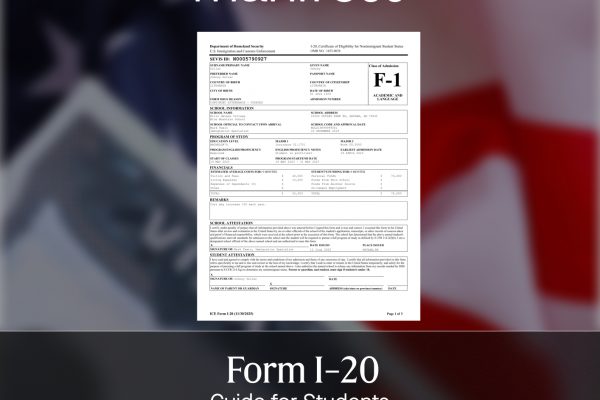
Your Form I-20 is the document your school issued to confirm your F-1 student status. It’s what you used to apply for your visa, and it continues to serve as proof that you’re enrolled and maintaining status while in the U.S.
A travel signature is an endorsement from your designated school official (DSO) on page 2 of the I-20. It confirms that you’re currently in valid F-1 status and are allowed to leave the U.S. and return.
This signature becomes essential when you re-enter the country. At the port of entry, CBP officers will check that your I-20 has a recent, valid travel signature. If the signature is missing or expired, you may face delays at the border or be denied entry.
How long is a travel signature valid?
- If you’re still enrolled in a degree program, a travel signature is valid for up to 12 months from the date it was signed, or until the program end date on your I-20, whichever comes first.
- If you’re on OPT or STEM OPT, a travel signature is valid for six months or until the end date on your EAD card, whichever comes first.
If your travel signature is older than these timeframes, you’ll need to request a new one before traveling.
How to get a travel signature
- Submit a travel signature request via your school’s international student portal or email your DSO.
- Provide required information like your travel dates and proof of enrollment (or employment letter if on OPT/STEM OPT).
- Your DSO signs the I-20 and gives you the updated signed document.
You should let your DSO know you’re planning to travel because leaving the U.S. without notice can create problems with your SEVIS record. It’s uncommon for a DSO to refuse travel, but they can end your record if you disappear from classes without communicating your plans.
What returning students can expect at the port of entry
When you return to the United States, you’ll go through inspection by CBP at the airport or land border, similar to when you first arrived to go to school. CBP officers may ask about your reason for travel, your school, and your academic plans. They’ll also look at your documents, so keep these accessible in your carry-on bag.
If you arrive in the U.S. without the required documents, or if there’s an issue with your SEVIS record, the CBP officer may issue you Form I-515A. This is a temporary document that allows you to enter the U.S. for 30 days, during which you must gather the missing paperwork and submit it to SEVP to keep your F-1 status.
Questions CBP may ask you
- What school do you attend?
- What program or degree are you studying?
- When do your classes resume?
- Are you currently working, or are you on OPT/STEM OPT?
- What was the purpose of your trip?
- Can you show your I-20 and travel signature?
Traveling on an F-1 to Canada, Mexico, or nearby islands
Typically, if your student visa has expired, you cannot re-enter the United States. There’s one crucial exception: automatic visa revalidation. AVR allows F-1 students to return to the U.S. with an expired visa when traveling to Canada, Mexico, or certain adjacent Caribbean islands (excluding Cuba). It works more like a short-term permission to re-enter, not a visa renewal—and the rules are strict.
You may qualify for AVR if all the following are true:
- Your trip was shorter than 30 days.
- You did not apply for a new U.S. visa while abroad.
- You have a valid passport, I-94, and I-20 with a travel signature.
If you meet these criteria, CBP may admit you back into the U.S. even if the F-1 visa in your passport has expired.
Travel during a change of status, reinstatement, or program transfer
Leaving the U.S. while any of these processes are pending can interrupt or even cancel your application, so it’s essential to understand how travel affects each situation.
School or program transfer
You can travel during a transfer, but only if the I-20 you use matches the school that currently controls your SEVIS record.
- Travel before the transfer release date: You must leave and return using your current school’s I-20, and complete the trip before the release date.
- Travel after the transfer release date: You must return using the new school’s I-20 with a valid travel signature.
- If you leave before the release date but return after: Your new school must issue a new Initial I-20 for re-entry.
- If your SEVIS record is terminated: You must enter with a new Initial I-20 from the transfer-in school and arrive no later than 15 days before the program start date.
Reinstatement
If you’re applying for reinstatement after falling out of F-1 status, travelling internationally can automatically end the reinstatement request, and you cannot return using a terminated SEVIS record. Some students choose to leave the U.S. and re-enter using a new Initial I-20, which resets their status, but this option comes with its own complications and should be considered carefully.
Change of status
In general, when changing status, including from F-1 to another visa category, leaving the country before USCIS makes a decision is considered abandonment of the application. You would need to restart the process from outside the U.S. through consular processing. Even a short trip abroad can affect your status. Your DSO will be able to confirm whether travel is safe—or recommend waiting until your paperwork is approved.
| 💡 If you’re navigating a change of status, timing is everything. Leaving the U.S. at the wrong time can void your application or force you to restart the process from scratch. An immigration attorney can help you map out the safest travel strategy and help you with your visa application process. |
Getting legal guidance for F-1 travel
International travel as an F-1 student can feel overwhelming, especially when you’re dealing with pending applications or with OPT. The rules aren’t always intuitive, and a small mistake, like an expired travel signature or a mistimed trip, can put your status at risk.
If you’re unsure whether it’s safe to travel or need help preparing your documents, Manifest Law’s immigration attorneys can guide you through every step. We’ll help you avoid common pitfalls, time your travel correctly, and make sure you have everything you need for a smooth return to the U.S.
Travel should feel exciting, not stressful. If you want clarity before your next trip abroad, our team is here to help.
👉 Request a consultation with Manifest Law’s experienced immigration lawyers now.
F-1 travel visa FAQs
How many countries can I travel to with an F-1 visa?
Your F-1 visa only affects your ability to re-enter the United States. It doesn’t limit where you can travel internationally. The number of countries you can visit depends entirely on your passport (and the fact that the U.S. is currently your country of residence). Always check the entry rules for your destination before traveling.
What is the 5-month rule for F-1 visas?
The five-month rule means your SEVIS record can be terminated if you’ve been out of classes or out of status for more than five consecutive months. This applies if you’ve been outside the U.S. for longer than this time during a break from school (unless you were in an authorized study-abroad program).
What if my I-20 was signed more than 12 months ago?
The travel signature is only valid for a year for F-1 visa students enrolled in a degree program. If you plan to travel, then you need to get a new I-20 with an updated travel signature from your DSO.
Do I need a new visa stamp every time I travel?
No. You only need a new F1 visa if your current one has expired or will expire before you re-enter the United States.
What documents does CBP check?
When you return from international travel as an F-1 student, you will need to present your passport, student visa, Form I-20, and, if required, proof of enrollment or financial support. If you’re doing an OTP, the CBP officer will ask for an EAD and a letter of employment.
What if I am stopped at secondary inspection?
During secondary inspection, CBP may ask additional questions or review your documents more closely. Cooperate with their request so they can verify your status, and provide the number for your DSO if you have it.