

Can Green Card Holders Buy a House?

- Your immigration status does not prevent you from buying a house in the United States.
- Both visa holders and Green Card holders can purchase property, though permanent residents often face fewer financing hurdles.
- Lenders may request proof of lawful presence during mortgage underwriting, but they cannot legally discriminate based on immigration status.
Green Card holders—also known as lawful permanent residents—can buy a house in the United States. Permanent residents have nearly the same property ownership rights as U.S. citizens, and there are generally no federal restrictions on the type of home they can purchase.
That said, while eligibility to buy property isn’t an issue, the process may feel different depending on your financial history, credit profile, or residency timeline—especially when it comes to financing.
Does buying a home affect your immigration status?
Buying property does not affect immigration status. It does not impact Green Card renewals or naturalization eligibility. Similarly, owning a home does not grant permanent residency to foreign nationals in the United States. To become a permanent resident, you typically need to go through family sponsorship, employer sponsorship, or humanitarian protection (like being a refugee).
If you’re curious about becoming a permanent resident or understanding your long-term immigration options, an immigration attorney can explain eligibility, potential timelines, and next steps based on your situation.
| 📘Green Card holder vs. visa holder: A permanent resident is someone who holds a Green Card and has the right to live and work in the U.S. indefinitely. A non-permanent resident typically holds a visa that allows them to temporarily work or study in the U.S., as with an H-1B, L-1, or F-1 visa. |
Getting a mortgage as a permanent vs. non-permanent resident
The biggest hurdle for both Green Card holders and non-permanent residents during the homebuying process is often financing. When you apply for a mortgage, the lender wants to be confident that you can pay back the loan in full. They’ll closely review your income, employment history, credit score, and overall financial stability.
This scrutiny during underwriting tends to be more intense if you have a limited U.S. credit history or a time-limited work authorization. For this reason, some foreign nationals choose to buy property with cash instead of a loan. According to the National Association of Realtors, 47% of foreign buyers (a group that includes permanent residents and those with non-immigrant visas) paid all cash for real estate purchases, compared to 28% of existing home buyers overall.
That said, having a Green Card or even a nonimmigrant visa does not automatically disqualify you from getting a mortgage. Lenders cannot deny a loan based solely on your citizenship status; they can only consider your status as far as it affects your ability to repay the loan.
Subscribe to our newsletter for immigration resources and news, without the legal jargon.
What types of loans can Green Card holders get?
Green Card holders generally qualify for the same types of mortgage as U.S. citizens, including government-backed options like FHA loans. These loans often come with lower down payment requirements and more flexible qualification standards.
Nonimmigrant visa holders, by contrast, usually do not qualify for FHA or similar government-backed loans. They may face higher down payment requirements, stricter underwriting, or more limited loan options overall.
Using non-U.S. income
If your U.S.-based income isn’t enough to qualify for a loan, lenders may allow you to use foreign income, as long as it can be documented and verified. If you don’t yet have a U.S. credit history, lenders may accept alternative credit evidence, such as rent payment records or international credit reports (ICRs).
| Regulatory note: Recent statements and actions by the U.S. Department of Justice (DOJ) and the Consumer Financial Protection Bureau (CFPB) have reinforced that lenders should not engage in aggressive or discriminatory practices based solely on immigration or citizenship status. |
What documents do Green Card holders need to buy a house?
The following lists of documents are typical for the homebuying process, though you may need additional documents based on your situation. If you are using any foreign documents, make sure they have been translated into English.
Proof of identity and lawful permanent residence:
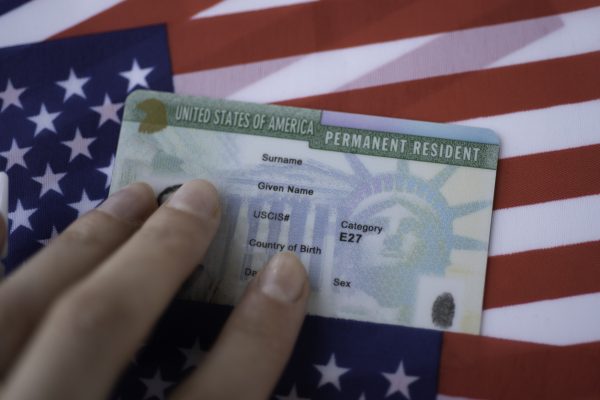
- Green Card or I-551 stamp
- Social Security Number (SSN) or Individual Taxpayer Identification Number (ITIN)
Proof of income and employment:
- Employment verification letter
- Recent pay stubs
- W-2 forms or 1099 forms
Tax and financial records
- Federal tax returns (typically the last two years)
- Bank statements showing savings and assets
Credit and debt information
- Credit reports
- Bank statements
- Documentation of any large or recent deposits
Property-related documents
- Offer letter or purchase agreement
- Appraisal letter
- Inspection report
Does the type of Green Card or visa you have matter when buying a house?
From a property ownership standpoint, there is no difference between a standard Green Card and a conditional two-year Green Card. Both give you the legal right to buy and own real estate in the U.S.
However, having a conditional Green Card could matter more to specific lenders, since it expires sooner than a standard Green Card. This is particularly true if you are close to the end of the two-year period and have not yet filed to remove conditions. This doesn’t prevent you from buying a home, but it may affect the type of mortgage you qualify for or the documentation that a mortgage lender requests.
How to buy a house with a Green Card
The home-buying process for Green Card holders looks very similar to that for U.S. citizens, but there are a few points where immigration status may come up—mainly during financing and identity verification.
1. Assess your finances
Take time to understand what you can realistically afford. This means reviewing your income, savings, credit, and monthly expenses so you know both your target price range and how much you’ll need upfront. One of the biggest costs to plan for is the down payment, which is the portion of the purchase price you pay upfront.
2. Get preapproved, if you’re applying for a mortgage
A lender will evaluate your finances and immigration status to determine how much you can borrow. Preapproval helps you understand your budget and shows sellers you’re a serious buyer. In some competitive markets, it’s also required before you’re allowed to see any homes.
To get a preapproval, you’ll typically need to show your Green Card, proof of income, and tax records.
3. Find a local real estate agent
A licensed real estate agent can help you navigate the local market, schedule viewings, and negotiate on your behalf. While immigration status doesn’t affect this step, an experienced agent should be able to help with both international and first-time buyers. Don’t be afraid to ask about an agent’s experience before agreeing to work with them.
4. Go house hunting
Begin touring homes within your price range. Most people need to look at a few houses before they find their dream home.
5. Make an offer and negotiate
Your agent will help you submit an offer and get it accepted. In addition to negotiating the price, they can help you understand the pros and cons of any contingencies that you or the seller wish to put in place.
Immigration status does not affect your ability to make or accept an offer, but timelines may depend on how quickly your lender can finalize underwriting.
6. Get an appraisal and inspection
Once your offer has been accepted, your agent will help you schedule inspections and an appraisal. The appraisal is particularly important as it determines the fair market value of the home you’re buying and helps the lender confirm that the purchase price is reasonable. (If the appraisal comes in lower than the agreed-upon price, you may need to renegotiate with the seller or make up the difference out of pocket.)
7. Navigate the closing process
During this period, you’ll finalize your mortgage, building on the loan you were preapproved for. Your lender may request updated financial documents and will complete underwriting before issuing final approval.
The day of closing, you’ll sign the final loan and property documents. You’ll also pay closing costs, which typically include lender fees, title insurance, and taxes. You may be asked to present your Green Card again for identity verification and compliance purposes.
Once everything is signed and recorded, ownership transfers to you—and you officially own the home, just like a U.S. citizen would.
FAQs about buying a house on a Green Card
Can you buy a house with an expired Green Card?
Yes, since an expired Green Card does not change your permanent resident status (unless it’s an expired conditional Green Card). If you’re concerned about this, you can file Form I-90 to renew your Green Card.
What types of property can Green Card holders buy?
Green Card holders can generally purchase any type of property, including a primary residence, vacation home, condo, apartment, or land. There are usually no restrictions based on immigration status.
Can I buy a house without a Green Card?
Yes. Non-citizens, including visa holders and foreign nationals without a Green Card, can purchase property in the U.S. Getting a mortgage in the U.S. may be more challenging, and lenders often require larger down payments, additional documentation, or proof of income and residency status.
Does buying a house help you get U.S. Citizenship?
No. Owning property does not affect your Green Card, immigration status, or eligibility for naturalization, but it can show good moral character and ties to the U.S.
Can I buy a house in the U.S. while living abroad?
Yes, but financing can be more complex. Lenders may request additional documentation, higher reserves, or proof of intended use as a primary or secondary residence.