Key Takeaways
- The H-1B is an employer-sponsored, nonimmigrant visa for specialty occupations that typically require at least a bachelor’s degree.
- Most H-1B jobs are subject to an annual cap of 85,000 visas, allocated through a lottery that now weights selection by wage level.
- The H-1B path includes registration, selection, an LCA, a Form I-129 petition, and (for many applicants) consular processing.
- Employers cover most filing fees, but a separate $100,000 payment now applies to employers filing certain H-1B petitions for workers abroad.
The H-1B visa is the most common employment visa for skilled foreign workers and a well-traveled path toward a Green Card. But it’s also competitive, time-sensitive, and increasingly expensive, with major changes to the lottery conducted in 2026.
What is the H-1B visa?
The H-1B is a nonimmigrant work visa that lets U.S. employers hire foreign workers in specialty occupations, or jobs that require specialized knowledge and at least a bachelor’s degree (or equivalent) in a specific field. Common H-1B roles include software engineers, data scientists, civil engineers, accountants, physicians, and researchers.
Because the H-1B is a nonimmigrant visa, it’s intended to be temporary. Initial status is granted for up to three years, with a possible extension to six total years. The H-1B allows a worker to have dual intent, meaning they can pursue becoming a lawful permanent resident while in H-1B status without jeopardizing their visa.
Get the latest H-1B news. H-1B rules and policies are changing fast. Manifest’s immigration news page gives you real-time updates on lottery results, fee litigation, and USCIS guidance.
Who qualifies for an H-1B?
The H-1B has a relatively short list of eligibility requirements, but each one matters. Both you and your employer have to meet specific criteria.
Subscribe to our newsletter.
*By clicking Submit and subscribing to our newsletter, you agree to the Manifest Terms and Privacy Policy.
H-1B visa requirements
- A qualifying job offer: A U.S. employer must offer you a specialty occupation role that normally requires a bachelor's degree.
- A bachelor’s degree or equivalent: You must hold a U.S. bachelor’s degree (or higher) in a field directly related to the job, or the foreign equivalent, or a combination of education and progressive work experience that adds up to a bachelor's.
- Specialized knowledge: Your education and experience must directly relate to the job duties.
- Any required licenses: If the role requires a state or local license to practice (for example, a medical license), you must have it before U.S. Citizenship and Immigration Services (USCIS) will approve your visa petition.
- Employer sponsorship: Your employer must agree to file the H-1B petition and pay the required fees.
- A certified Labor Condition Application (LCA): Before filing the petition, your employer must obtain LCA certification from the Department of Labor confirming that you’ll be paid the prevailing wage and that your employment won't harm U.S. workers.
Unpaid roles, fellowships, and most contract or third-party placements without clear employer control don’t typically qualify.
The Department of Labor has proposed raising the minimum wage, or the prevailing wage, for foreign workers. See Manifest’s analysis to learn how that may affect H-1B wage levels.
How does the H-1B visa lottery work?
There are far more H-1B candidates than visas each year, so USCIS uses a lottery to decide who can move forward with a visa application.
Final selection in the lottery is random, but registrants with higher wages get more lottery entries. Starting with FY 2027, under a DHS final rule that took effect Feb. 27, 2026, each registration receives entries based on its Department of Labor wage level: Level I gets 1 entry, Level II gets 2, Level III gets 3, and Level IV gets 4. Wage levels reflect how a worker’s offered salary compares to others doing similar work in the same area. Higher-wage roles don’t guarantee selection, but they do give better odds.
Annual limits on H-1B visas: Congress caps new H-1B visas at 65,000 per year, plus an additional 20,000 reserved for those who hold an advanced degree of a U.S. master’s degree or higher. That brings a total of 85,000 cap-subject visas per fiscal year.
H-1B lottery timeline
Here’s the basic timeline for the FY 2027 H-1B lottery:
- March 4–19, 2026: Initial lottery registration window
- March 31, 2026: USCIS notifies selected registrants
- April 1–June 30, 2026: 90-day petition filing window
- Oct. 1, 2026: Earliest H-1B employment start date
Note that the U.S. government’s fiscal year is different from a calendar year. The U.S. government’s fiscal year runs from October 1 through September 30. So a worker selected in the spring 2026 lottery is being chosen for FY 2027, with employment authorized to start no earlier than October 1, 2026.
And if you’re an F-1 student trying to bridge OPT into October, the H-1B cap-gap extension may keep your status intact.
How the H-1B lottery changed in 2026: The FY 2027 cycle is the first to use wage-weighted selection. Read our breakdown of the FY 2027 H-1B key dates and new rules to see how it could affect your odds.
Which jobs are exempt from the H-1B lottery?
Some H-1B jobs are cap-exempt, meaning they don’t count against the 85,000 annual cap and don’t require a lottery to select who may submit a petition. A cap-exempt H-1B has the same eligibility criteria, but cap-exempt employers can file H-1B petitions at any point in the year.
Cap-exempt employers generally include:
- Institutions of higher education (most accredited colleges and universities)
- Nonprofit organizations affiliated with those institutions
- Nonprofit research organizations
- Governmental research organizations
If you’re working for a cap-exempt employer and want to move to a cap-subject employer, you’ll have to enter the lottery.
How do you get an H-1B visa?
For lottery-subject applicants, the H-1B path is essentially a sequence of steps that runs from late winter through fall. It looks like this:
- Register for the lottery. Your employer creates a USCIS organizational account and submits a registration for each beneficiary, paying a $215 fee per registration during the March window.
- Wait for selection. USCIS announces lottery selections through the employer’s online account, typically by March 31.
- File the LCA. If selected, your employer files a Labor Condition Application with the Department of Labor, certifying wage and working-condition commitments. Certification typically takes about seven business days.
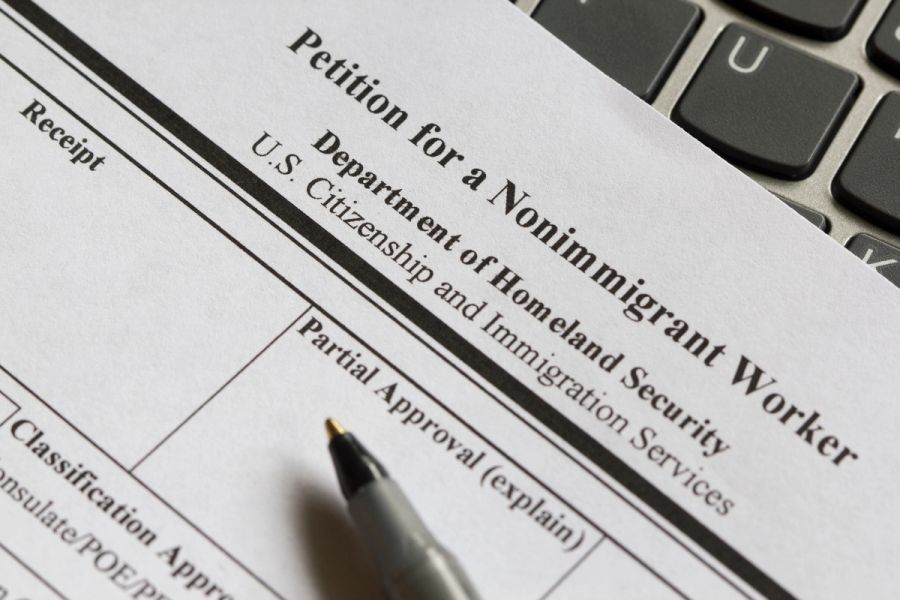
- File Form I-129. Once the LCA is certified, your employer submits Form I-129, Petition for a Nonimmigrant Worker, with supporting documents (offer letter, degree credentials, position description, and proof of specialty occupation).
- Respond to any RFEs. USCIS may issue a Request for Evidence if it needs more documentation. Petitioners typically have up to 12 weeks to respond.
- Adjust status or process at a consulate. If you’re already in the U.S. on another valid status, the petition can request a change of status. If you’re abroad, you’ll go through H-1B consular processing at a U.S. embassy. Some applicants in the U.S. now have access to domestic visa stamping for renewals.
- Start work on or after Oct. 1. Once approved, you can begin working on your H-1B start date or October 1 of the new fiscal year, whichever is later.
For a walkthrough of what happens after selection, see our guide to the steps after H-1B lottery selection.
What are H-1B visa approval rates?
The H-1B lottery is the biggest hurdle, with selection rates around 30% in recent years. The approval rate for the H-1B petition has been about 98% recently.
- H-1B lottery selection rate: In recent fully random cycles, the average selection rate hovered around 30%. Manifest’s analysis of our FY 2027 H-1B lottery selection results suggests Level III and Level IV registrations were selected at roughly 2.5x–2.8x the rate of Level I under the new weighted system.
- H-1 petition approval rate: Once a petition is filed, the H-1B approval rate has been very high, coming in at 97.9% for Fiscal Year 2025.
For historical context on selection rates, you can also browse our H-1B lottery history and data.
How many H-1B visa holders are there? Manifest’s analysis of the U.S. cities and industries with the most H-1B employees shows where H-1B workers live and which sectors hire them most. Spoiler: Tech and professional services lead the way.
How long does it take to get an H-1B visa?
From registration to petition approval, getting an H-1B visa can take about a year, but it depends on case type and whether you go through consular processing.
Here’s a typical timeline:
- Registration and selection: March (registration) through late March (results)
- LCA certification: about 7 business days
- Form I-129 standard processing: typically 10 to 11.5 months
- Form I-129 with premium processing: 15 business days, for an additional fee
- Consular processing (if abroad): weeks to months, depending on the embassy
Premium processing speeds up USCIS review but does not improve approval odds.
How much does it cost to get an H-1B visa?
Employers generally cover H-1B costs, including the $215 registration fee, the LCA filing, the Form I-129 base fee, an anti-fraud fee, and (where applicable) the American Competitiveness and Workforce Improvement Act (ACWIA) training fee. Standard Form I-129 filing fees start around $460 and vary by employer size and petition type. Premium processing, when used, costs $2,965.
Applicants typically pay only personal costs, such as visa application (DS-160) fees if processing abroad, travel to a consulate, and any optional fees they choose to cover. Many employers allow workers to pay for premium processing personally if they want a faster review.
Who has to pay $100,000 for an H-1B visa?
In September 2025, President Trump signed a proclamation imposing a $100,000 fee on certain H-1B petitions filed on or after Sept. 21, 2025. According to USCIS, the fee generally applies to new H-1B petitions filed for beneficiaries who are outside the United States and don’t have a valid H-1B visa, as well as petitions requesting consular notification.
(Note: A judge has struck down the $100,000 fee, but it remains in effect while the government appeals the ruling.)
The fee does not apply to currently valid H-1B visas or petitions filed before Sept. 21, 2025. It also doesn’t apply to workers who are already inside the U.S. and petition for a change of status, amendment, or extension.
The fee is being challenged in federal court, so policy could shift again. See our full breakdown of the $100,000 fee for current details.
What are the alternatives to an H-1B visa?
If you’re not selected in the lottery, or you simply don’t fit the H-1B profile, there are several other visa categories you can explore. Here are the most common alternatives:
- J-1 visa: A nonimmigrant exchange visitor visa often used by trainees, researchers, physicians, and scholars
- L-1 visa: For employees of multinational companies transferring from a foreign office to a U.S. office, including managers, executives, and employees with specialized knowledge
- O-1 visa: For individuals with extraordinary ability in their field—the eligibility bar is high—there’s no lottery, no annual cap, and it’s renewable indefinitely
- TN visa: For Canadian and Mexican citizens in qualifying professional roles under the USMCA, there’s no lottery and it’s relatively quick to get
For a more detailed comparison, including country-specific options like the E-3 (Australia) and H-1B1 (Chile and Singapore), see our guide to H-1B visa alternatives.
Start your H-1B journey with confidence
The H-1B is still a reliable way for employers to hire highly skilled foreign professionals. Plus, for many workers, it’s a viable route to long-term U.S. employment. But the lottery has changed, the costs have shifted, and small mistakes at the registration stage can cost a year. Working with experienced immigration counsel can help you build a stronger case from the start.
👉 Request a consultation with Manifest Law to talk through your options with one of our H-1B attorneys.
FAQs about H-1B visas
Can an H-1B spouse work?
Sometimes. Spouses and unmarried children under 21 of H-1B workers may apply for H-4 dependent visas. Certain H-4 spouses, such as those whose H-1B partner has an approved Form I-140 or has been granted an H-1B extension beyond six years under AC21, can apply for an Employment Authorization Document (EAD) and work in the U.S.
How long does an H-1B visa last?
An initial H-1B is typically valid for up to three years and can be extended once for a total of six years. Workers with a pending or approved employment-based Green Card may qualify for additional extensions beyond six years under the American Competitiveness in the 21st Century Act (AC21).
Can you change jobs on an H-1B?
Yes. H-1B portability rules let you start working for a new employer once they file a valid H-1B transfer petition (Form I-129) on your behalf. You generally don’t have to wait for final USCIS approval. You can also work for two employers at once through a concurrent H-1B filing, or update your existing petition through an H-1B amendment if your job duties, location, or wage materially change. If you’re laid off between jobs, the H-1B grace period generally gives you up to 60 days (or until your I-94 expires, whichever is shorter) to find a new sponsor.
Is there a minimum salary for an H-1B visa?
There’s no flat minimum salary, but employers must pay the prevailing wage for the role and area, as set by the U.S. Department of Labor (DOL). Wage levels also now affect lottery odds, so the salary you’re offered matters more than ever.
Does an H-1B lead to a Green Card?
The H-1B allows dual intent, so many workers pursue lawful permanent residence through employment-based categories. The most common options are the EB-2 and EB-3. Our H-1B to Green Card guide walks through the path step by step.
How soon can you apply for a Green Card from an H-1B?
There’s no fixed waiting period. The timing depends on your category, your employer’s plans, and Visa Bulletin movement. See our breakdown of how soon you can apply for a Green Card after an H-1B for a realistic timeline.
About the Author

Reviewed By

Immigration Lawyer to Manifest Law
Ana Gabriela Urizar is an award-winning immigration attorney licensed in Arizona and New York. With nearly a decade of experience, she advises global corporations on complex U.S. immigration matters. Originally from Guatemala, Ana Gabriela previously spent close to ten years at the world’s largest immigration firm, managing business immigration matters for leading technology, science, and financial companies. She has been recognized by Best Lawyers: Ones to Watch (2027) and Negocios Now’s Tri-State 40 Under 40.
Read bioShare this article: