





- The H-1B visa allows you to legally pursue a Green Card, while the TN visa requires you to maintain an intent to return home.
- The TN visa is not subject to an annual cap or lottery, potentially offering a more predictable route to U.S. employment.
- The H-1B is open to all nationalities in a specialty occupation, while the TN is exclusively for citizens of Canada or Mexico in one of 62 specific professions.
The TN (treaty national) and H-1B (specialty occupation) are both temporary work visas for skilled foreign nationals. The TN visa is exclusive to Canadian and Mexican citizens and allows entry into the U.S. for specific professions. There’s no annual cap, but you have to maintain an intent to return home.
The H-1B visa is available to professionals from any country. It’s subject to an annual lottery and allows you to maintain status while seeking permanent residency.
| 🧑⚖️Clear guidance, without the legal jargon. This article is informed and reviewed by Manifest Law’s experienced immigration attorneys—and written to make the law make sense. Because you deserve to understand the system, not fight it. Check out our editorial policy for more info. |
Overview of TN and H-1B visas
The TN and H-1B are both temporary work visas, but they have distinct eligibility criteria and pathways to permanent residency.
Subscribe to our newsletter for immigration resources and news, without the legal jargon.
TN visa
The TN nonimmigrant classification was established under the North American Free Trade Agreement (NAFTA) and is now governed by the United States-Mexico-Canada Agreement (USMCA). This classification is exclusively available to citizens of Canada and Mexico. It allows them to work temporarily in the U.S. in one of 62 specific professional occupations. The roles include accountants, engineers, computer systems analysts, and scientists.
Mexicans must get a TN visa at a U.S. consulate or embassy, while Canadians can also apply at a U.S. port of entry. You must have a job offer to work in one of the listed fields.
H-1B visa
The H-1B visa is open to nationals of any country and is intended for nonimmigrants working in a specialty occupation. That means the position involves the theoretical and practical application of a body of highly specialized knowledge and requires, at minimum, a bachelor’s degree or its equivalent.
The H-1B is subject to an annual cap and lottery system. Unlike the TN visa, the H-1B allows for dual intent, meaning you can pursue permanent residency while on the H-1B.
Key differences between TN and H-1B visas
TN and H-1B visas are designed for different pools of workers and have different purposes. One of the most critical distinctions is that the TN visa requires you to maintain an intent to leave the U.S., while the H-1B visa permits dual intent.
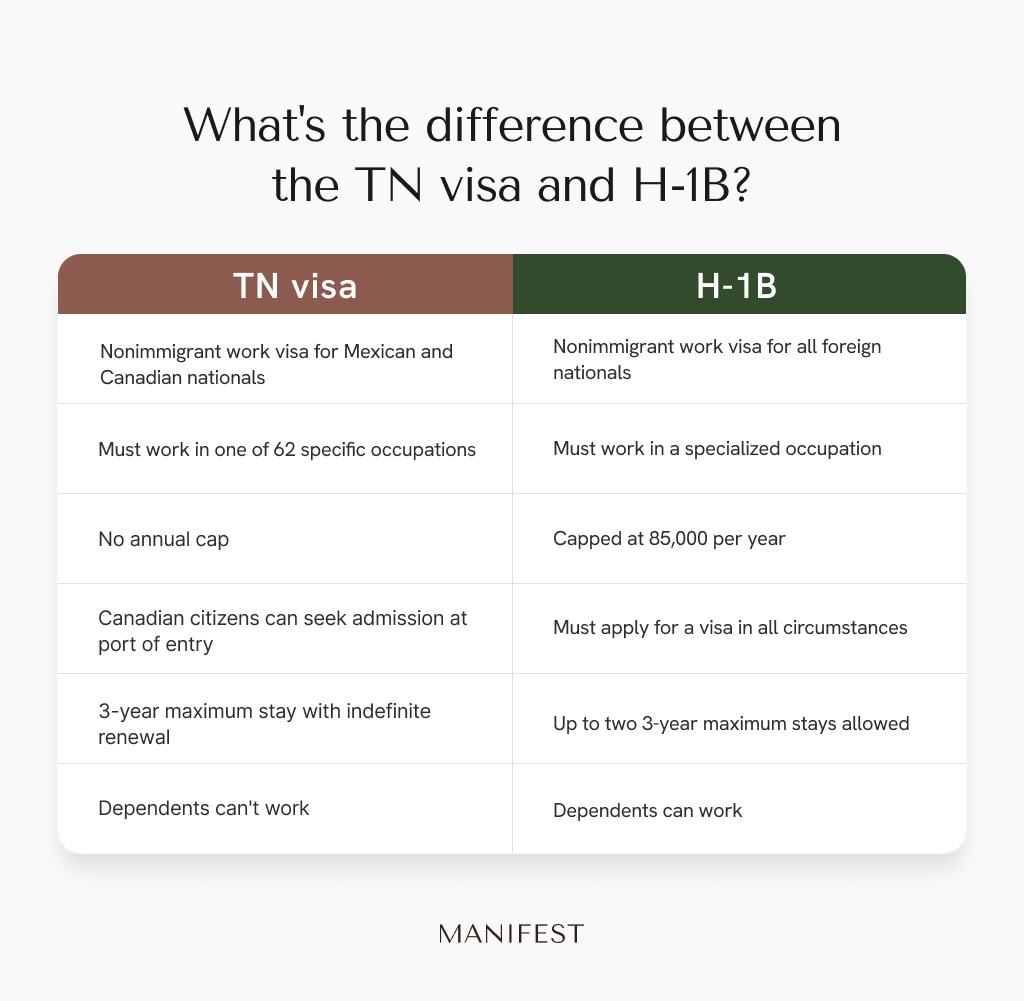
Occupations and eligibility
The TN visa is limited exclusively to Canadian and Mexican citizens who qualify for one of the 62 professions listed in the USMCA. The H-1B is available to nationals of any country working in a specialty occupation, which can encompass many roles, as long as they require the equivalent of a bachelor’s degree and the application of specialized knowledge.
| 🧑💼 Curious how others in your field made it work? Manifest Law’s experienced attorneys have helped thousands of immigrants secure their future in the U.S. Explore our visa approval notices and success stories to learn how we helped founders, researchers, and artists like you turn their stories into winning petitions. |
Cap and lottery
The H-1B program is capped at 85,000 new visas (a regular cap of 65,000 plus a cap of 20,000 for those with an advanced degree) annually and your application must be selected by a random lottery before your employer can file a petition. The TN visa has no annual cap or lottery, making the process more straightforward for qualified applicants.
Learn more about the H-1B lottery for 2026.
Duration and renewability
The TN visa is granted for an initial period of up to three years and can be renewed indefinitely, as long as you continue to demonstrate an intent to return home.
The H-1B visa is also granted for an initial period of three years, but it can be extended up to a maximum of six years. Extensions beyond that are possible, but typically only if you’ve received an approval for an immigrant visa petition and are waiting for a Green Card.
Dependent work authorization
Family members of TN visa holders (TD dependents) are not permitted to work in the U.S., but they can attend school. Conversely, certain family members of H-1B holders (H-4 dependents) are eligible to apply for an Employment Authorization Document, which permits them to work in the U.S., as long as the H-1B worker meets certain criteria, such as having an approved I-140 immigrant petition. They can also attend school.
Learn more about the H-4 EAD, including H-4 EAD processing times.
Costs
The TN visa can be inexpensive, especially for Canadian citizens: If you’re applying at a U.S. port of entry or pre-flight inspection facility, the application fee can be as little as $50 USD $, paid directly by the applicant. Mexican citizens will have to pay a little more: $185 for a visa interview, a minimum of $79 for a visa reciprocity fee, and $50 at the border. Both nationalities will also need to pay a $24 fee for Form I-94.
When applying via USCIS for a change of status or extension (Form I-129), the filing fee starts at $1,015.
Conversely, the H-1B visa filing fees can exceed $5,000, comprising the filing fee, American Competitiveness and Workforce Improvement Act (ACWIA) fee, and Fraud Prevention and Detection Fee. The employer may choose to pay an additional $2,965 for premium processing. In addition, H-1B petitions filed after Sept. 21 are subject to an additional $100,000 fee.
TN vs. H-1B summary
| TN | H-1B | |
| Eligibility | Citizens of Canada and Mexico | Nationals of virtually any country |
| Occupations | Must fit one of 62 listed professions | Must be working a specialty occupation |
| Annual limit | No annual cap or lottery | Subject to an annual cap of 85,000 and lottery |
| Immigrant intent | Requires intent to return to original country | Allows for pursuit of Green Card |
| Maximum duration | Indefinite renewals in 3-year increments | Limited to 6 years, with exceptions while Green Card petition is processing |
| Dependent work | No: TD dependents can’t work | Yes, for eligible H-4 spouses |
| Cost | As little as $50 to $338, depending on your nationality | Potentially over $100,000 |
Eligibility and professional requirements for H1-B vs. TN visas
The H-1B and TN nonimmigrant visas both allow professional foreign nationals to work temporarily in the U.S. but they differ in their citizenship requirements, paths to permanent residence, and the types of jobs you’re allowed to do.
TN visa requirements
Citizenship: Applicants must be Canadian or Mexican citizens.
Professions: Must be on a specific list of about 60 professions defined by the USMCA. This list includes roles like accountant, engineer, scientist, and management consultant.
Qualifications: You must possess the minimum qualifications for the listed profession, typically a bachelor’s degree or other credentials.
Sponsorship: A U.S. job offer is required, but the employer doesn’t need to go through a formal sponsorship process with U.S. Citizenship and Immigration Services (USCIS), as is required with H-1B.
Intent to return: The TN visa requires nonimmigrant intent. You must show that your stay is temporary and you have no immediate intention of pursuing permanent residence.
H-1B visa requirements
Specialty occupation: Your job must qualify as a specialty occupation. This means it requires the theoretical and practical application of a body of highly specialized knowledge and that the minimum requirement for the position is a bachelor’s degree or its equivalent in a specific field.
Education: To qualify to work the specialty occupation, you as the applicant must have the required degree, or its equivalent in experience.
Sponsorship: The H-1B process is employer-sponsored. A U.S. employer must petition USCIS on behalf of the prospective employee. Before filing the petition, the employer must submit and receive certification for a Labor Condition Application (LCA) from the Department of Labor. The LCA is a certification that the employer will pay the foreign worker at least the prevailing wage for that occupation, and that their employment won’t adversely affect the working conditions of similarly employed U.S. workers.
Dual intent: Unlike the TN visa, the H-1B visa permits dual intent. The H-1B holder can legally enter the U.S. temporarily while simultaneously seeking a Green Card, without violating their visa status.
TN vs. H-1B visa durations and extension restrictions
The H-1B allows for dual intent, while the TN requires you to maintain nonimmigrant intent. However, the TN can be renewed indefinitely.
TN visa duration and extensions
The TN visa is purely for temporary entry. An initial period of admission is up to three years.
There is no limit on the number of years you can hold TN status. You can receive extensions indefinitely in three-year increments as long as you continue to meet all the eligibility requirements, including demonstration of nonimmigrant intent. Your employment must be temporary and you must plan to return home. Because of this, filing for a Green Card could jeopardize future TN renewals.
H-1B visa duration and extensions
The H-1B is a temporary work visa with a defined maximum stay. The initial period of admission is for up to three years and can be extended up to a total period of six years. Once you reach this limit, you must leave the U.S. or change to a different visa status.
The H-1B permits extensions beyond the six-year limit under some exceptions tied to the permanent residency process:
- Extensions up to one year are available if at least 365 days have passed since an employer filed an LCA or an immigrant visa petition on your behalf.
- Extensions up to three years are available if you’re the beneficiary of an approved immigrant visa petition under the EB-1, EB-2, or EB-3 classifications but you can’t receive a Green Card one is not available to you yet, per the Visa Bulletin.
These extensions continue until the Green Card process reaches a final decision.
Note: If you’re applying for an H-1B and possess more than 50% ownership in the petitioning organization, your initial approval and first extension may each be limited to 18 months.
Start your journey with confidence
The choice between a TN and H-1B visa for Canadian and Mexican professionals hinges on your long-term goals. The TN visa may cost less and, with no cap, might be a more reliable way to start working in the U.S. The H-1B is subject to a cap and lottery. However, it allows you to maintain dual intent, providing a path to permanent residency.
👉 If you want the best advice on either path, our immigration attorneys are here to help. Request a consultation with Manifest Law now.
Frequently asked questions
Can I change employers on an H-1B or TN visa?
Yes, you can change employers, but the process differs. The H-1B lets you start the new job immediately once your new employer files a petition for a nonimmigrant worker and an LCA on your behalf. Also, your status is maintained for a 60-day grace period if you get laid off.
For the TN visa, you must file a new I-129 and wait for approval before starting work. Alternatively, Canadian citizens who want to change or add a U.S. employer can leave the U.S. and apply for readmission at a port of entry.
Can I transition from a TN to an H-1B visa?
Yes, and this transition can be a key step toward permanent residency since the H-1B allows for dual intent. You have to meet the speciality occupation requirements and a U.S. employer must petition on your behalf. If you are subject to the annual cap, you must be selected in the H-1B lottery before you can successfully change status.
Can TN or H-1B dependents work in the U.S.?
TN dependents (TD status) can’t work, but can attend school. H-1B dependents (H-4 status) are eligible to work in certain situations. They can apply for an Employment Authorization Document if the H-1B worker has an approved Form I-140 immigrant petition or has received an H-1B extension beyond six years while they’re seeking a Green Card.