

F-1 Visa Interview: 2025 Guide

- Prepare thoroughly for common interview topics, such as academic intent and ties to your home country.
- Answer confidently and truthfully while keeping your responses aligned with the requirements of a nonimmigrant student visa.
- Bringing all the required documents, plus supplemental materials like transcripts and bank statements to support your case.
- Expect a short but important interview, where officers verify that you qualify for an F-1 visa
For many international students, the visa interview remains the final step in their F-1 application process. To verify that you qualify for an F-1 student visa, a consular officer will ask about your intent and ability to study in the U.S. And since most decisions are made after this step, acing the interview should be your utmost priority.
Common F-1 visa interview questions
Immigration officers do not follow any official script or questionnaire when conducting an F-1 visa interview, but they will ask several questions in order to assess whether they can approve your F-1 petition. Because of that, it can be useful to know what to expect during your appointment.
Subscribe to our newsletter for immigration resources and news, without the legal jargon.
Below are some questions you might hear:
Academic intent
- What are you planning on studying in the U.S.?
- Why do you want to study in the U.S.?
- Where will your academic studies take place?
Previous academic achievements
- Can you share your high school and/or college transcripts?
- What is your TOEFL score/English proficiency?
- Please share some of your recent test scores.
Financial stability
- How do you plan to pay for tuition?
- Do you have a sponsor paying for any of your educational expenses?
- Are you planning on working while studying in the U.S.?
Intent to return to your home country
- Do you plan to work in the U.S. after graduation?
- Do you have any family members in the U.S.?
- Will you return to your home country after your studies are completed?
How to answer F-1 visa interview questions
Ana Gabriela Urizar, immigration attorney at Manifest Law, says that international students closely review all details related to their student visa application. “You should be prepared to talk about your academic goals, finances, and post-graduation plans,” Urizar says. “Know how studying in the U.S. fits your future goals.”
During the actual interview, answer honestly and with confidence. While it may be nerve-racking to sit in front of a consular officer, remember that they are not there to trick you. You’ve done the majority of the hard work required to get accepted into an academic institution and apply for a F-1 student visa. All that remains is confirming that you qualify for it.
| 🪪 Transferring from an H-1B to an F-1 visa? Read our guide on this specific change of status, and who can best benefit from it. |
What not to say in an F-1 visa interview
Ana Gabriela Urizar, immigration attorney at Manifest Law, recommends that applicants answer questions honestly and in line with their F-1 visa category. “Remember that the F-1 is a nonimmigrant visa,” Urizar says. “If an immigration officer believes your intentions don’t match the student visa requirements, they may deny your case.”
That means you should avoid talking about living or working permanently in the U.S. — even if they’re just plans on the horizon. Any answers that contradict the strict requirements of an F-1 visa could result in your case being denied.
What to expect at your F-1 interview
After you’ve scheduled your F-1 visa interview, you’ll need to prepare for your appointment in several ways. This includes gathering the right documents, choosing appropriate attire, and knowing what to expect during the interview.
Documents you’ll need to bring
Prior to your appointment, the U.S. Department of State states that you must bring:
- A valid passport
- A confirmation page for Form DS-160
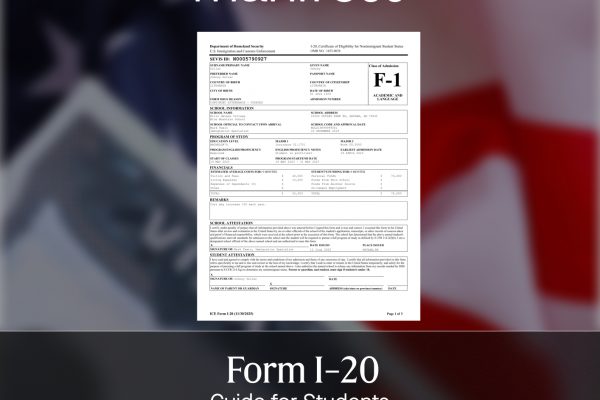
- Form I-20, a certificate of eligibility from your school
- Receipt for your application fee
- A valid photograph, if you could not upload it online
In addition, you may want to bring copies of:
- Academic transcripts and diplomas
- Standardized test results required by your academic institution, such as GRE or TOEFL scores
- Bank statements
While not all these documents are necessary, having them on hand can be crucial if an immigration officer requests them.
What to wear to your F-1 visa interview
There’s no formal dress code for an F-1 visa interview. Still, you should try to wear professional attire to your appointment. Given that visa interviews are formal events, you’ll want to dress appropriately and make a good first impression with your consular officer.
What to expect during the actual visa interview
Once you arrive at your respective U.S. embassy or consulate, you’ll need to check in prior to your appointment start time. At some branches, the check-in process can be rigorous — in fact, popular items like laptops and cell phones are often not allowed. Because of that, plan to arrive at your appointment early.
After checking in, you’ll meet with a consular officer who will ask you questions related to your F-1 application. Most interviews only take a few minutes, but they may take longer if an official has questions or concerns about your application. At some embassies or consular offices, you may also have to submit fingerprint scans as part of your appointment.
After the interview, the consular officer will decide if your case should be approved or denied, or if it needs additional administrative processing. Some people are told their results immediately after the interview, while others have to wait until they receive a notice.
| ⚠️ Important: As of July 2025, some countries are experiencing limited validity for various visa categories, including the F-1. Read our guide to see if you’re affected. |
Preparing for your F-1 visa interview? Our team of immigration attorneys can walk you through what to expect and how to best prepare for your appointment. Request a consultation to learn more.
F-1 visa interview FAQs
How can I prepare answers for an F-1 visa interview?
Ana Gabriela Urizar, immigration attorney at Manifest Law, says you should review details about your school and case closely. “Immigration officers are not there to trick you,” she says, stressing that they’re only there to verify information about your case and clear up any questions they may have.
Can I be exempt from the F-1 visa interview?
As of February 18, 2025, most people cannot be exempt from the F-1 interview.
Before this change, many international students did not have to attend a visa interview. As a response to the COVID-19 pandemic, the U.S. Department of State allowed consular officers to waive the interview requirement for many nonimmigrant visas.
That policy is no longer in effect. If you’re requesting an F-1 visa, you must go through an interview unless you qualify for an exemption.
How long does the interview last?
Most F-1 visa interviews only take a few minutes to complete. However, an immigration officer may take longer if they have any questions or doubts about your case.
What English level is acceptable?
The State Department itself does not outline any English level requirements, but many American institutions do. These requirements vary across universities but generally require an advanced or fluent score for acceptance.
For the actual visa interview, you don’t need perfect English-speaking skills. However, being able to clearly and confidently answer questions from an immigration officer will help your case.
Will they ask about my GPA?
Yes, an immigration officer may ask about your GPA. If you attended an academic institution that didn’t have a GPA system, they can request your academic transcripts or grades instead.