Key Takeaways
- Citizenship is a legal status, while naturalization is the application-based process many immigrants use to obtain that status.
- You may already be a U.S. citizen through birth or a parent—only those who don’t qualify automatically need to naturalize.
- Naturalization requires meeting residency, testing, and eligibility rules, but once approved, naturalized citizens receive nearly identical rights and protections as birthright citizens.
If you're researching how to become a U.S. citizen, you need to understand the difference between these two terms—they're related but not interchangeable. This guide will explain what citizenship and naturalization actually mean, walk you through who qualifies for each pathway, and show you exactly how to apply, including timelines, required tests, necessary forms, and the rights you'll gain once you become a citizen.
Are naturalization and citizenship the same thing?
While the terms are often used interchangeably, naturalization and citizenship refer to different concepts. Citizenship is a legal status that defines your relationship with the United States and grants you specific rights and responsibilities. Naturalization is the specific legal process through which lawful permanent residents (Green Card holders) become U.S. citizens.
Think of it this way: citizenship is the destination, while naturalization is one of several possible routes to reach it. You can become a U.S. citizen even if you were born outside the United States, and naturalization is only one of the possible paths.
Some people acquire U.S. citizenship at birth through a U.S.-citizen parent, depending on the law in effect at the time and the parent’s physical-presence requirements. Others may derive citizenship automatically as minors when a parent naturalizes and certain conditions are met. But if you were born abroad and do not fall under the acquisition or derivation rules, then naturalization becomes the process to obtain citizenship.
This YouTube video is hidden until you accept functional cookies.
What is citizenship?
U.S. citizenship is a legal status that establishes you as a full member of the United States with the highest level of rights and protections under U.S. law. Citizens have the right to vote in federal elections, run for most public offices, obtain a U.S. passport, and live permanently in the United States without conditions.
The benefits of citizenship include access to federal jobs, eligibility for federal grants and scholarships, priority in sponsoring family members for immigration, and the security of never facing deportation. Citizens also receive full protection when traveling abroad through U.S. embassies and consulates.
However, citizenship comes with responsibilities and certain limitations. Citizens must serve on juries when called, may be required to register for Selective Service, and must pay U.S. taxes on worldwide income regardless of where they live. While dual citizenship is permitted, some countries require you to renounce previous nationalities when becoming a U.S. citizen. Additionally, U.S. citizenship is difficult to renounce and comes with significant exit tax implications.
Did you know? Citizens and permanent residents have different rights in the U.S. Citizens can vote, hold most public offices, and travel freely with a U.S. passport. Permanent residents can't vote (with limited exceptions), but they can live and work in the U.S. long-term.
What is naturalization?
Naturalization is the legal process established by Congress that allows foreign-born individuals to become U.S. citizens. According to USCIS, this process requires lawful permanent residents to meet specific eligibility criteria, submit an application, pass tests on English language and U.S. civics, and take an Oath of Allegiance to the United States.
The primary benefit of naturalization is achieving the same citizenship status as those born in the U.S.. Naturalized citizens can travel freely with a U.S. passport, petition for family members to immigrate, and enjoy permanent protection from deportation.
The drawbacks include a lengthy and sometimes complex application process, significant fees (currently $710 for the Form N-400 application if filing online), and strict eligibility requirements around physical presence, continuous residence, and good moral character. (Learn more about the costs of becoming a U.S. citizen.)
Applicants must also demonstrate English proficiency and knowledge of U.S. history and government, though exemptions exist for certain individuals. Naturalized citizens have all the same rights as citizens born in the U.S. except one: they cannot serve as President or Vice President of the United States.
Naturalization vs. citizenship
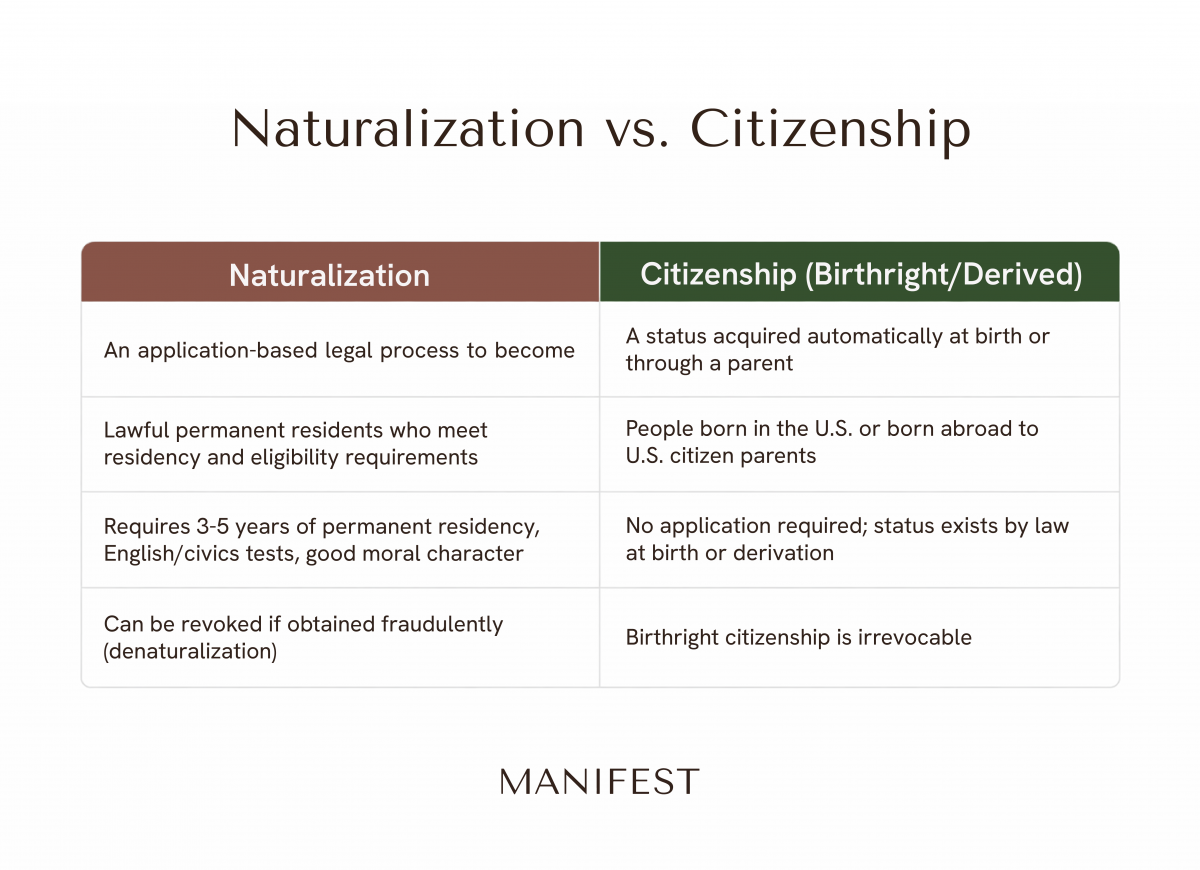
The fundamental difference lies in how you obtain the status. Citizenship can be acquired automatically through birth on U.S. soil (birthright citizenship under the 14th Amendment) or through at least one U.S. citizen parent, even if you were born abroad. These individuals never need to apply for citizenship—they simply possess it from birth or automatically acquire it based on their parents' status.
Another way to become a U.S. citizen is through derivation, which happens automatically if you are under 18, living in the United States as a lawful permanent resident, and residing with a parent who naturalizes before your 18th birthday.
Naturalization, by contrast, requires an active application process available only to lawful permanent residents who meet specific criteria. The naturalization process involves demonstrating five years of continuous residence (or three years if married to a U.S. citizen), physical presence in the U.S., good moral character, attachment to constitutional principles, and passing English and civics tests.
Lawful permanent residents may also be able to naturalize after serving in the U.S. armed forces.
The requirements differ significantly. Automatic citizenship requires no application, fees, tests, or waiting periods—you either qualify at birth or you don't. Naturalization requires years of lawful permanent residence, documentation proving eligibility, biometric appointments, interviews, testing, and oath ceremonies. Deriving citizenship from a U.S. citizen does not require you to apply, however it is recommended to file form N-600 and include evidence that you met the legal requirements in order to obtain a certificate of citizenship.
Once obtained, however, the rights are virtually identical. Naturalized and birthright citizens enjoy the same constitutional protections, voting rights, ability to hold most public offices, and passport privileges. The only practical difference is that naturalized citizens can have their citizenship revoked (denaturalized) if obtained fraudulently, while birthright citizenship is irrevocable.
How do you qualify for naturalization?
Basic naturalization eligibility requires that you've been a lawful permanent resident (Green Card holder) for at least five years (or three years if married to a U.S. citizen) and meet continuous residence and physical presence requirements. You must demonstrate good moral character, pass English and civics tests (with certain exemptions), and show attachment to the principles of the U.S. Constitution.
For detailed eligibility requirements, see Manifest’s comprehensive naturalization guide which covers specific residence calculations, good moral character standards, and documentation needed.
Several exemptions and waivers can modify standard requirements. Applicants aged 50 and older with 20 years of legal permanent residency, or age 55 with 15 years of legal permanent residency, can take the civics test in their native language. Those 65 and older with 20 years of residence receive simplified civics test questions. Medical exemptions exist for those with physical or developmental disabilities that prevent them from meeting testing requirements.
Alternative paths include naturalization through military service, as a spouse of a U.S. citizen employed abroad, or through certain programs for human trafficking victims. Each path has unique residency and timing requirements compared to standard naturalization.
What are naturalization vs. citizenship certificates?
Certificate of naturalization
A Certificate of Naturalization is the official document issued to foreign-born individuals who complete the naturalization process or those who derive citizenship from their naturalized parents before 18 and apply for the certificate. You receive this certificate at your oath ceremony after being approved for naturalization. It serves as legal proof of your U.S. citizenship and is required to apply for a U.S. passport, register to vote, and prove citizenship for employment purposes.
If you lose your Certificate of Naturalization, you can request a new one by filing Form N-565 with USCIS.
Certificate of citizenship
A Certificate of Citizenship documents that an individual obtained U.S. citizenship automatically through birth abroad to citizen parents or by deriving citizenship through parents who naturalized. Unlike the naturalization certificate, this document isn't required—those who acquired citizenship automatically are already citizens, whether or not they obtain this certificate.
However, it provides proof of citizenship status and is obtained by filing Form N-600 with USCIS; to request a replacement, you file Form N-565.
Ready to take the next step?
Becoming a citizen is the ultimate goal for many people immigrating to the U.S. That’s why so many have worked with Manifest to ensure their plans to naturalize are ironclad. Our experienced immigration attorneys can help make sure your paperwork is ready to go and that you understand the process and responsibilities involved in naturalizing to become a citizen.
Request a consultation with Manifest today.
Naturalization vs. citizenship FAQs
How long does it take to get citizenship vs. naturalize in the U.S.?
Citizenship by birth within the U.S. is immediate—you're a citizen from the moment you're born. For naturalization, the timeline depends on your path. The fastest route is often through marriage to a U.S. citizen, where you can apply after three years of permanent residence, while others typically need to wait five years.
From application to oath ceremony, processing currently takes eight to 12 months on average, though times vary by location. Military service members can naturalize even faster, sometimes immediately during qualifying service periods.
Do I have to get a Green Card before naturalization?
Yes, you must obtain a Green Card (lawful permanent residence) before you can naturalize. There's no way to skip permanent residence and go directly to citizenship through naturalization. You'll need to maintain your Green Card for the required period—typically five years or three if married to a citizen—before becoming eligible to apply.
Do naturalized citizens have the same rights as citizens by birth?
Naturalized citizens enjoy virtually identical rights to birthright citizens. Both can vote, hold most public offices, obtain passports, and receive equal protection under the Constitution. The only differences are that naturalized citizens cannot serve as President or Vice President, and naturalized citizenship can be revoked if obtained fraudulently.
What if I'm already a citizen through a parent?
If you acquired citizenship automatically through a parent, you're already a U.S. citizen and don't need to naturalize. However, you may want to file Form N-600 to obtain a Certificate of Citizenship as proof. Alternatively, you can simply apply for a U.S. passport, which also serves as proof of citizenship and is often faster and less expensive to obtain.
Are people born in Puerto Rico U.S. citizens, and what rights do they have?
Yes. Anyone born in Puerto Rico is a U.S. citizen at birth. Puerto Ricans have the same rights and responsibilities as U.S. citizens born in the 50 states. They can travel with a U.S. passport, live anywhere in the United States, vote in presidential primaries, and run for federal office (except the presidency, which has its own constitutional rules).
The only limitation is that residents of Puerto Rico cannot vote in the general presidential election unless they reside in one of the 50 states or D.C.
What are the requirements to derive U.S. citizenship from a parent?
A child automatically derives U.S. citizenship when all three of the following conditions are met: The child is under 18 years old, the child is a lawful permanent resident (Green Card holder) living in the United States, and the child is residing with a parent who becomes a U.S. citizen.
If all requirements are met before the child turns 18, citizenship is automatic. Many families choose to file Form N-600 to obtain an official Certificate of Citizenship as proof.
Learn more about N-600 processing times.
About the Author

Contributing Writer
Carolyn Yang is an urban planner, storyteller, and cultivator of unlikely partnerships. She enjoys translating dense policy language into digestible, actionable information for those seeking to navigate the immigration system.
Read bioReviewed By

Senior Immigration Attorney at Manifest Law
Henry is an Estonian American attorney licensed in Arizona with broad experience in employment-based immigration. He handles EB-1A, EB-2 NIW, O-1, and E-2 cases for founders, professionals, and creatives across industries worldwide, and has helped hundreds of clients achieve successful outcomes.
Read bioShare this article: