



How to Change Your Address as a Green Card Holder

- Most Green Card holders must file a USCIS change of address within 10 days of moving to avoid penalties and missed notices.
- You can usually use USCIS’s E-COA online tool to update your address for Green Cards and all pending cases.
- Financial sponsors who signed Form I-864 must file Form I-865 within 30 days of moving, or risk civil fines.
- If you can’t use the online tool, you must report your new address by filing Form AR-11 by mail within 10 days of moving.
For Green Card holders and most visa holders, one of the first things you should do when you move is update your address with the U.S. Citizenship and Immigration Services (USCIS).
Failing to change your address within 10 days of a move is considered a misdemeanor, and it could result in fines, jail time, or deportation. While those types of penalties aren’t typically carried out, it’s best to closely follow all requirements and update your address as soon as you move.
The good news is, in most cases, you can update your address online.
Do Green Card holders need to update USCIS after a change of address?
Yes. If you are a lawful permanent resident or conditional Green Card holder, you’re required to update your address with USCIS within 10 days of a move. This ensures that you continue to receive any correspondence from USCIS without delays, which could happen if you simply forward mail through the post office.
It’s important to note that changing your address with the U.S. Postal Service doesn’t change your address with USCIS. You have to complete the separate change-of-address form that USCIS requires.
Not updating your address within 10 days could mean delays in receiving immigration benefits or jeopardize eligibility if any deadlines are missed due to mail delays from an incorrect address.
In addition, failing to change your address within 10 days of a move is a misdemeanor under U.S. immigration law. In serious cases, it can lead to fines, time in jail, and even deportation.
It’s free to update your address with USCIS.
| 💡 Manifest tip: Sponsors of Green Card applicants, or anyone who submits an Affidavit of Support (Form I-864), also must notify USCIS when they move. They must submit their change of address using Form I-865 within 30 days of a move. Failing to file on time can result in a civil fine of at least $250 and up to $2,000, and in some circumstances even higher penalties under the law. |
Can I file my change of address online?
USCIS makes it easy for most Green Card holders to update their address online, via the Enterprise Change of Address (E-COA) self-service tool.
E-COA allows lawful permanent residents and anyone with pending cases to notify USCIS of a move and update their physical and mailing addresses with the agency.
Only a few categories of people cannot use the online tool. For example, anyone whose case is protected for safety or confidentiality reasons—mostly survivors of domestic abuse, trafficking, or certain crimes—have special “safe address” procedures instead.
People who can’t use E-COA and must file a paper form include:
- Victims of abuse or crimes
- Certain intercountry adoption-based petitioners and applicants (for orphan and Hague intercountry adoption cases)
- Certain special immigrant Afghan or Iraqi nationals
- Attorneys and accredited representatives seeking to change their office address
- Civil surgeons
- U.S. citizens or nationals who have submitted an affidavit of support for another person
- Certain people with international addresses
Steps for Green Card holders to change your address with USCIS
Changing your address with USCIS takes just a few steps, and it’s important not to miss a step.
1. Confirm the 10-day rule applies to you
Green card holders must report a change of address to USCIS within 10 days of moving, unless a specific exception applies.
U.S. citizens, U.S. nationals, and lawful permanent residents who financially sponsor an immigrant have 30 days to notify USCIS of an address change.
2. Check if you can to use the online tool (E-COA)
Most people can change their address using the E-COA tool in their USCIS online account.
People in certain categories (protected persons, some adoption cases, some Afghan/Iraqi special immigrants, civil surgeons, and some sponsors) cannot use the E-COA tool. They must follow special instructions, which may include mailing Form AR-11. Financial sponsors should file Form I-865 instead.
3. Create or log in to your USCIS account
You can only access E-COA through your USCIS online account. Visit my.uscis.gov to log in or create an account.
4. Use the E-COA tool to change your address
This is where you’ll enter your basic biographical info plus your new address. The steps you’ll follow are roughly:
Choose “Change of Address”.
Enter your new physical and mailing address. These can be the same if you want to receive mail at your home address.
Add receipt numbers for each pending case.
If you have pending cases, add your receipt numbers so USCIS updates each file (I-485, I-751, N-400, I-130, etc.) with your new address.
E-COA can update pending applications, even if those pending applications were filed by mail.
Save or print the confirmation for your records.
You should always keep good records of what you submit to USCIS.
If you can’t use the online tool, file Form AR-11
If you can’t or shouldn’t use the online tool, you can instead complete Form AR-11, Alien’s Change of Address Card. Mail it to USCIS, following the mailing instructions.
It’s a simple form with just a few fields for:
- Your name
- Date of birth
- Alien registration number
- Present physical address
- Previous physical address
- Mailing address
- Signature
- Date of signature
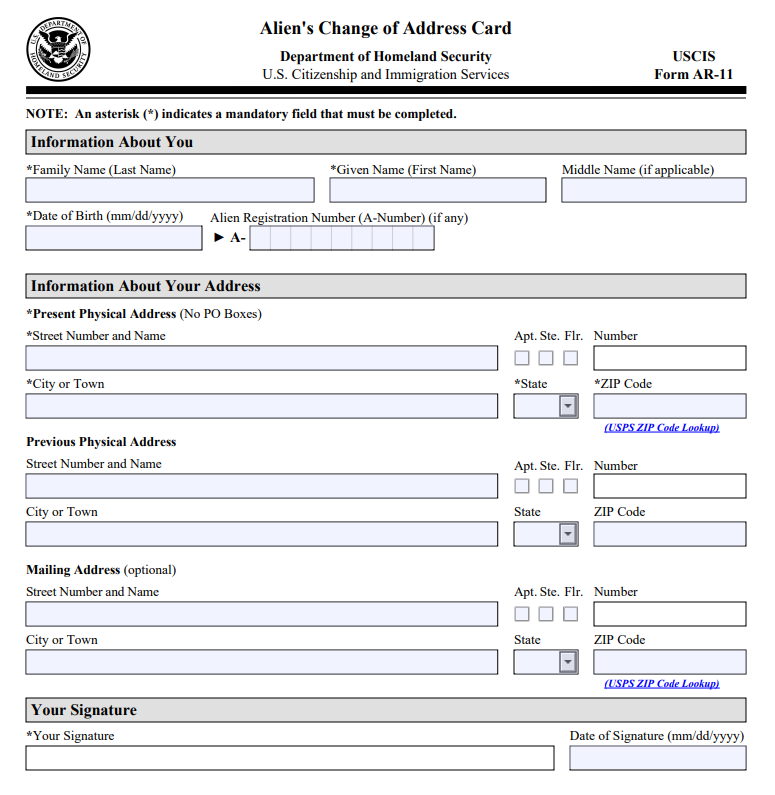
When complete, mail the form to:
U.S. Department of Homeland Security
Citizenship and Immigration Services
Attn: Change of Address
1344 Pleasants Drive
Harrisonburg, VA 22801
Always be sure to double-check the official address at USCIS.gov to make sure it hasn’t changed.
As with anything you mail to USCIS, you should keep a copy of your completed form and send it with tracking, like through USPS Certified Mail, to confirm when it was delivered.
If you’re in immigration proceedings, also update the immigration court
USCIS makes it clear that anyone in immigration proceedings should also file a change of address with the immigration court, or the Executive Office for Immigration Review (EOIR).
You’ll need to file Form EOIR-33/IC. This can be done electronically, in person, or by mail.
| 💡 If you need to update your address with the immigration court, they require notice within 5 days of a move, so be sure to update your details with them as soon as you move. |
Where else should Green Card holders update their address?
If you have a pending case that is going through consular processing, you should also change your address with the National Visa Center (NVC) and the U.S. embassy handling your case.
To update your address with the NVC, submit your details using the public inquiry form.
Simplify your Green Card change of address
If you work with an immigration attorney, they can make a change of address as easy as possible. Plus, an attorney can make sure your immigration records are complete and up to date, especially if you have any pending applications or benefits.
At Manifest Law, our experienced attorneys and paralegals can support you with all parts of the immigration process, so you remain compliant with USCIS rules. Request a consultation today to learn more.
Green Card change of address FAQs
Will changing my address affect my immigration status or delay my Green Card?
Changing your address won’t negatively affect your immigration status or delay your Green Card. Failing to change your address within the required time period, on the other hand, could do both of those things.
When do I have to update USCIS on my change of address?
In most cases, you need to update your address within 10 days of a move. But don’t wait. Update USCIS as soon as you move to be sure you don’t miss any deadlines or notices.
What documents do I need to change my address with USCIS?
No other documents are required to change your address with USCIS. If you have pending applications, you’ll need to know the receipt number for each one, so you can update those specifically.
What happens if I move after scheduling my Green Card interview?
If you move after your Green Card interview is scheduled, USCIS might move your interview to a different field office. If this happens, you’ll be notified of the change. That might also affect your interview date.
Do I need a replacement Green Card if my address changed?
No. Green Cards don’t list an address, so there is no need to request a replacement permanent resident card.