




- Lawfully’s user data shows hundreds real-time case outcomes for EB-1A and EB-2 NIW applicants, providing some insight into how USCIS is currently adjudicating these petitions.
- According to Lawfully’s data, the EB-1A I-140 approval rate in February was 43% for regularly processed petitions, up from a low of 31% in September 2025.
- For EB-2 NIW I-140s, the February approval rate for regularly processed petitions was 41%.
Proprietary data from the case tracking platform Lawfully shows that EB-1A and EB-2 NIW (national interest waiver) approval rates may have risen in February. Request for Evidence (RFE) rates appear to have remained stable across EB-1A and EB-2 NIW I-140s, with some fluctuations month-to-month.
While Lawfully’s approval rate data is a positive signal for current EB-1A and EB-2 NIW adjudication trends, it only reflects the outcomes of petitions filed by Lawfully users. Official data from USCIS has not been released since quarter 3 of Fiscal Year 2025.
| About this report: Manifest Law’s attorneys reviewed data from Lawfully, an app that allows users to track their visa cases after they’re submitted to USCIS. This report focuses on February 2026 outcome data for I-140 filings in the EB-1A and EB-2 NIW categories. Note that Lawfully’s data set skews toward cases filed through regular processing. It covers 293 EB-1A petitions and 468 EB-2 NIW petitions from February 2026. This represents 100 fewer petitions than Lawfully recorded in January 2026. To put this sample into context, data from U.S. Citizenship and Immigration Services (USCIS) covers 3,527 EB-1A approvals and 1,769 denials and 5,311 EB-2 NIW approvals and 4,520 denials per quarter. Because of this, we treat these numbers as a directional signal, not as a substitute for USCIS approval data. |
February 2026 EB-1A approval rates
Approval rates for high-skilled visas could be showing signs of steady growth, Lawfully’s data suggests. After a period of volatility in late 2025, the data suggests a more stable environment for applications.
These gains follow a difficult period in late 2025. In September, Lawfully’s EB-1A approval rates dipped to 31%. The current upward trend suggests approvals may be stabilizing.
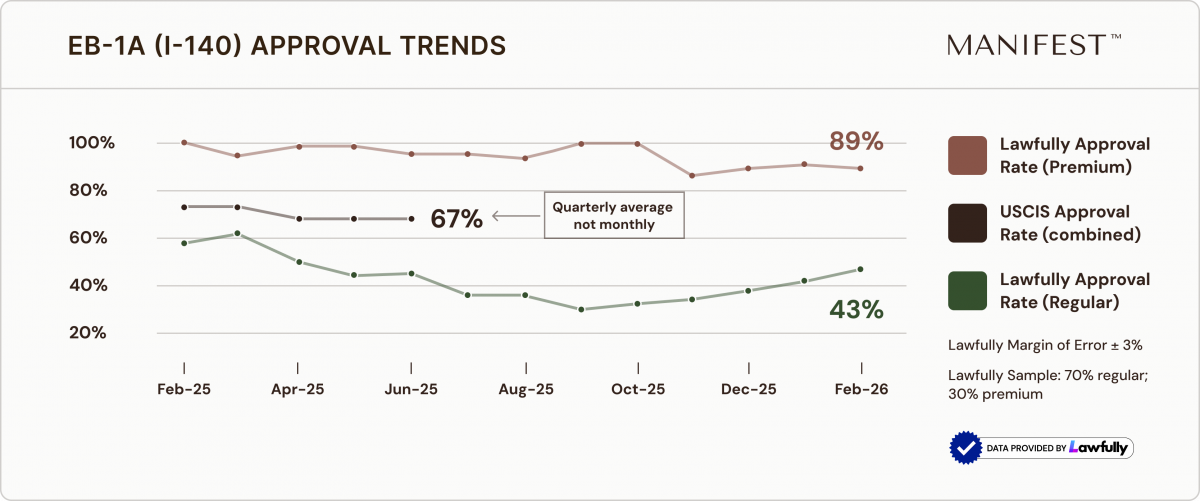
Based on data from Lawfully. These findings reflect 1,789 approvals and 1,488 denials tracked via Lawfully from February 2025 to February 2026. This is a sample of the total number of EB-1A petitions adjudicated each month. Manifest’s attorneys review this data to understand broader trend lines in approval rates. Because it is of a limited scope, it should not be viewed as a definitive or fully representative measure of current USCIS adjudication outcomes.
Premium processing vs. regular processing approval rates
Lawfully’s data on EB-1A I-140 petitions filed with premium processing shows that they are being approved at significantly higher rates, standing at 89% in February 2026. This high success rate could be because they’re typically prepared by experienced legal teams who prepare a strong evidence package before the case is filed.
While premium processing is faster, the legal standard for EB-1A is the same: proving you’re at the top of your field. The goal is still to prepare a petition that demonstrates that.
February 2026 EB-2 NIW approval rates
Lawfully’s approval rates for EB-2 NIW are also seeing a steady climb. While the gains are smaller than with EB-1A, the data shows the steep decline in approval rates we saw in 2025 could be reversing.
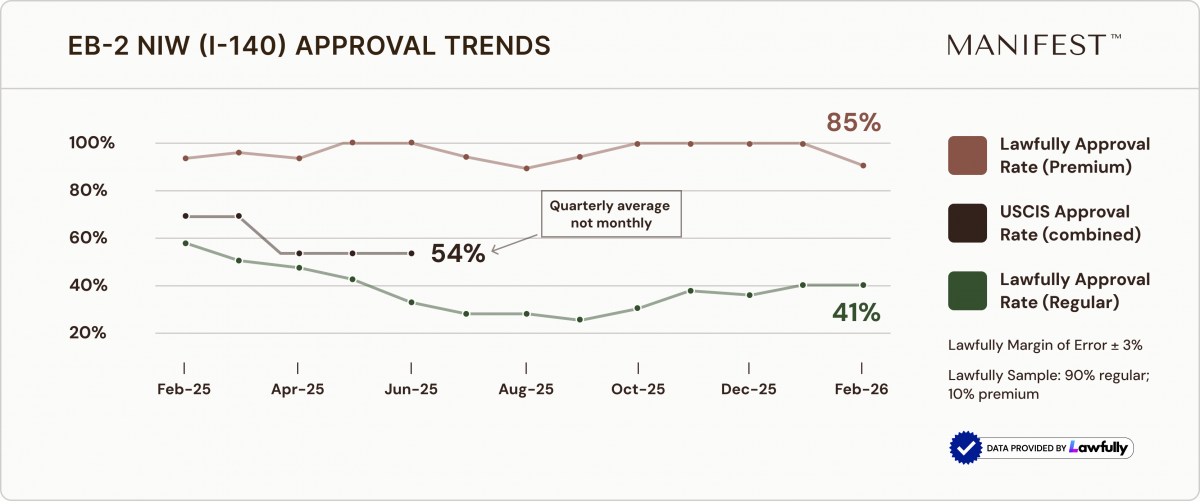
Based on data from Lawfully. These findings reflect 2,280 approvals and 2,871 denials tracked via Lawfully from February 2025 to February 2026. This is a sample of the total number of EB-2 NIW petitions adjudicated each month. Manifest’s attorneys review this data to understand broader trend lines in approval rates. Because it is of a limited scope, it should not be viewed as a definitive or fully representative measure of current USCIS adjudication outcomes.
How EB-1A and EB-2 NIW RFE rates changed in February 2026
Lawfully’s data showed an increase in the RFE rate for regularly processed EB-1A I-140 petitions from 46% in January to 49% in February. Lawfully tracked 135 EB-1A RFEs in February.
EB-2 NIW saw the lowest RFE rate since October among the petitions Lawfully tracked. The rate dropped from 49% in January to 41% in February. There were 183 RFEs for NIW petitions for cases tracked on Lawfully’s platform in February.
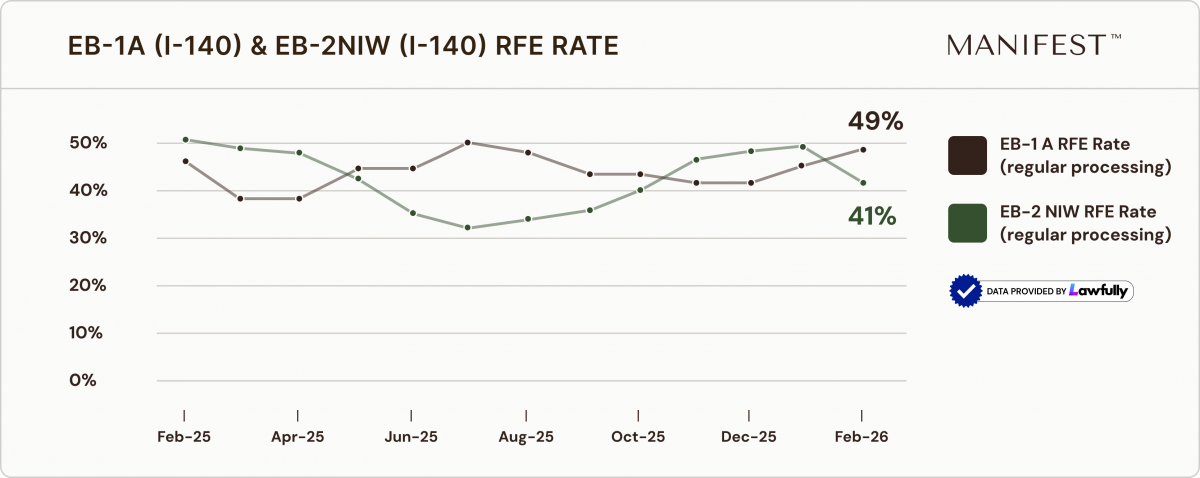
Based on data from Lawfully. These findings reflect 2,056 EB-1A RFEs and 3,554 EB-2 NIW RFEs tracked via Lawfully from February 2025 to February 2026. This is a sample ofthe total number of petitions adjudicated each month. Manifest’s attorneys review this data to understand broader trend lines in approval rates. Because it is of a limited scope, it should not be viewed as a definitive or fully representative measure of current USCIS adjudication outcomes.
How to use this data (and how not to)
Think of these numbers as a weather report for the EB-1A and EB-2 NIW Green Cards. Lawfully’s February data can point to adjudication trends, but doesn’t show the whole picture.
The overall climate matters more than a daily weather report. These monthly numbers can go up or down, but the long-term trend shows that high-skilled immigration visas remain viable for qualified professionals.
You shouldn’t decide your immigration pathway based on a single month of case-tracker data. The best strategy is to focus on what you can control. Regardless of the approval rate this month, the legal standards remain the same.
Designing your immigration strategy
The latest numbers from Lawfully are a positive sign for highly skilled immigrants. While processing can be unpredictable, the steady rise in approvals indicates that the path forward may be stabilizing. Now is the time to focus on your strategy and prepare the evidence for your case.
If you’re ready to take the next step, we’re here to help. Request a consultation with Manifest Law’s experienced immigration attorneys team to discuss your goals. For more data and a detailed analysis of EB-1A and EB-2 NIW data, you can view the official USCIS data here and our 2026 outlook report that leveraged both recent USCIS data and Lawfully’s case outcome data.
Data Sources and Limitations: This report incorporates data provided by Lawfully, Inc. Lawfully, Inc. is not affiliated with USCIS or Manifest Law, and the data provided by Lawfully is based on information collected and processed through its own systems. While we believe the data sources referenced are generally reliable, Manifest Law has not independently verified all underlying data and makes no representations or warranties regarding the completeness, accuracy, or timeliness of the data or any conclusions drawn from it. The analysis and interpretations contained in this report are provided for informational purposes only and may reflect estimates, assumptions, or categorizations that could affect results. Data in this report is current as of March 10, 2026.