



EB-1A vs. EB-2 NIW: How to Choose the Green Card That Works for You

- EB-1A suits top performers with major achievements and international recognition.
- EB-2 NIW is ideal for professionals whose work benefits the U.S., even without global fame.
- Both allow self-petitioning and include Green Card options for spouses and children.
If you’re a high-achieving professional already living and working in the U.S., chances are you’ve been navigating the immigration system for years—first as a student or trainee, then on a work visa like the O-1 or H-1B. You’ve built a life here. Maybe your spouse is working. Maybe your kids are in school. And maybe—like many of our clients—you’re tired of visa renewals, travel restrictions, and the constant uncertainty about what comes next.
The EB-1A and EB-2 NIW are two of the most powerful Green Card options for people like you: accomplished professionals who want to stay in the U.S. long-term, without being tethered to a single employer. Both let you self-petition, meaning you don’t need company sponsorship. Both can lead to permanent residency for you and your family. But while they share that common ground, the way they work—and who they’re right for—can be very different.
For many applicants, this choice isn’t just about immigration law. It’s about timing, job security, family needs, and how long you’re willing to wait. The real question isn’t just “Do I qualify?”—it’s “Which path will move my life forward, without putting everything else on hold?” That’s the lens through which we approach this decision: not just what’s possible, but what’s practical, strategic, and right for you.
| 🧑⚖️Clear guidance, without the legal jargon. This article is informed and reviewed by Manifest Law’s experienced immigration attorneys—and written to make the law make sense. Because you deserve to understand the system, not fight it. Check out our editorial policy for more info. |
EB-1A vs. EB-2 NIW: What They Have in Common and Where They Differ
EB-1A and EB-2 NIW are two self-petition Green Card options available to high-achieving professionals. They both allow you to apply without employer sponsorship and can lead to permanent residency for you and your family. But they’re built for different types of applicants—and the path to and speed of approval can vary quite a bit.
The EB-1A Green Card is designed for individuals with extraordinary ability, those at the top of their field, with national or international recognition. The EB-2 NIW, on the other hand, focuses on whether your work helps the U.S. in a meaningful way, even if you’re not well known outside your field.
Subscribe to our newsletter for immigration resources and news, without the legal jargon.
How the EB-1A and EB-2 NIW Are Similar
- Self-petition: You don’t need a job offer or employer to sponsor you.
- Permanent residency: Both lead to a Green Card for you and eligible dependents.
- No labor certification: You can skip the PERM process, which normally requires your employer to prove that no qualified U.S. worker is available for your job.
- Strong documentation required: You’ll need to prove your qualifications and impact.
How the EB-1A and EB-2 NIW Are Different
While EB-1A and EB-2 NIW share some core benefits—like self-petitioning and a path to permanent residency—they serve different types of professionals and come with different timelines, eligibility standards, and strategic advantages.
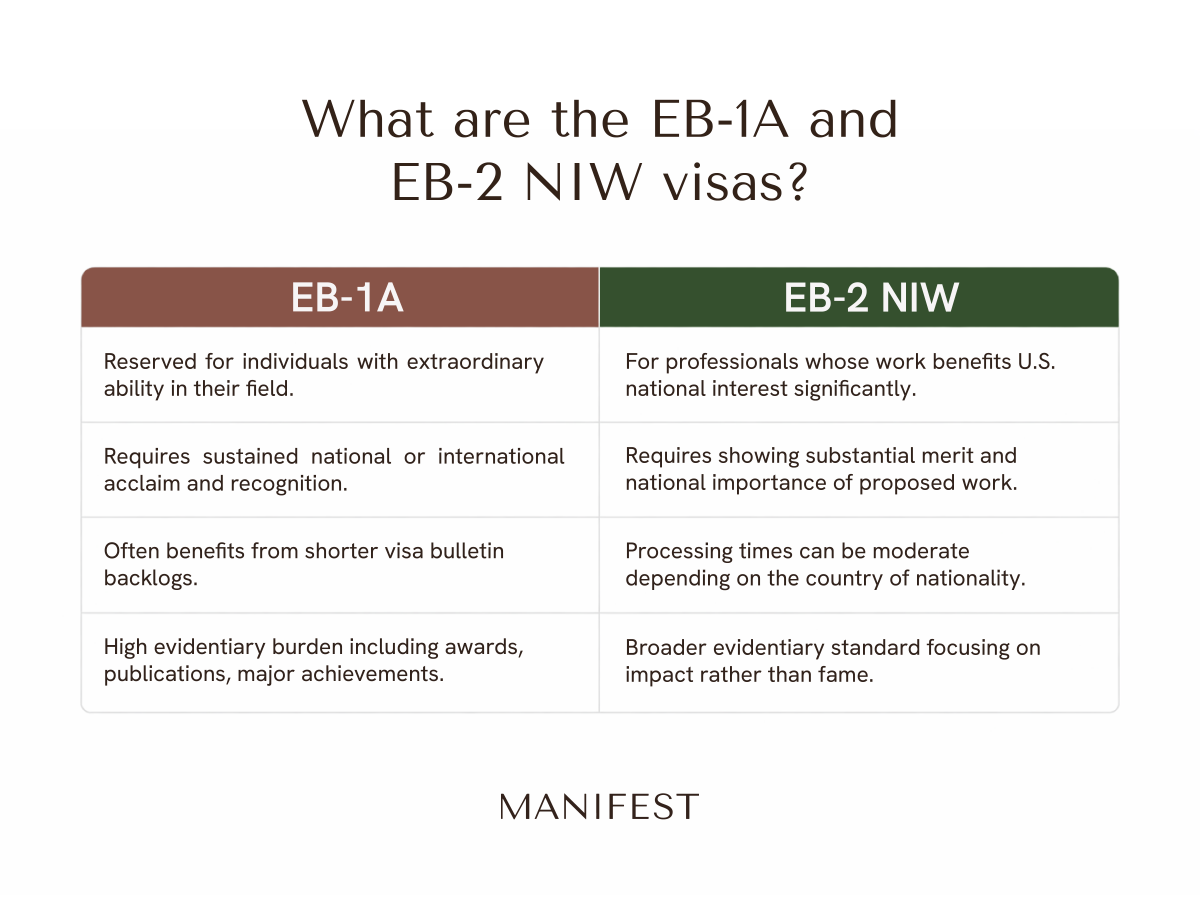
Here’s a side-by-side look at the differences between EB-1A and EB-2 NIW:
| Feature | EB-1A | EB-2 NIW |
| Standard | Extraordinary ability in your field | Work must benefit the national interest |
| Evidence required | Sustained acclaim, original contributions, major media, judging others, etc. | Impactful work, public benefit, expert letters, government or institutional support |
| Competitiveness | High — for top-tier professionals | Moderate — for professionals doing important U.S.-focused work |
| Visa bulletin wait times | Usually current (except India/China) | Backlogged 3+ years (more for India/China) |
| Approval timeline | Can be fast if eligible | May be faster to prepare and file |
| Career impact | Seen as prestigious and high-achieving | Viewed as practical and mission-driven |
| Best for | Researchers, founders, innovators, high-profile professionals | Policy experts, public health leaders, engineers, educators, entrepreneurs |
| Can file I-485 right away? | Often yes | Only if the Visa Bulletin is current |
Qualifying for the EB-1A vs. EB-2 NIW
On paper, both the EB-1A and EB-2 NIW allow you to self-petition. Neither requires a job offer or employer sponsorship. But the standards for qualification are very different, and so is the kind of story you need to tell USCIS about your work.
| 💡This is where many applicants get stuck—not because they aren’t qualified, but because they don’t know how to present their achievements effectively. At Manifest Law, we help translate your real-world impact into a clear, compelling immigration case. We’ll guide you toward the best path, highlight your strongest evidence, and make sure your petition reflects both your strengths and your long-term goals. Learn more about working with our experienced EB-1 lawyers and EB-2 NIW lawyers. |
EB-1A Qualifications: Reserved for Those at the Top of Their Field
To qualify for the EB-1A, you must demonstrate extraordinary ability in your field, something well beyond holding an advanced degree or having a strong resume. USCIS is looking for individuals who have achieved sustained national or international recognition, backed by clear, documented evidence.
This typically means your work has made a significant impact—not just within your institution, but across your field:
- Have you received major awards or been invited to speak at prominent conferences?
- Has your research been published in top journals or covered in major media?
- Have you contributed original work that others rely on, cite, or build upon?
- Have you judged the work of others through peer review, grant panels, or juried competitions?
These types of accomplishments align with the EB-1A criteria, which include things like nationally or internationally recognized awards, published material about your work, original contributions of major significance, and authorship of scholarly articles.
You don’t need to meet all ten criteria, but to qualify, you’ll need to satisfy at least three and show that your impact is sustained, well-documented, and recognized beyond your immediate environment.
Ultimately, the EB-1A is about proving, with evidence, that your contributions matter beyond your immediate circle and that USCIS will see your impact as both exceptional and well-documented.
Examples of successful EB-1A applicants may include:
- A biomedical researcher whose work on CRISPR has been cited in global clinical trials
- A climate scientist who’s served on federal advisory panels and published in Nature
- An artist whose work has been exhibited in leading museums and reviewed in The New York Times
EB-2 NIW: National Interest Without the Fame
The EB-2 National Interest Waiver (NIW) offers a more accessible path than EB-1A, though it’s still selective. Rather than asking whether you’re at the top of your field, USCIS wants to know whether your work benefits the United States in a meaningful way.
That could mean addressing public health challenges, contributing to infrastructure or climate solutions, advancing education, or supporting the U.S. economy. Your work doesn’t have to be famous, it just needs to be important, with evidence to show it:
- Have you contributed to government-funded projects, published impactful research, or collaborated with institutions that serve the public good?
- Can you show that your contributions go beyond your employer and benefit society more broadly?
If your work solves real problems and you plan to keep working in the same area after receiving your Green Card, the NIW could be a strong fit—especially if you’re still building toward EB-1A but want to self-petition now.
Successful EB-2 NIW applicants may look like:
- An environmental engineer developing water conservation systems for underserved communities
- A policy researcher contributing to federal health access initiatives
- A software founder building AI tools to improve U.S. manufacturing efficiency
How Your Country of Birth Shapes the Wait Time for EB-1A vs. EB-2 NIW
When you’re evaluating different paths to a Green Card, it’s easy to assume your qualifications are the most important factor. And they are, but where you were born matters, too.
The U.S. places annual limits on how many Green Cards it issues to applicants from each country. So if you’re from a country with high demand, like India or China, even a strong application can be stuck in a backlog, AKA, a long wait caused by more people applying than there are Green Cards available.
Henry Lindpere, Senior Counsel at Manifest Law, explains why backlogs happen, and why there are especially long wait times or certain countries:
“The Immigration and Nationality Act includes annual limits on how many Green Cards can be issued in each category. In addition to the global total, it also states that no country can get more than 7% of the total number. If there are more petitions approved than Green Cards available, a waitlist is formed.
The waitlist has grown especially long for countries with large populations and a lot of immigration to the United States because they hit the 7% maximum very quickly each year. That’s why the EB-2 backlog for India is so long that many people with approved petitions will retire or die before they can get a Green Card.”
So, how can this impact your EB-1A or EB-2 NIW application? Well, when you file your I-140 petition, you’re given a priority date—think of it as your spot in line. Each month, the government updates the Visa Bulletin, which shows who can move forward and what current USCIS processing times are.
Once your priority date is current, you can apply for your Green Card. Until then, you’ll need to wait your turn. Which for many people, can mean waiting in line for years or decades.
| 📘What does it mean for your priority date to be “current”? When your priority date is current, it means your place in line has arrived—you’re now eligible to apply for your Green Card. If your date isn’t current yet, you’ll need to wait until the government moves forward in the Visa Bulletin for your category and country. |
Why the Visa Backlog and Priority Dates Matter for EB-1A and EB-2 NIW
U.S. immigration can be a slow-moving system, but the stakes are personal. That’s why when you file—and which petition you choose to file first—can have a real impact on your timeline and options.
For most countries, EB-1A is usually current, meaning there’s no wait after petition approval. But for India and China, both EB-1A and EB-2 NIW can be backlogged, and EB-2 often moves much more slowly.
If you’re approaching the end of your O-1 or H-1B work visa, trying to secure work authorization for a spouse, or have a child nearing age 21, these delays can disrupt your family’s plans, limit your career flexibility, and create avoidable stress.
Even if you’re not ready to apply for EB-1A yet, filing an EB-2 NIW now can still help you long-term. It lets you claim your spot in line for a Green Card. Later, if you qualify for EB-1A, you can often reuse that same spot, which might help you move ahead faster.
The sooner you file your first petition, the sooner the clock starts. That can make a big difference when you’re planning around visa renewals, family needs, or job changes.
Filing EB-1A and EB-2 NIW Together: What to Know
When it comes to applying for a Green Card, you don’t have to choose just one petition. For many high-achieving professionals, especially those from backlogged countries, filing both EB-1A and EB-2 NIW can be a strategic way to reduce uncertainty and shorten your timeline.
Many applicants use EB-2 NIW as a safety net, filing it first to secure a priority date while they continue building a stronger case for EB-1A. Since EB-1A requires a higher bar, it may take more time to gather evidence or earn additional recognition. Meanwhile, the NIW allows you to get in line now.
Dual filing also gives you flexibility:
- If one petition is denied, you still have another in play.
- If both are approved, you can move forward with whichever becomes current in the Visa Bulletin first.
There is no legal limit to how many I-140s you can file. The only requirement is that you disclose prior or pending filings when submitting a new I-140, including whether they were approved, denied, or still pending. This is standard and doesn’t harm your case, but transparency is essential.
The Cost of Dual Filing
The only drawback? You’ll have to pay both EB-1A visa costs and EB-2 NIW costs. Filing two petitions means:
- Two sets of USCIS filing fees
- Two legal preparation fees (unless your law firm offers bundled pricing)
- More time spent gathering evidence and preparing materials
It’s also a bit more administrative effort—tracking timelines, paperwork, and case status for two petitions. But for applicants seeking speed and security, the tradeoff is often worth it.
Should You File Both EB-1A and EB-2 NIW?
Consider dual filing if:
- You qualify (or nearly qualify) for EB-2 NIW and want to secure your priority date now
- You’re aiming for EB-1A but know it may take time to prepare a strong petition
- You’re from India or China and want to reduce the impact of visa backlogs
- You’re in a time-sensitive situation with your visa, family, or career
For many professionals, this isn’t about having a Plan A and Plan B. It’s about pursuing parallel strategies that keep your Green Card journey moving no matter how the timeline shifts.
| 💡Filing both EB-1A and EB-2 NIW isn’t overkill—it’s a smart way to protect your timeline. If one petition moves faster or gets approved first, you have a path forward. If one is denied, you still have a second chance in play. For professionals dealing with visa backlogs, career deadlines, or family pressures, dual filing offers more control, fewer delays, and real peace of mind. |
How Your Family Comes With You on EB-1A and EB-2 NIW
When you apply for a Green Card through EB-1A or EB-2 NIW, your spouse and unmarried children under 21 can apply as your dependents. This is done by filing their own Form I-485 for adjustment of status (if you’re applying from inside the U.S.) or going through consular processing (if applying from abroad), once your priority date is current.
They don’t need their own petition—they qualify through yours. Once you’re eligible to apply, your family can submit their applications at the same time, or shortly after. Your spouse can also request a work permit while the Green Card is pending.
What does that mean in practice? Your spouse can get a work permit, and your children can attend school without needing separate visas. It also means you all stay on the same immigration timeline, so you don’t have to worry about your child aging out at 21 or your spouse being left behind without status.
To keep everyone on the same timeline, the key is filing early and knowing when your priority date becomes current.
Beyond the Green Card: What Each Path Means for Your Career
Getting a Green Card isn’t just about status; it’s about freedom. The freedom to change jobs without worrying about sponsorship. The freedom for your spouse to work. The freedom to plan long-term, whether that means negotiating better offers, starting a business, or finally settling down in one place.
While both EB-1A and EB-2 NIW can get you there, they shape your professional path differently. Understanding those differences can help you choose a strategy that supports not just your immigration goals, but your career and family plans, too.
EB-1A: The Fastest Route to Independence
If you qualify, EB-1A often gets you to a Green Card faster, especially if you’re not from a backlogged country. That speed can make a big difference. Once your I-485 is filed (and especially once the Green Card is approved), you’re free to change employers, pursue leadership roles, or even launch your own company without needing to justify every move to USCIS.
The EB-1A also tends to carry professional weight. It signals you’re operating at the top of your field, which can strengthen your credibility in academia, R&D, and high-level roles. And because your Green Card arrives sooner, your spouse can get a work permit faster, and your children are more likely to get Green Cards before they age out.
EB-2 NIW: Strategic, Reliable, and Still Powerful
EB-2 NIW may not offer the same speed, but it’s still a strong path, especially if you’re not yet ready for EB-1A. It has a lower threshold for qualification and can help you lock in a priority date while you continue building your career.
Even before the Green Card arrives, having an approved I-140 makes you a more appealing hire. Employers are often reluctant to invest in someone nearing the end of their H-1B time, but an approved NIW petition allows you to extend H-1B status beyond the six-year cap. That added stability can make you a safer bet for long-term hiring and promotion opportunities.
EB-1A or EB-2 NIW: Develop Your Green Card Strategy with Manifest Law
EB-1A is the fastest route to career freedom if you’re already near the top of your field. It removes the need for employer sponsorship, gives you full job flexibility, and sends a strong signal of professional excellence. For many, it’s the Green Card that unlocks real negotiating power—and peace of mind.
EB-2 NIW, on the other hand, is a practical and respected option for professionals in research, public health, education, policy, energy, and infrastructure. The standard is lower than EB-1A, but the impact must be clear. It’s often the right move if you’re still building toward an EB-1A case—or if you simply want to secure your place in line now and keep momentum going.
At Manifest Law, we understand that this isn’t just a legal decision—it’s a life decision. Choosing between EB-1A and EB-2 NIW means balancing your achievements, timeline, career goals, and family needs.
Our role is to help you cut through the confusion, assess your strengths, and weigh real-world factors like backlogs, job flexibility, and long-term plans. Whether you’re aiming to move fast, reduce uncertainty, or build toward a stronger case, we’ll guide you toward the Green Card strategy that truly fits—not just what looks good on paper.
👉Request a consultation to get started. We’ll walk you through the process, the cost, and what to expect, step by step.
Frequently Asked Questions
What’s the main difference between EB-1A and EB-2 NIW?
EB-1A is for individuals with extraordinary ability—those at the very top of their field. EB-2 NIW is for professionals whose work serves the national interest of the U.S., even if they’re not as widely recognized. Both let you self-petition, meaning you don’t need a U.S. employer to sponsor you.
Do I need an advanced degree for either visa category?
An advanced degree (like a master’s or Ph.D.) is required for EB-2 NIW, or a bachelor’s plus five years of experience, or exceptional ability. While it is possible, it is very rare for someone to be able to prove exceptional ability (being significantly above the norm in their field) without any degrees or a degree and very little work experience
EB-1A does not have a formal degree requirement, but you’ll need to prove sustained national or international recognition, often through publications, awards, or high-impact contributions.
What is “national importance,” and how does it affect EB-2 NIW eligibility?
To qualify for a National Interest Waiver, your work must benefit the U.S. at a broad level, not just your company. This could mean research that improves public health, work that supports critical infrastructure, or technology that advances the economy.
How long does the application process take for EB-1A and EB-2 NIW?
Processing times vary, but EB-1A processing is generally faster, especially if you’re not from a backlogged country. EB-2 NIW can take longer, particularly for applicants from India or China. Premium processing is available for both categories.
Do I need a labor certification for either category?
No. One of the biggest advantages of both EB-1A and EB-2 NIW is that they waive the PERM labor certification requirement—the step where an employer must prove no qualified U.S. worker can do the job. That means you skip the PERM process entirely.
Can I apply for both EB-1A and EB-2 NIW at the same time?
Yes. There’s no limit on how many I-140 petitions you can file, as long as you disclose prior filings. Many applicants use EB-2 NIW to secure a priority date, then pursue EB-1A once their profile is stronger.
What counts as “significant contributions” for EB-1A or EB-2 NIW?
In both categories, you’ll need to show that your work has had a measurable impact. For EB-1A, this means original work that others rely on, cite, or build upon—something that stands out as truly exceptional. For EB-2 NIW, the bar is slightly lower, but your contributions must still benefit the United States broadly, in areas like science, health, policy, or infrastructure.
Can either option lead to U.S. permanent residency?
Yes. Both EB-1A and EB-2 NIW are employment-based Green Card options that can result in U.S. permanent residency (and eventually, citizenship) for you, your spouse, and your children under 21, without needing a job offer or employer sponsorship.