


E-3 Visa Processing Times in June 2026

- E-3 processing times can range from a few weeks to a few months, depending on whether you apply through USCIS or consular processing abroad.
- The Labor Condition Application (LCA) step typically takes about seven days, but USCIS adjudication can add several more months to the timeline.
- Consular processing is often faster than USCIS processing, but timelines depend heavily on visa interview appointment availability.
- Premium processing can shorten USCIS review to 15 business days, but it costs nearly $3,000 in additional government fees.
The E-3 visa is a nonimmigrant temporary work visa specifically for Australian citizens. It’s often an easier and faster alternative to an H-1B visa for both employers and employees.
The biggest factor that influences the timeline for an E-3 visa is whether a visa applicant is inside the U.S. and filing for a change of status, or outside the U.S. and going through consular processing. For many Australians, consular processing is quicker and less expensive than a change of status within the U.S.
Typical E-3 visa processing times
E-3 visa processing can take anywhere from six weeks to six months, depending on your situation. Once you have a formal job offer for a specialty occupation, the process to obtain an E-3 visa can begin. It starts with your employer filing a labor condition application (LCA).
Subscribe to our newsletter for immigration resources and news, without the legal jargon.
Labor condition application
The LCA is often the fastest part of the E-3 process. Your employer files it with the Department of Labor (DOL), and processing takes just seven business days.
Getting an E-3 from outside the U.S.
The fastest route for an E-3 visa is usually to apply while living outside of the U.S., and going through consular processing. You can apply by filing Form DS-160, and your visa application will be reviewed at a U.S. embassy or consulate in Australia.
Wait times for a visa interview vary, but typically are one to two months.
Getting an E-3 from inside the U.S.
If you are already in the U.S. on another valid visa, like an F-1 or H-1B, your employer must file a Form I-129 with U.S. Citizenship and Immigration Services (USCIS) to request to change your status to E-3.
USCIS processing of Form I-129 takes about 4 months, but the process is subject to backlogs with USCIS. While a change of status is pending, you generally can’t travel outside the country. Traveling abroad could lead USCIS to consider your petition abandoned. The only way to speed up the wait time is with premium processing.
E-3 premium processing
You can pay an extra fee for premium processing to receive a decision on your I-129 from USCIS within 15 business days. The fee is $2,965, but it will be increasing to $2,965 for petitions filed on or after March 1, 2026.
Wait time for E-3 extensions and employer changes
When you’re already working in the U.S. on an E-3, getting a visa extension or changing employers will require the same process and timeline.
There are just two steps to apply for an extension of an E-3 visa or to change employers on an E-3:
- Your employer must file an LCA with the DOL. Processing takes seven business days.
- Your employer must file Form I-129 with USCIS. Processing at this stage is highly dependent on USCIS backlogs, but it generally takes about 4 months. Premium processing can reduce this phase to 15 business days.
Considerations for E-3 extensions
If your employer files a timely E-3 extension, you can generally keep working for the same employer for up to 240 days while USCIS processes the petition.
An E-3 visa is valid for two years and can be extended for another two years. There is no limit to the number of times an E-3 may be extended.
Considerations for E-3 employer changes
Changing employers on an E-3 is treated like applying for a new visa, and the petition must be approved before you’re authorized to work for the new employer.
Some workers opt to leave the U.S. and apply for the new E-3 through consular processing. This is often the faster path because consular processing can be shorter than with USCIS—unless you choose to pay for premium processing. This avenue also allows you to get a visa stamp for traveling.
Why E-3 visas are often quicker than H-1Bs
Although both E-3 and H-1B are temporary work visas for employees in specialty occupations, Australian citizens will find there are fewer hurdles to getting an E-3 visa.
Just like H-1B, the E-3 requires employers to file an LCA. The E-3 visa also has an annual cap, just like the H-1B.
Unlike the H-1B, however, the E-3 is only for Australians. There is much less competition for the limited number of visas available. Because there is less competition, there is no cap lottery, as with the H-1B. You don’t have to face the uncertainty of whether your employer’s registration will be selected to file a petition.
| 🧑💼 Curious how others in your field made it work? Manifest Law’s experienced attorneys have helped thousands of immigrants secure their future in the U.S. Explore our visa approval notices and success stories to learn how we helped founders, researchers, and artists like you turn their stories into winning petitions. |
What can delay E-3 visa processing
There can be delays with any visa application, and an E-3 is no exception. Common delay triggers include:
- LCA problems: Mistakes such as a wrong SOC code, wage level, worksite, start date, or other simple human errors can cause the LCA to be returned or not certified.
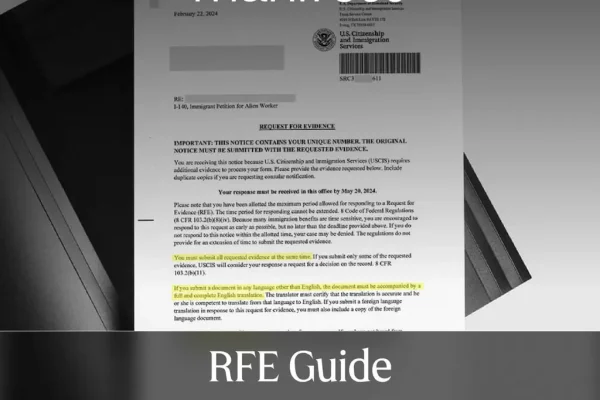
- USCIS RFEs: USCIS may send you a Request for Evidence (RFE) if you have unclear evidence of your specialty occupation, a weak employer support letter, a degree and job-duty mismatch, missing transcripts or credentials evaluation, or not enough documentation about a third-party placement.
- Timing mistakes: Filing too close to a visa expiration without adding a premium processing buffer, or traveling before approvals and visa stamping, can cause delays.
- Consular scheduling constraints: Consular appointment availability varies by location and month, and can be a big factor in processing times.
- Administrative processing or security checks: USCIS or the Department of State can decide to add extra screening, which varies by case and has no definite timeline.
- Document issues: Passport validity, DS-160 mistakes, or inconsistent job details across documents can cause delays if information isn’t clear or doesn’t match.
E-3 visas are straightforward, but strategy still matters
Even though the E-3 system is faster than other types of work visas, your individual case can slow down if certain application details aren’t clear, if the LCA is filed with avoidable errors, or if a job change is poorly timed.
You can avoid delays by having a clear E-3 visa strategy. Whether you need a new visa, an extension, or an employer change, the immigration attorneys at Manifest Law are here to help. Request a consultation to speak with a lawyer about your individual plans.
FAQs for E-3 visa processing times
Can I start working while my E-3 change of status is pending?
If you’re changing employers in E-3 status, the best approach is to wait for approval for a change of status before working for a new employer. If you’re changing status with the same employer, you may be able to keep working while the petition is pending, but it depends on your current status and timing. An experienced E-3 visa attorney can provide guidance on your specific situation.
How long are wait times for E-3 visa interviews?
Wait times vary by consulate and embassy. The State Department publishes monthly appointment wait-time data, and as of February 2026, the consulates in Australia showed interview wait times of one to two months.
Does premium processing speed up E-3 visas?
Yes, premium processing can potentially save you months of waiting, but it comes at a cost: $2,965 for requests made on or after March 1, 2026. Premium processing also applies only to change of status requests, not consular processing.
How long does an E-3 extension take?
An E-3 extension takes about the same amount of time as an initial application, including seven days for LCA processing and about 4 months for Form I-129 processing with USCIS.