


Form I-290B: How to Appeal or File a Motion
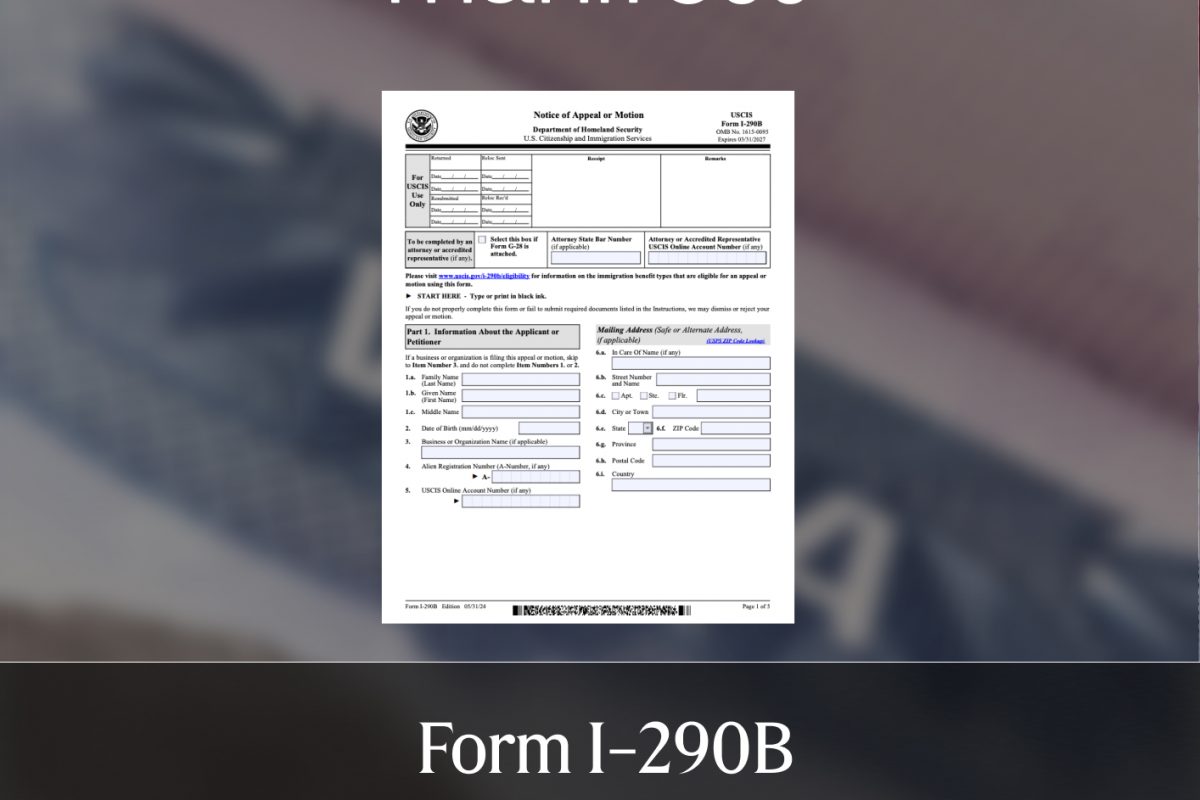
- Form I-290B allows you to appeal, reopen, or reconsider a USCIS decision after a denial, revocation, or dismissal.
- Deadlines are strict: 30 days for most cases, 15 for some. Missing them ends your chance to challenge an unfavorable decision.
- Appeals go to the AAO, while motions are reviewed by the USCIS office that made the decision.
- Strong evidence and a clear statement of basis are essential. Work with an immigration attorney to improve your chances of success.
Receiving an unfavorable decision from U.S. Citizenship and Immigration Services (USCIS) isn’t always the end of the road. You may have one last line of defense to keep your case moving forward: Form I-290B, Notice of Appeal or Motion.
Filing an appeal to challenge a USCIS decision means requesting that a separate USCIS appeals office with different authority review your case. Filing a motion means asking the USCIS office that handled your case to reopen and review it. In this guide, we’ll take a deep dive into everything you need to know about Form I-290B, including what it is, who can use it, and when and how to file it.
| 🧑⚖️ Clear guidance, without the legal jargon. This article is informed and reviewed by Manifest Law’s immigration attorneys, and written to make the law make sense. |
What is Form I-290B: Notice of Appeal or Motion?
Form I-290B is the official USCIS Notice of Appeal or Motion. Form I-290B is used to…
1. File immigration appeals with the Administrative Appeals Office
The USCIS Administrative Appeals Office (AAO) conducts reviews of USCIS officers’ decisions. When you file an appeal, the AAO reviews the details of your case to determine if the officer’s decision reflects an accurate and consistent interpretation of immigration law and policy.
2. File a motion to reopen
If you have new or additional evidence that proves your eligibility for your visa, Green Card, or status, you can file a motion to reopen. This asks the USCIS officer to take another look at your case, apply the new evidence, and review their original decision.
3. File a motion to reconsider
If you believe your case decision was based on a legal or policy error, you can file a motion to reconsider. This argues that the USCIS officer’s decision was incorrect based on the evidence and law at the time of filing and that the decision should be reconsidered.
4. File a combined motion to reopen and reconsider
Form I-290B also lets you file a combined motion to reopen and reconsider. This is considered as two separate requests, and the USCIS officer may approve both, none, or one of them.
Who can file Form I-290B and appeal a decision from USCIS?
Usually, the person who filed the immigration case (the petitioner or applicant) is the only one who can file Form I-290B. The person who simply benefits from the petition (the beneficiary) normally cannot.
However, certain approved beneficiaries of Form I-140, Immigrant Petition for Alien Worker whose Form I-140 was revoked may be able to file an appeal using Form I-290B. You’ll just need to include the USCIS revocation with your form.
You can use Form I-290B to file an appeal and/or motion for a variety of cases, including:
| Type of case | USCIS form (used in original petition/application) | Can I file an appeal? | Can I file a motion to reopen or reconsider? |
| Work-based visas: H-1B, H-2, H-3, L, O, P, Q, R | I-129 | Yes | Yes |
| Work-based visas: E-1, E-2, E-3, TN, H-1B1 | I-129 | No | Yes |
| Employment-based Green Cards: EB-1, EB-2, EB-3 | I-140 | Yes | Yes |
| Investor visas | I-526 and I-526E | Yes | Yes |
| Family-based petitions: F1, F2A, F2B, F3, F4 | I-130 | Yes (using Form EOIR-29, not I-290B) | Yes |
| Fiancé(e) visas: K-1 and K-2 | I-129F | Yes | Yes |
| Adjustment of status | I-485 | No | Yes |
| Naturalization and citizenship | N-400 | Yes (using Form N-336, not I-290B) | If denial comes from a USCIS office: Yes If denial comes from the USCIS National Benefits Center: Follow instructions on denial notice |
| Naturalization and citizenship | N-600, N-600K | Yes | Yes |
| Extension or change of nonimmigrant status | I-539 | No | Yes |
| Employment authorization | I-765 | No | Yes |
For a complete list of when and how to use Form I-290B, visit the USCIS website.
Form I-290B filing deadlines you can’t miss
For most cases, the deadline to file Form I-290B is 30 days from the date of the decision. However, some cases have a 15-day filing window, such as when your petition approval has been revoked.
Here are some important things to note about Form I-290B deadlines:
- You can find the I-290B deadline for your case on the decision letter you received from USCIS.
- The 15- or 30-day window starts the day USCIS makes its decision, not the day you receive that decision.
- If your decision was mailed to you, you have an extra three days to file Form I-290B, for a total of 18 days (for revocations) or 33 days (for denials).
These deadlines are strict and there are no extensions. If you miss the filing window, you also miss your opportunity to challenge USCIS’s decision.
Filing fees and waivers for Form I-290B
As of August 2025, the filing fee for Form I-290B is $800.
You can pay the I-290B filing fee by:
- Money order, personal check or cashier’s check (payable to the U.S. Department of Homeland Security)
- Credit card or debit card (by submitting Form G-1450, Authorization for Credit Card Transactions)
- Electronic bank transfer (ACH) payment (by submitting Form G-1650, Authorization for Credit Card Transactions)
Note that after October 28, 2025, you’ll no longer be able to pay using a paper check or money order.
If you’re struggling financially, you can request a fee waiver by filing Form I-912, Request for Fee Waiver, along with supporting evidence that you meet the eligibility criteria.
What documents and evidence are needed to file Form I-290B?
Filing Form I-290B gets your appeal or motion on record, but you’ll also need to submit additional documents to support your claim.
Supporting evidence for an appeal
When you file an appeal, the goal is to show the AAO that USCIS misinterpreted and/or misapplied the law when ruling on your case. To do so, you might include supporting evidence like:
- A detailed legal brief explaining why the initial decision was incorrect
- Affidavits or expert opinions clarifying or adding context to complex evidence from the original filing
- Legal citations, policy guidance, or precedent decisions that support your case’s approval
Supporting documents for a motion to reopen
If you’re filing a motion to reopen, you need to present new facts that demonstrate why the USCIS should reverse its unfavorable decision. Depending on your application or petition, these might include:
- New documentary evidence (such as updated contracts, proof of continuing employment, tax documents and financial records, or credentialing and licensing documents)
- Affidavits from employers, colleagues, or experts that explain new circumstances
- Documents that were missing from your application
Supporting documents for a motion to reconsider
When you file a motion to reconsider, you’re arguing that the USCIS officer incorrectly applied the law to your case and that the evidence at the time of filing actually warranted an approval.
While you can’t submit new evidence with a motion to reconsider, you can submit documents that support your claim, like:
- A legal argument brief pointing out misapplied regulations, statutes, or policies
- Legal citations, policy guidance, or precedent decisions that support your case’s approval
- A clear explanation of why your original evidence, if properly interpreted, should have led to approval
Supporting doucments for all I-290B submissions
You’ll need to include your $800 filing fee payment along with any required paperwork (like Form G-4150 for credit or debit card payments). If you’re requesting a fee waiver, you’ll need to include a completed Form I-912 and supporting evidence.
If you’re working with an immigration attorney or accredited representative, you’ll also need to submit a completed Form G-28, Notice of Entry of Appearance, when filing Form I-290B.
Step-by-step guide to filing Form I-290B: Notice of Appeal or Motion
Let’s break down the step-by-step process for filing Form I-290B.
- Download the form. Download Form I-290B from USCIS.
- Complete the form. Fill out the form, ensuring all information is accurate and complete. Type or use black ink. For further insights on how to complete the form, refer to the USCIS instructions for Form I-290B.
- Prepare your statement of basis and supporting evidence. An experienced immigration lawyer can help you gather this evidence and prepare a statement.
- Pay the filing fee. Pay the $800 filing fee using one of the available payment options, making sure to include the correct payment authorization form with your submission.
- Submit to the correct address. The correct filing address for Form I-290B varies by case type. Refer to the USCIS website for the most up-to-date direct filing addresses.
- Check signatures and deadlines. Before you send your completed I-290B, make sure you’ve signed the form and are submitting it prior to the deadline.
How long does it take to process Form I-290B?
While there are no universal timelines for appeals or motions, according to AAO and USCIS guidance:
- Appeals to the AAO: The AAO aims to issue a decision within 180 days of receiving your case. (This is following USCIS’s initial field review, which can take up to 45 days.) Complex cases may take longer to process.
- Motions with USCIS: USCIS tries to resolve motion filings within 90 days, although certain cases may take longer.
While the AAO and USCIS aim to wrap up cases in a timely manner, delays may occur. If your case is taking longer than expected, you can contact the USCIS Contact Center at 800-375-5283 and ask them to expedite your request
What happens after you file Form I-290B?
Here’s what you can typically expect after filing Form I-290B:
1. Receive a receipt notice (Form I-797C) from USCIS
After USCIS receives your appeal or motion, you’ll get a receipt notice (Form I-797C). This confirms your filing was accepted and includes your case number, which you can use to track your case status online.
2. Initial field review and routing your case if needed
If you filed an appeal, USCIS will conduct an initial field review to determine if it has enough information to approve the appeal. If they determine they don’t have enough information to reverse the original decision, the officer will then forward your case to the Administrative Appeals Office (AAO) for review. Initial field reviews can take 45 days or longer.
If you filed a motion to reopen or reconsider, your case will stay with the USCIS service center or field office that issued the original decision. That office will re-evaluate your case based on the new evidence (motion to reopen) or your legal argument (motion to reconsider).
3. USCIS and/or AAO case review
Depending on the case, USCIS or the AAO will review your Form I-290B and supporting documents/evidence. This process can take anywhere from 90 days or longer for motions and 180 days or longer for appeals.
4. Receive a decision from USCIS and/or AAO
After reviewing your case, the USCIS or AAO officer will make a decision on your appeal or motion. Possible outcomes include:
- Approve/Sustain: The original unfavorable decision is overturned, and your original visa application or immigration petition is approved.
- Remand: The AAO finds error in the original decision and sends your case back to the original USCIS office for further review, along with an explanation of why the case is being remanded.
- Denial/Dismissal: Your appeal or motion is denied, and the original decision stands.
- Rejection: This may happen if your appeal is not filed timely, doesn’t include the correct filing fees, or contains other mistakes.
If your appeal or motion results in another unfavorable decision, you still have options. Depending on your situation, you may choose to refile the original petition or application, pursue a different visa or immigration benefit, or take your case to federal court.
| 💡Tip: The best next step after a denial or dismissal depends on your timeline, immigration goals, and the strength of your evidence. Before you decide how to move forward, talk to an experienced immigration lawyer. They can help you create the most effective strategy for your case. |
Tips for a stronger I-290B: Notice of Appeal or Motion
Want to increase your chances of success when filing an appeal or motion? Keep these tips in mind.
- File fast: As mentioned, there are strict deadlines for filing Form I-290B—and if you miss your deadline, your appeal may be rejected.
- Give specific evidence: The clearer you can show USCIS or AAO why the original decision is incorrect, the more likely they are to reverse the decision. Make sure to include specific evidence, like legal citations or new documents that support your argument, to strengthen your case.
- Work with an experienced immigration attorney. An experienced immigration attorney can help you understand how to write your appeal, what documents to include, and what to expect after you file.
Form I-290B offers a second chance to move forward with your case
An unfavorable decision from USCIS can throw a wrench in your plans. But Form I-290B gives you a chance to challenge that decision and keep your case moving forward.
If you’ve received a denial, revocation, or other unfavorable decision, don’t panic—but don’t delay either. Filing Form I-290B quickly and strategically could mean the difference between losing your case and securing the immigration benefit you’ve worked so hard for.
👉 Want to learn more about how Manifest Law can support you in your appeal or motion? Request a consultation today.