




L-1A vs. L-1B Visa: Key Differences, Eligibility Requirements, and More

- The L-1 visa is for intracompany transfers between U.S. and foreign branches of multinational companies.
- The L-1A visa is for executives and managers.
- The L-1B visa is for employees with specialized knowledge.
- An employee’s role, level of authority, and type of expertise determine eligibility.
The L-1 visa program allows multinational companies to transfer key employees from a foreign office to a related U.S. company on a temporary basis.
There are two L-1 visa categories: the L-1A visa for executives and managers, and the L-1B visa for employees with specialized knowledge. Understanding the key differences between these two types, L-1A vs. L-1B, is crucial for employers, HR professionals, and foreign workers planning a U.S. transfer.
| 🧑⚖️Clear guidance, without the legal jargon. This article is informed and reviewed by Manifest Law’s experienced immigration attorneys—and written to make the law make sense. Because you deserve to understand the system, not fight it. Check out our editorial policy for more info. |
What is the L-1 visa program?
The L-1 visa is a temporary nonimmigrant visa designed for intracompany transfers. Established by Congress in 1970 and revised several times since, most of these visas are administered by U.S. Citizenship and Immigration Services (USCIS).
The L-1 category helps multinational companies bring employees from their foreign offices to U.S. offices for work assignments.
The visa has two subcategories based on the applicant:
- L-1A visa: for executives and managers.
- L-1B visa: for professionals with specialized knowledge of a company’s products, services, or proprietary systems.
Both categories are dual-intent visas, meaning visa holders may lawfully pursue permanent residency (Green Cards) while in L-1 status. So, even though the L-1 visa is temporary, it can serve as a bridge to permanent residency under certain conditions—primarily through the EB-1C Green Card program for multinational executives and managers.
| 💡 Did you know? Some Canadian nationals can qualify for an L visa by applying at a port of entry, like an airport or land border. If a company has an approved Blanket petition, it could send its employees to a U.S. embassy or consulate to apply for an L visa without the need to submit the application to USCIS. |
What is the L-1A visa?
The L-1A visa is reserved for employees in executive or managerial positions who are being transferred to a U.S. company within the same corporate group as their foreign company.
Managing a few direct reports isn’t enough though—you and your employer must show that you are needed for the U.S. branch of the company to function.
The USCIS defines executive and managerial employees in specific ways.
| Executive Capacity | Managerial Position |
| Direct the management of the organization or a major part of it. | Supervise and control the work of other professional employees, or manage an essential function of the company. |
| Establish goals and policies. | Have authority to hire and fire (or recommend such actions). |
| Exercise wide latitude in decision-making. | Exercise discretion over daily operations. |
| Receive only general supervision from higher-level executives, the board of directors, or stockholders. |
Common jobs of L-1A visa holders
Typical L-1A transferees include:
- Corporate directors
- Department heads
- Senior project managers
- Regional executives who have authority over business units.
L-1A duration and maximum stay
| Initial Stay | Up to 3 years, or 1 year if entering to open a new office under the L-1 “new office” classification. |
| Extensions | Up to 2 years at a time |
| Maximum Stay | 7 years of physical presence |
L-1A eligibility and supporting documentation
To qualify for an L-1A visa:
- You must have worked continuously for at least 1 year within the last 3 years of your application for a foreign company affiliated with the U.S. employer.
- You must be coming to the U.S. to work in an executive or managerial capacity.
- If applying through USCIS, the employer must submit Form I-129 (Petition for a Nonimmigrant Worker).
You’ll have to provide supporting documentation, which includes:
- Organizational charts showing executive hierarchy.
- Detailed job descriptions.
- Proof of corporate relationship or ownership between the foreign office and the U.S. office.
- For new office L-1A visa, business plans or lease agreements.
| 💡Tip for L-1A applicants: USCIS wants to see that you’ll have employees who take over your day-to-day operational tasks so you can focus on managing. When describing your role, make sure at least 51% of your duties are truly managerial in nature. |
What is the L-1B visa?
The L-1B visa is for employees who have specialized knowledge about their company, whether it’s the products, services, and technologies, or the internal systems or procedures.
Applicants do not have to be managers or executives. What matters is that your expertise is specific and valuable to your company and not easy to find elsewhere.
Subscribe to our newsletter for immigration resources and news, without the legal jargon.
Examples of employees with specialized knowledge
You might be eligible to apply for an L-1B if you’re:
- An engineer familiar with a company’s proprietary manufacturing process.
- A software developer deeply involved in building or maintaining a company’s core platform.
- A quality assurance specialist with an expert understanding of a company’s compliance systems.
- Chefs or culinary specialists uniquely trained in a restaurant group’s proprietary recipes, kitchen systems, or cultural techniques—skills not easily replicated by U.S. workers.
- Artisans or craft specialists with exclusive training in a brand’s production methods (e.g., high-end textiles, luxury leather goods, or handcrafted products).
- Marketing or brand strategists responsible for unique company frameworks, campaigns, or internal methodologies.
- Logistics or supply-chain professionals using company-developed forecasting systems or routing technology not used elsewhere.
L-1B duration and maximum stay
| Initial Stay | Up to 3 years, or 1 year for new office L-1 petitions |
| Extensions | Up to 2 years at a time |
| Maximum Stay | 5 years |
L-1B eligibility and documentation requirements
To qualify, you must:
- Have worked with a foreign office of the same company for at least 1 continuous year in the past 3 years.
- Possess of special or advanced knowledge that is not easily found in the U.S. labor market.
- Be transferring to a U.S. branch, parent, affiliate, or subsidiary of your employer.
To support your application, you’ll need evidence showing your expertise and its importance to the company—such as detailed job descriptions, letters from supervisors or company leaders, and documentation of how your skills are critical to the company.
| 🧑💼 Curious how others in your field made it work?Manifest Law’s experienced attorneys have helped thousands of immigrants secure their future in the U.S. Explore our visa approval notices and success stories to learn how we helped founders, researchers, and artists like you turn their stories into winning petitions. |
Key differences between L-1A vs. L-1B
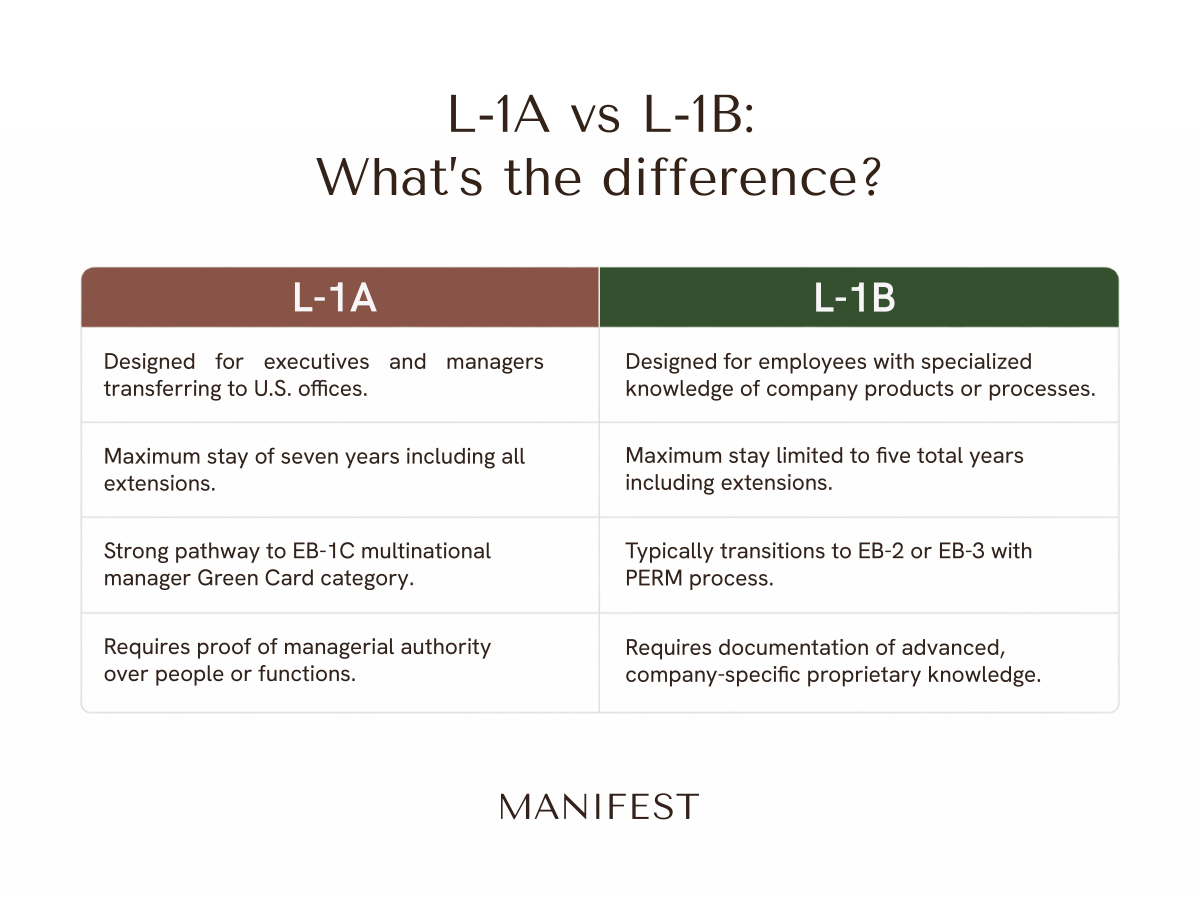
While both subcategories are part of the same L-1 visa program, each visa serves distinct purposes.
| L-1A visa | L-1B visa | |
| Who can apply | Designed for executive and manager transferees | Designed for transferees with specialized knowledge |
| Max stay and duration | Up to 3-year initial stay, can be extended to 7 years. For new office transferees, the initial stay is 1 year | Up to 3-year initial stay, can be extended to 5 years. For new office transferees, the initial stay is 1 year |
| Green Card pathways | Often eligible for EB-1C Green Card for multinational managers and executives without a labor certification. | Common options include E-B2 and E-B3, but require employer sponsorship and PERM labor certification. |
What are the advantages of an L-1A vs. L1-B visa?
L-1A advantages
- You can extend for up to 7 years, or more if you have spent time outside of the U.S. during your L1 stay.
- You qualify based on your managerial or executive role, which can be easier to document than proving specialized knowledge.
- You don’t need a PERM labor certification.
- You have a clearer path to a Green Card through the EB-1C visa category, which can make permanent residency faster.
L-1B advantages
- You don’t need to be in a leadership position, like a manager or executive to qualify.
- You don’t need a PERM labor certification.
- You still benefit from dual intent, meaning you can apply for permanent residency while on the L-1B visa.
What are the restrictions for an L-1A vs. L-1B Visa?
L-1A restrictions
- Mid-level managers or team leads usually do not qualify.
- Extensive documentation is required to prove your management role if org charts and management duties are not clearly defined.
- If you are a people manager, USCIS wants to see that you will be managing professionals (with at least a U.S. bachelor’s degree or higher).
L-1B restrictions
- You must meet a high standard to prove specialized knowledge, y and USCIS may issue an RFE.
- The maximum stay is 5 years, which is shorter than the L-1A.
- The path to a Green Card is more complex, since most L-1B employees must go through the PERM labor certification process first.
Application process for L-1A vs. L-1B visas
All L-1 categories share the same visa application process, but the documentation differs.
1. Employer files I-129
If filing through USCIS, the U.S. employer files Form I-129, Petition for a Nonimmigrant Worker, along with the L Supplement specifying whether the applicant is L-1A or L-1B. You can pay for premium processing to shorten the processing time to 15 business days.
2. Provide supporting documentation
As part of the petition, the employer must include proof of a qualifying relationship between the foreign company and the U.S. company, plus evidence of the employee’s eligibility for the specific visa category.
For L-1A, you will have to prove that you work at the management or executive level, while for L-1B, you will have to demonstrate that you have critical specialized knowledge.
3. USCIS reviews the petition
If the government needs clarification on the application, it will issue an RFE (Request for Evidence).
4. Consular processing or change of status
Once your L-1 visa is approved, you can apply at a U.S. consulate and attend a visa interview before arriving in the U.S. If you are already in the U.S. under another nonimmigrant visa, your employer can apply to change your status.
5. Arrival and work authorization
Upon approval, you can begin work at the U.S. office under your new valid L-1 status.
L-1A vs L-1B Green Card pathways
L-1A visa to Green Card (EB-1C)
If you’re in the U.S. on an L-1A visa, the EB-1C Green Card is the most natural next step— this visa category was intended for multinational executives and managers who want to become permanent residents.
If you can prove your eligibility, the EB-1C Green Card is a great option. The process can move relatively quickly, especially compared to other employment-based categories, and it can be sponsored by the same U.S. employer that issued your L-1A visa.
Applicants must demonstrate ongoing executive capacity or managerial position abroad and in the U.S.
L-1B visa to Green Card
For L-1B visa holders, the common ways to get permanent residency are typically through the EB-2 or EB-3 visa categories. These options are open to professionals with advanced degrees or specialized skills, but unlike the EB-1C, they require PERM labor certification.
Get help making the right visa decision
Choosing between the L-1A and L-1B visa—or planning your next step toward a Green Card—can be complex. Which one you should choose depends on role and company structure, but also your long-term goals in the country.
At Manifest, our experienced immigration attorneys can help you make a plan with confidence. We have years of experience working with both managerial applicants and workers with specialized knowledge. Request a consultation with our L-1 visa lawyers today.
L-1A vs. L-1B visa FAQs
What are the approval rates for L-1A vs. L-1B visas?
According to USCIS data from Fiscal Year 2025 (Year-to-Date), the approval rate for the L-1A visa is 92.3% and the approval rate for the L-1B visa is 92.9%
What are the processing times for L-1A and L-1B visas?
Typical processing times range from 1 to 6 months, depending on the service center and case complexity. Using premium processing reduces the waiting period to 15 business days.
Can L-1 visa holders transfer between employers?
No. L-1A and L-1B visa holders are limited to the employer and corporate structure that filed the petition. To work for another company, a new L-1 petition must be filed, including a new I-129. However, L-1 employees can be promoted or reassigned within the same multinational group.
What’s the difference between the L-1 visa and the H-1B?
The L-1 and H-1B are both employment-based nonimmigrant visas, but they serve different purposes. The L-1 is designed for employees transferring within the same multinational company, either as managers/executives (L-1A) or specialized knowledge professionals (L-1B). The H-1B, by contrast, is for specialty occupation workers and allows employment with any sponsoring U.S. employer.
Can spouses of L-1A and L-1B visa holders work in the U.S.?
Yes. Spouses of L-1 visa holders (L-2s) are allowed to work incident to status, which means they can work automatically, without needing to apply for a separate work permit (EAD). They can work for any employer, full-time or part-time, or even start their own business.
What is the L-1 Blanket Petition, and what are the benefits for L-1A and L-1B petitions?
An L-1 Blanket Petition lets large multinational companies pre-qualify their corporate structure with USCIS. This streamlines the process so employees can apply directly at a U.S. consulate abroad instead of waiting for USCIS approval. It dramatically speeds up processing for both L-1A and L-1B applicants.
For Canadian citizens, there’s also the NAFTA (now USMCA) option, which allows them to apply for L-1 status at the border or port of entry rather than through a consulate or USCIS, making the process even faster.