



- EB-2 visas are for advanced degree or exceptional ability professionals, with an NIW option allowing self-petition without employer sponsorship.
- EB-3 visas cover skilled, professional, and certain unskilled workers, requiring employer sponsorship and PERM labor certification in most cases.
- EB-2 and EB-3 share similar processes, but EB-2 typically moves faster unless country-specific backlogs affect visa availability.
- Choosing the right category depends on your education, experience, job offer, and eligibility for a National Interest Waiver or Schedule A designation.
If you want to pursue a U.S. Green Card based on your work experience or professional qualifications, the EB-2 and EB-3 are two of the most common immigrant visas. Both are employment-based paths to permanent residency—but they’re designed for different types of professionals and have different requirements, timelines, and advantages.
The EB-2 is a second preference employment-based visa, and it’s an option for professionals with advanced degrees or exceptional ability. An advanced degree means the professional has a master’s degree or higher-level degree or a professional who has a bachelor’s degree and five years of experience after graduation in your field.
The EB-3 is even more accessible for a wider group of skilled workers, professionals, and even some other workers. It’s designed for individuals who might not qualify under the EB-1 or EB-2 visas but still have valuable skills needed by U.S. employers.
Let’s take a closer look at both options.
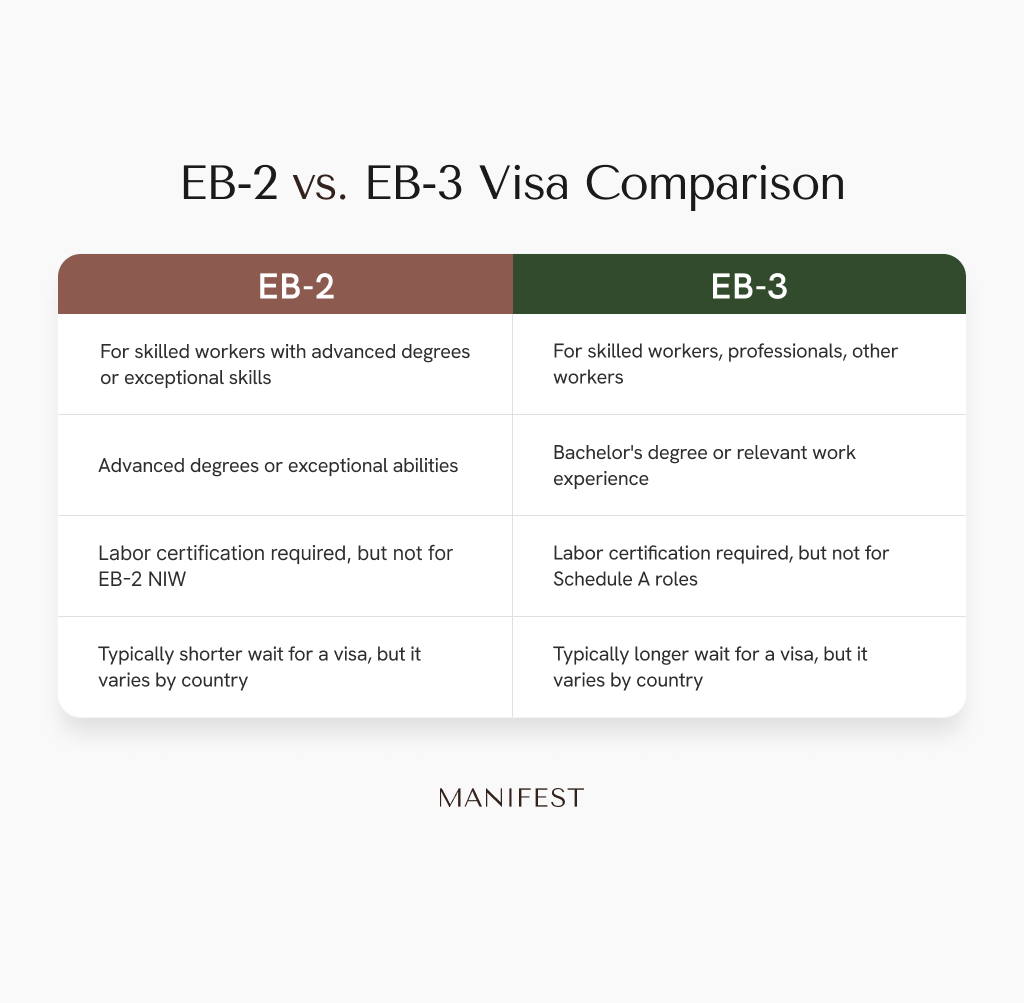
EB-2 vs. EB-3 comparison chart
While both the EB-2 and EB-3 visas are employment-based Green Card options, there are some key differences you should know. Understanding the two categories will help you decide which option is best for your unique eligibility and qualifications.
See the table below to compare details for these two visa types.
| EB-2 Visa | EB-3 Visa | |
| Eligible Professionals | Professionals with advanced degrees (includes professionals with a master’s degree or higher-level degree or bachelor’s degree or its equivalent and 5 years of experience in their related field post graduation) or exceptional abilities. | Skilled workers, professionals, and other workers |
| Proof Required | An advanced degree (master’s degree or higher) or a bachelor’s degree with at least five years of work experience post graduation or exceptional abilities, which you would prove with professional licenses, employer letters, awards received, awards, recognitions, high salary, or comparable evidence | Bachelor’s degree; two+ years of job experience or training; unskilled labor with less than two years of job experience |
| Labor Certification (PERM) | Required unless applying under a National Interest Waiver (NIW) or Schedule A category | Required unless applying for the U.S. Department of Labor’s Schedule A occupation designation |
| Job Offer | Usually required, except if applying for a National Interest Waiver (NIW) | Required |
| Application Process | Three-step process: PERM labor certification (unless NIW or Schedule A), Form I-140 petition, then adjustment of status or consular processing. NIW applicants can self-petition and skip PERM. | Three-step process: PERM labor certification, Form I-140 petition, then adjustment of status or consular processing. Requires employer sponsorship and PERM in nearly all cases. |
| Sponsorship Requirements | Employer sponsorship required, unless NIW applies | Employer sponsorship required |
| Priority Dates | Typically more recent than EB-3, meaning applicants can apply sooner | Longer wait times for priority dates to become current |
| 💡Not sure whether the EB-2 or EB-3 visa is right for you? Request a consultation with Manifest Law today to speak with an experienced immigration attorney who can help you select the best Green Card strategy for your unique situation. |
What is the EB-2 visa?
The EB-2 visa is a type of Green Card for skilled professionals and individuals with advanced degrees who want to live and work permanently in the U.S. It’s designed for people who either have high-level educational qualifications under the Advanced Degree criteria or exceptional abilities in their field.
There are two main types of EB-2 visas, plus the National Interest Waiver:
Subscribe to our newsletter for immigration resources and news, without the legal jargon.
EB-2 Visa: Advanced Degree Professionals
If you have an advanced degree or significant work experience in your field and are looking to take your career to the next level in the U.S., then the EB-2A visa might be the right path to U.S. citizenship for you.
- Who it’s for: Professionals with advanced degrees (master’s degree or higher) or those with a bachelor’s degree plus at least five years of progressive experience in their field
- What you need: You must provide proof of your advanced degree or a bachelor’s degree and significant work experience. This could include diplomas, transcripts, and letters from past employers.
- Labor certification required?: Generally, you need a labor certification to prove that there are no qualified U.S. workers available for the position. However, if you qualify for a National Interest Waiver (NIW), you can skip this requirement.
| 💡 What is Labor Certification (PERM)? Labor certification, also known as PERM, is a process where a U.S. employer must prove there are no qualified U.S. workers available for a job. It’s required for most EB-2 and EB-3 Green Card cases, unless you qualify for a National Interest Waiver. |
EB-2 Visa: Individuals with Exceptional Ability
To qualify for the EB-2 under the exceptional ability classification,, you’ll need to demonstrate that your skills and achievements are significantly above the standard in your industry.
- Who it’s for: Individuals who have exceptional ability in their field, such as science, arts, or business
- What you need: You need to provide evidence of your exceptional ability. You can provide proof of your ability through awards received, memberships in professional organizations, letters from employers showing work experience of at least 10 years, proof of high salary in your field, proof of important contributions in your field, or professional licensure for your field. USCIS requires that you meet at least three of the listed criteria.
- Labor certification required?: For an EB-2, you usually need a labor certification unless you qualify for a National Interest Waiver (NIW).
What is the EB-2 NIW visa?
The EB-2 National Interest Waiver (NIW) is a special path within the EB-2 category that allows professionals to self-petition for a Green Card without an employer sponsor. It’s designed for individuals whose work serves the national interest, such as advancing science, public health, technology, education, or the economy.
If you’re working on a project that benefits your entire field, industry, or the country as a whole, this could be a good option for you.
To qualify, you must meet the basic EB-2 criteria (either an advanced degree or exceptional ability) and demonstrate:
- Your work is of significant value and importance to the interests of the U.S.
- You have the skills and experience to advance the project or work
- The U.S. would benefit from waiving the standard job offer and labor certification requirements in your specific case
The EB-2 NIW is especially appealing because it allows you to self-petition and doesn’t require an employer sponsor or going through the PERM process. Researchers, physicians, startup founders, and public sector professionals can take advantage of this path if they have a compelling case and strong evidence to prove their work is in the national interest.
What is the EB-3 visa?
The EB-3 visa is a type of Green Card for skilled workers, professionals with a bachelor’s degree, and certain unskilled workers who want to live and work permanently in the U.S. It’s designed for people who have either some work experience or a degree but does not escalate to an advanced degree or professional that fits the extraordinary ability criteria.
There are three types of EB-3 categories:
EB-3 Visa: Skilled Workers
If you have at least two years of work experience or training in your field, but don’t hold a degree, the EB-3 might be an option for you.
- Who it’s for: Skilled workers with at least two years of experience or training
- What you need: You must provide proof of your work experience or training, and this can be through letters from current or former employers. Academic records could provide proof of relevant training through post-secondary education, even if you didn’t complete a degree program.
- Labor certification required?: You need a labor certification to prove that there are no qualified U.S. workers available for the position with your employer.
EB-3 Visa: Professionals
The EB-3 visa could be a path for you if you’ve earned a bachelor’s degree, or a foreign equivalent, and have a job offer from a U.S. employer that requires your degree.
- Who it’s for: Professionals who’ve earned a bachelor’s degree, or foreign equivalent, and have a role that requires that degree
- What you need: You will need to provide academic records showing proof of your degree for the EB-3 visa. A combination of education and experience without a full bachelor’s degree won’t qualify for this route.
- Labor certification required?: You need a labor certification to prove that there are no qualified U.S. workers available for the position with your employer.
EB-3 Visa: Other Workers
For workers without a degree who provide unskilled labor that requires less than two years of work experience or training, the EB-3C visa is an option. The job with a U.S. employer must be a full-time, permanent role, not temporary or seasonal work.
- Who it’s for: Other workers, or unskilled workers, who fill a role that requires less than two years of experience or training
- What you need: You will need to provide proof that you meet the qualifications of the role specified in the labor certification.
- Labor certification required?: You need a labor certification to prove that there are no qualified U.S. workers available for the position with your employer.
| 💡What is a Schedule A occupation designation? Employers can request that the U.S. Department of Labor (DOL) waive certain steps of the PERM labor certification process for occupations with a documented shortage of qualified U.S. workers. These jobs include nurses, physical therapists, and individuals with exceptional ability in the sciences, arts, including college and university teachers and exceptional ability in the performing arts. |
Key differences between the EB-2 vs. EB-3 Green Cards
The EB-2 and EB-3 visas both offer a pathway to U.S. permanent residency, but there are some differences in eligibility requirements, process, and speed of adjudication. Here are a few key differences to know:
1. Eligibility criteria
- EB-2: Designed for skilled workers with an advanced degree or exceptional ability in their field. The National Interest Waiver (NIW) offers a self-petition path for certain EB-2 applicants who work on projects that benefit the national interest.
- EB-3: Designed for skilled workers without a degree but work experience, hold a bachelor’s degree, or certain other workers who perform unskilled labor.
2. Evidence requirements
- EB-2: Visa applications need to include academic credentials or proof of exceptional ability, often demonstrated through education, experience, or letters of support. For NIW cases, USCIS also assesses whether your work has national importance, whether you are well-positioned to implement your project, and justifies waiving the labor certification.
- EB-3: Academic records, letters from current and former employers, and degrees can serve as proof of eligibility for visa applicants in this category.
3. Self-petition vs. employer sponsorship
- EB-2 NIW: Can be self-petitioned.
- Standard EB-2 PERM and EB-3 PERM: Require a U.S. employer to sponsor your petition and, in most EB-2 and EB-3 cases, a labor certification.
4. PERM labor certification
- EB-2: Typically requires labor certification, unless applying under the National Interest Waiver or applying for Schedule A Occupation designation.
- EB-3: Typically requires labor certification, unless applying for Schedule A Occupation designation.
5. Visa bulletin and backlogs
- EB-2: Can face long waits for priority dates, especially for applicants from India or China. NIW petitions may also take longer to adjudicate because of the additional evidence required, though they share the same visa queue as other EB-2 cases.
- EB-3: Processing and priority date movement can vary by country and year. In some periods, EB-3 moves faster than EB-2 for certain countries, and vice versa. EB-3 for India, for example, has a longer wait than EB-2 visas from India.
| 💡What is the Visa Bulletin, and why does it matter?The Visa Bulletin, published monthly by the U.S. Department of State, shows when someone can seek residency and which Green Card applications are currently being processed based on priority date, country of birth, and visa category (like EB-2 or EB-3). |
If your priority date is “current,” you can move forward with your Green Card. If it’s backlogged, you’ll need to wait until your date becomes current. This matters most for professionals from high-demand countries like India or China, where EB-2 and EB-3 backlogs are common. Other categories, such as EB-1, often move faster but have higher bars for eligibility.
6. Processing time
- EB-2: Slightly faster than EB-3 processing, but applying with a NIW and using premium processing can speed up the process.
- EB-3: Visa processing time can be longer due to higher demand and a lower bar to meet eligibility for EB-3 visas.
EB-2 vs. EB-3: Which is better?
Your personal qualifications and eligibility will play a large role in choosing between EB-2 and EB-3.
The EB-2 visa is a good choice if you have an advanced degree or exceptional abilities in your field and plan to apply for an adjustment of status or consular processing once your priority date is current. If your work qualifies for a National Interest Waiver, that can speed up the process plus give you more flexibility to submit your own petition without an employer sponsor.
The EB-3 visa offers a path to a Green Card for individuals who don’t have an advanced degree but have work experience that U.S. employers need. While processing times are a bit longer than for EB-2 visas, the EB-3 is a solid choice if you clearly qualify and have an employer sponsor.
Some applicants may qualify for both EB-2 and EB-3 categories. In that case, it can be strategic to pursue both, depending on which priority date moves faster — though it’s best to decide this with help from an immigration attorney.
Bottom line: the “better” choice between EB-2 and EB-3 depends on which category aligns best with your education, experience, long-term immigration goals, and timeline.
Need help with your EB-2 or EB-3 strategy?
At Manifest Law, we specialize in high-stakes immigration cases for skilled professionals. Our experienced immigration attorneys will evaluate your qualifications, recommend the strongest filing strategy, and guide you every step of the way, from evidence prep to approval.
👉 Request a consultation and get clarity on your Green Card path today.
FAQs about EB-2 vs. EB-3
Can I apply for both at the same time?
If you qualify for both EB-2 and EB-3 categories, you may choose to file petitions under both. This can serve as a strategic backup. If the priority date for EB-2 or EB-3 becomes current earlier, you’ll be ready. Dual filings do involve extra cost and complexity, and the ultimate timeline still depends on visa number availability.
How does PERM processing work for EB-2 and EB-3?
The permanent labor certification process, also known as the PERM process, is the first step before your employer can sponsor you for an EB-2 PERM or EB-3 PERM Green Card. This process tells the U.S. government that sponsoring a new Green Card holder for a job with the employer won’t hurt the U.S. job market or drive down wages.
Employers will need to receive a prevailing wage determination from the Department of Labor, then make a reasonable effort to hire an American citizen worker for the role. If they don’t make a hire, they can submit Form ETA 9089, the Application for Permanent Employment Certification. Once that’s approved, the employer can then file Form I-140 to proceed with your petition.
Can I sponsor myself for an EB-2 or EB-3 Green Card?
You can self-sponsor for an EB-2 Green Card by receiving a national interest waiver in the EB-2 category (known as EB-2 NIW), which lets you apply for the Green Card without a job offer or PERM labor certification. You’ll need to prove in your petition that your work is of major importance to the U.S., which means including large amounts of evidence.
The EB-3 does not offer self-sponsorship.
Can my three-year bachelor’s degree count towards the educational requirement?
A three-year bachelor’s degree typically does not meet the educational requirement for EB-2 or EB-3 skilled worker PERM-based green card applications because it is not considered equivalent to a four-year U.S. bachelor’s degree. While some three-year programs from certain countries were once accepted, current evaluations—such as those found in the Electronic Database for Global Education (EDGE)—usually determine that these degrees represent only two to three years of U.S. undergraduate study, rather than a full bachelor’s equivalent. For professional-level positions under EB-2 or EB-3, combining a three-year degree with work experience or additional coursework generally does not satisfy the required educational equivalency.