




- The E-1 visa is for companies with a continuous, high volume of international trade, with more than half of the trade conducted with the U.S.
- The E-2 visa requires you to invest substantial, at-risk capital to start or or direct a U.S. business.
- Both E-1 and E-2 visas allow for an initial two-year stay that can be renewed indefinitely if you keep meeting the qualifications.
The E-1 treaty trader and E-2 treaty investor visas allow citizens of certain countries to run businesses in the U.S. Both visas are temporary, but they’re designed for different goals. The E-1 visa is for companies that focus on international trade, while the E-2 is for people making a large financial investment to start or direct a U.S. company.
| 🧑⚖️Clear guidance, without the legal jargon. This article is informed and reviewed by Manifest Law’s experienced immigration attorneys—and written to make the law make sense. Because you deserve to understand the system, not fight it. Check out our editorial policy for more info. |
E-1 vs. E-2 at a glance
Choosing between the E-1 treaty trader visa and E-2 treaty investor visa is often the first step for foreign nationals looking to launch or grow a U.S. business. Both nonimmigrant visas let you stay long-term and are based on treaties. The key distinction is the primary activity for each: For the E-1 visa, you must conduct trade between your home country and the U.S.; for the E-2, you need a significant investment in a U.S. business.
| Feature | E-1 treaty trader visa | E-2 treaty investor visa |
| Purpose | For you or your business to conduct substantial trade between the U.S. and the treaty country | For you to develop and direct an enterprise in which you make a substantial capital investment |
| Key requirement | Trade must be continuous and trade with the U.S. must comprise more than 50% of the firm’s total international trade | Proving the capital you invest is “at risk” and the business is not “marginal” |
| Nationality | At least 50% of the U.S. enterprise must be owned by a national of a treaty country | At least 50% of the U.S. enterprise must be owned by a national of a treaty country |
| Maximum initial stay | Up to 2 years | Up to 2 years |
| Renewal | Indefinitely if you continue to meet the qualifications and you maintain an intention to depart | Indefinitely if you continue to meet the qualifications and you maintain an intention to depart |
| Path to Green Cad | Not direct. Requires switch to an immigrant visa, such as EB-1 or EB-2 | Not direct. Requires switch to an immigrant visa, such as EB-1 or EB-2 |
What are the E-1 and E-2 visas?
The E-1 and E-2 classifications are temporary, nonimmigrant visas established by U.S. treaties with specific countries. They are designed for foreign nationals who enter the U.S. as part of certain business activities or investments.
They’re similar in that both grant an initial admission of up to two years and can be renewed indefinitely. Extensions are processed by U.S. Citizenship and Immigration Services (USCIS) if you’re in the U.S., while a consular officer will review your application if you’re abroad. Also, both visas can cover the owner/investor as well as employees, if they’re serving in an executive, supervisory, or essential role.
Subscribe to our newsletter for immigration resources and news, without the legal jargon.
E-1 treaty trader visa
The E-1 visa allows a citizen of a treaty country to enter the U.S. to carry on substantial trade activities in areas such as services or technology, principally between the U.S. and the treaty country.
E-2 treaty investor visa
The E-2 visa allows a citizen of a treaty country to enter the U.S. to develop and direct the operations of an enterprise in which they have invested, or are in the process of investing, a substantial amount of capital.
Key differences between E-2 and E-1 visas
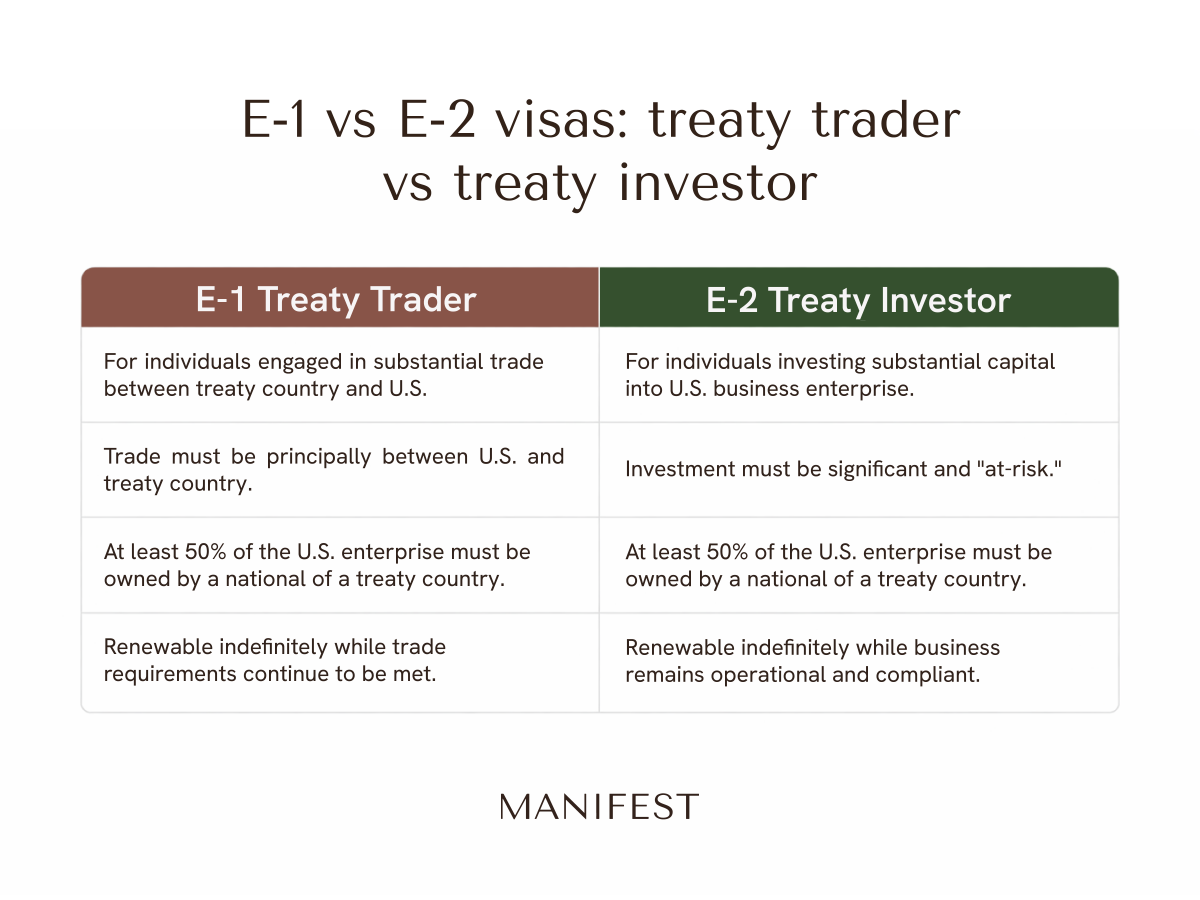
The distinction between the two visas centers on what your company does and the evidence you need to prove its compliance with the treaty. The E-1 visa primarily requires a continuous volume of goods or services, while the E-2 calls for a commitment of capital to develop an operating business. The specific requirements for each visa are codified in immigration law.
Business qualifications
For the E-1 treaty trader, the business must engage in ongoing trade of items such as goods, services, or technology. You have to show:
- Your trade is substantial, meaning there’s a continuous flow of transactions.
- Your trade is principally conducted between the U.S. and the treaty country, meaning it makes up more than 50% of the total international volume of trade.
For the E-2 treaty investor, the focus is on investment in the business. You have to show:
- The investment you make is substantial relative to the size of the enterprise.
- The business is not marginal. It must generate significant revenue, beyond what the investor needs to make a living.
Required evidence
- E-1: The applicant must provide documentation like invoices, bills of lading, and purchase orders to demonstrate the volume of continuity of international trade transactions.
- E-2: For a successful visa application, you should include a business plan, the source of funds you invest, and proof of the expenditure of capital, such as escrow documents, purchase agreements, and equipment inventory listings.
Who qualifies for an E-1 treaty trader visa?
The E-1 visa allows a citizen of a treaty country to enter the U.S. to engage in substantial trade in goods, services, or technology, principally conducted between the U.S. and the treaty country. The business should have a high volume of continuous transactions. Meeting these standards determines your eligibility:
E-1 eligibility criteria
The E-1 visa can be issued to:
- The principal treaty trader: The owner or director of a qualifying enterprise engaging in substantial trade between the treaty country and the U.S.
- Essential employees: Staff coming to serve in an executive, supervisory, or essential capacity that requires their specific, special qualifications. For example, a company executive who must be in the U.S. to manage ongoing trade contracts, or a technician with specialized knowledge of the traded product.
The applicant must prove that they have the nationality of the treaty country and own at least 50% of the trading business.
| 🧑💼 Curious how others in your field made it work?Manifest Law’s experienced attorneys have helped thousands of immigrants secure their future in the U.S. Explore our visa approval notices and success stories to learn how we helped founders, researchers, and artists like you turn their stories into winning petitions. |
Who qualifies for an E-2 treaty trader visa?
The E-2 visa allows a citizen of a treaty country to invest a substantial amount of capital in a U.S. business and come to the U.S. to develop and direct that business. This nonimmigrant classification is designed for entrepreneurs who commit funds to an active enterprise. Your eligibility largely depends on your investment.
E-2 eligibility criteria
The E-2 visa can be issued to:
- The principal treaty investor: The person who has invested substantial capital in the U.S. business. For example, someone starting a new restaurant or launching a consulting firm with a significant sum of money.
- Essential employees: Like the E-1 visa, the E-2 status can also be granted to employees with special qualifications essential to the successful operation of the enterprise, or those in executive or supervisory roles.
The capital invested must be substantial, actively committed, and the business must not be marginal. It has to be able to generate more than a living for the investor.
What are the treaty countries?
E-1 and E-2 visas are only available to citizens of countries with which the U.S. maintains a treaty of commerce and navigation. Not all countries qualify for both E-1 and E-2. The Department of State maintains a list of treaty countries on its website.
How to choose between an E-1 and E-2
The decision hinges on what your company does. The E-1 visa requires proof of extensive, continuous trade, while the E-2 visa requires proof of a substantial, at-risk capital investment.
Questions to ask about your business
If you answer yes to most of these questions, the E-1 visa is likely the best fit:
- Does your business already engage in a continuous, high volume of trade with the U.S.?
- Does trade with the U.S. account for more than half of your company’s international trade volume?
- Are you personally coming to the U.S. to oversee or manage this ongoing trade?
- Do you have documentation, like bills of lading and contracts, showing a steady flow of trade?
- Is the business trading goods, services, banking services, or technology?
If you answer yes to most of these questions, the E-2 is likely the best fit:
- Have you committed a substantial amount of capital to a new or existing U.S. business?
- Is there a risk you could lose your investment if the business fails?
- Will the business generate revenue beyond a minimal living for you and your family?
- Is your role to develop and direct the operations of the business?
- Is the business currently actively producing goods and services for profit?
Getting legal help for an E-1 or E-2 visa
The E-1 is for businesses doing a high volume of continuous, international trade, while the E-2 is for entrepreneurs making a substantial investment in the U.S. In either case, you must provide complex documentation to meet the eligibility requirements.
👉 Our immigration lawyers can help you prepare a compelling evidence package for your E-1 or E-2 visa application. Request a consultation with Manifest Law now.
Frequently asked questions
What counts as ‘substantial trade’ for an E-1 visa?
Substantial trade is defined by a continuous flow of numerous, recurring transactions, not necessarily a fixed dollar amount. The trade must principally be between the U.S. and the treaty country, meaning more than 50% of the company’s international trade volume. This can include goods, services, banking services, or technology transfers.
How do I know if my country qualifies for E-1, E-2, or both?
Check the official U.S. Department of State’s list of countries that maintain treaties of commerce and navigation with the U.S. Not all E-1 countries are E-2 countries, and vice versa.
Can my spouse work in the U.S. on an E-1 or E-2 visa?
Yes, dependent spouses of E-1 and E-2 visa holders are authorized to work. The class of admission code on their I-94 (either E-1S or E-2S) serves as proof of authorization.
Can an E-1 or E-2 visa lead to a Green Card?
The E-1 and E-2 visas are temporary, nonimmigrant categories, so they do not directly lead to a Green Card. But they can be a first step, allowing you to establish a U.S. business that can help you transition to an employment-based visa category, such as the EB-1C (multinational executive) or EB-2 national interest waiver, which can both lead to permanent residency.