

Embassy vs. Consulate: What’s the Difference?
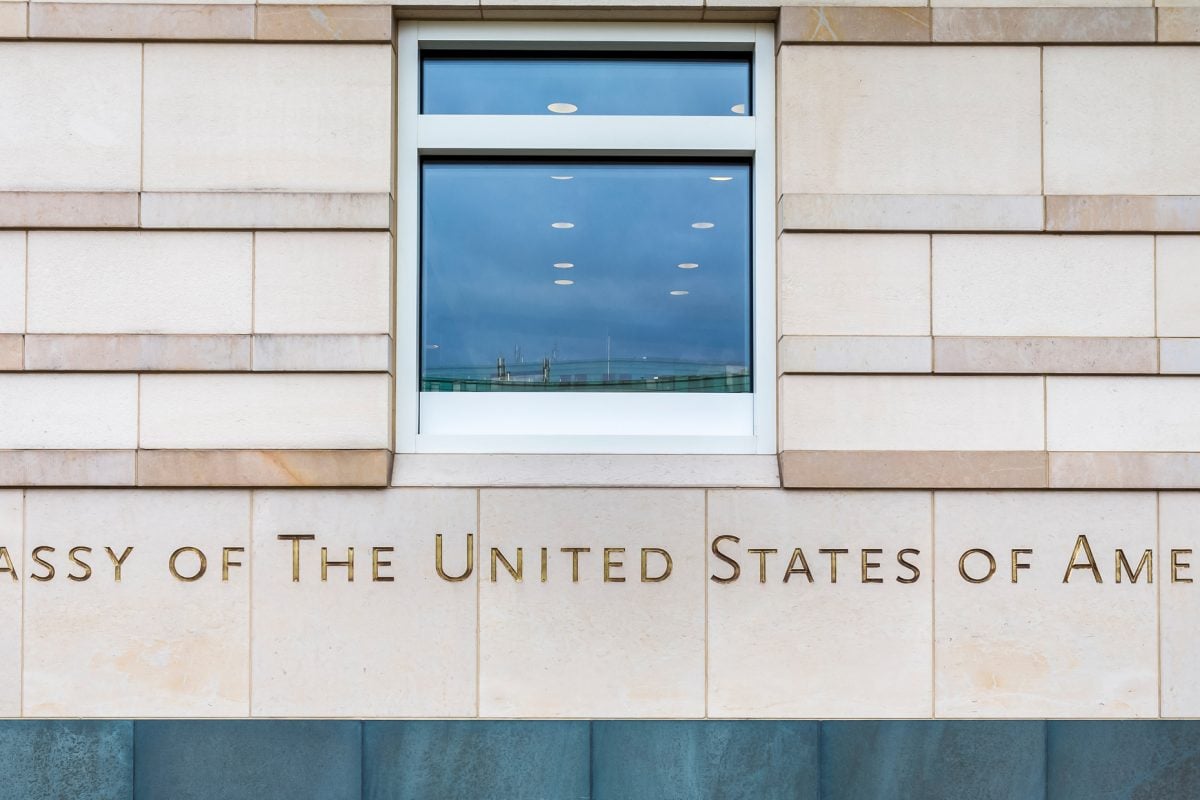
- Embassies are the main U.S. diplomatic missions in capital cities, led by ambassadors and responsible for managing overall political relations.
- Consulates are smaller regional offices led by consuls general, handling visas, passports, emergencies, and local citizen services.
- Most immigrant and nonimmigrant visa applicants must attend in-person interviews at a U.S. embassy or consulate, with only narrow exceptions.
- Applicants usually cannot choose their interview location, which is assigned based on residence and sometimes nationality.
When you apply for a U.S. visa abroad, you’ll almost always deal with a U.S. embassy or consulate. The terms are often used together or interchangeably, especially when people talk about “going to the embassy” for a visa interview.
There are, however, some key differences between an embassy and a consulate. Whether you’re applying for a new visa or renewing a visa, understanding those differences can help you make sense of where your case is processed and who does what. In most countries, visa interviews actually happen at the consulate or the consular section of the embassy.
What is an embassy?
An embassy is the main diplomatic mission of one country inside the borders of another country. The United States, for example, has embassies in India, China, the United Kingdom, and more than 100 other countries.
Staff at embassies assist Americans who visit or live in a host country. They also handle diplomatic functions and interact with local governments, businesses, and communities to foster relationships.
| 💡 The U.S. has no embassy in a few countries, including North Korea, Bhutan, Iran, and Syria. In Taiwan, the American Institute in Taiwan (AIT) is not technically an embassy but provides similar consular and visa services on behalf of the United States. |
What is a consulate?
A consulate is a smaller, local branch or extension of an embassy. They often provide the same services as an embassy but have fewer staff.
Consulates typically review visa applications and interview host country citizens who want to visit or immigrate to the United States. Consular officers assess whether people requesting to enter the U.S. qualify under U.S. law and don’t pose any security risks.
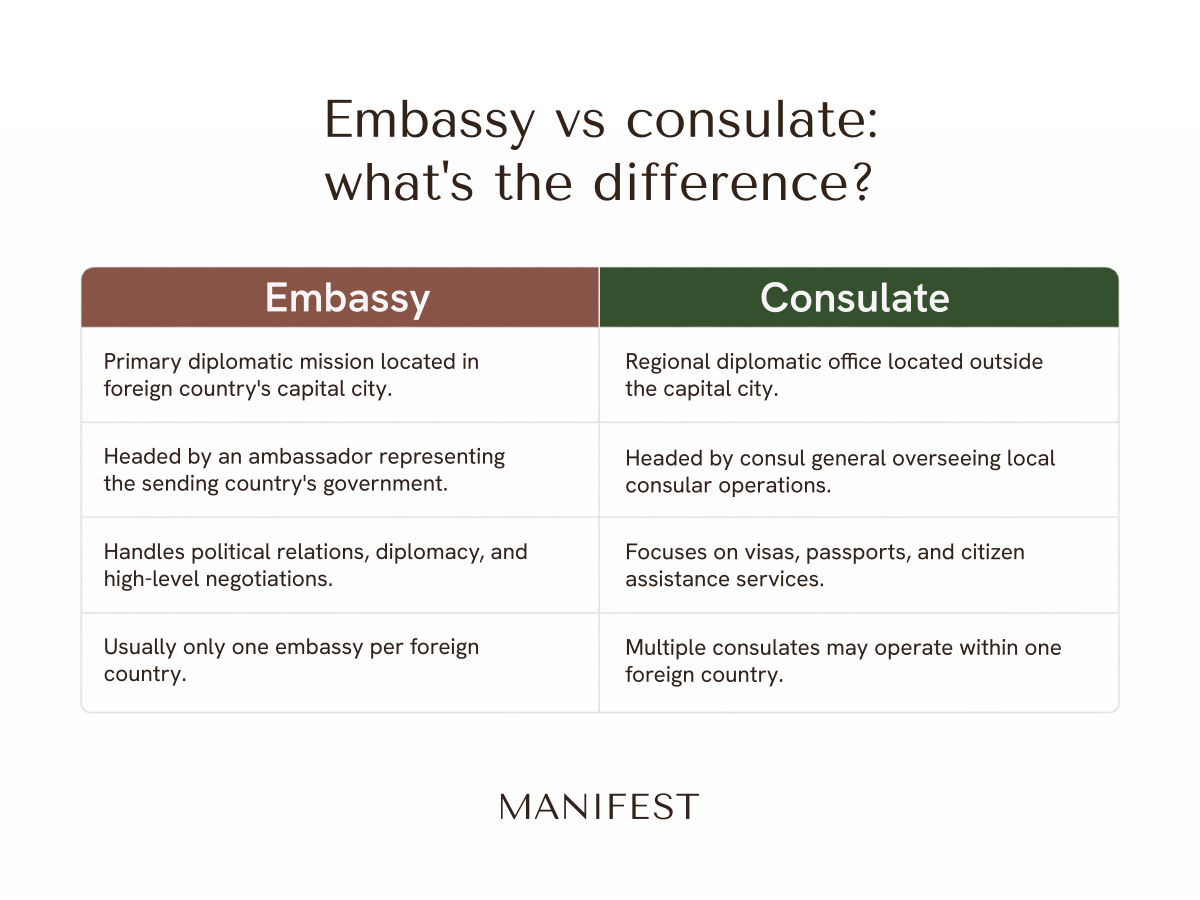
Embassy vs Consulate: Key Differences
Here is a quick guide to the key differences between consulates and embassies.
| Feature | Embassy | Consulate |
| Location | Usually in a capital city | Other major cities |
| Head official | Ambassador | Consul general |
| Main role | Manages the overall U.S. relationship with the host country | Helps people in that city or region with passports, emergencies, and visas |
| Visa work | Many embassies have a consular section (department) that processes visas and provides services to U.S. citizens. | Often, the main place for visa applications and interviews in that region. |
Not every U.S. embassy or consulate processes visas, so it’s always worth checking the post’s website to see which services are available.
Where are embassies and consulates located?
An embassy is usually located in the capital city of a host country. In India, for example, the U.S. embassy is in New Delhi.
Consulates are usually located in other major cities of a host country. To use our same example host country, the U.S. has consulates in India in Mumbai, Chennai, Hyderabad, and Kolkata.
In Mexico, for example, the embassy is in Mexico City. There are consulates in a number of cities, including Tijuana, Guadalajara, and Ciudad Juarez, to name just a few.
Visa interviews at an embassy vs. consulate
For most people, getting a U.S. visa means going to an in-person interview at a U.S. embassy or consulate.
Immigrant visas (Green Cards)
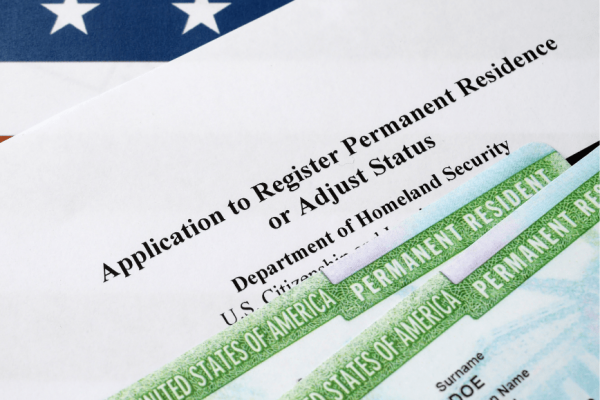
For immigrant visas processed abroad (known as consular processing), U.S. law and State Department regulations have long required a personal interview with a consular officer. That in-person interview is a major factor in deciding whether to issue or refuse an immigrant visa.
There was a temporary COVID-era rule that let consular officers waive the in-person interview for a small group of certain immigrant visa replacement applicants, but it didn’t eliminate the general interview requirement for new immigrant visa cases.
The National Visa Center (NVC) schedules your interview at the embassy or consulate that processes immigrant visas for your country of residence (or, in some cases, nationality).
As of November 1, 2025, the State Department requires immigrant visa applicants to be scheduled for interviews in the consular district for their country of residence, or in their country of nationality if requested.
So you usually don’t get to choose “embassy vs consulate.” You go wherever NVC assigns you, which might be the U.S. embassy in your capital city or a designated consulate (for example, Ciudad Juárez for many applicants in Mexico or Montreal for many in Canada).
| 💡 If you are already in the United States and apply for a Green Card through adjustment of status, your interview is usually with USCIS inside the U.S., not at an embassy or consulate abroad. |
Nonimmigrant visas (or temporary visas)
For nonimmigrant visas such as tourist, student, or work visas, in-person interviews have long been standard, but consular officers were allowed to waive interviews for certain low-risk or renewing applicants. That interview waiver was granted more frequently during the COVID-19 pandemic, and many people were able to renew visas without going in.
In 2025, the State Department began rolling back most of the pandemic-era nonimmigrant visa interview waivers. Beginning September 2, 2025, most nonimmigrant visa applicants would once again need to appear in person for an interview, with only narrow exceptions.
A separate update clarified that, effective September 6, 2025, nonimmigrant visa applicants should schedule their interview at the U.S. embassy or consulate in their country of residence or nationality.
Bottom line: Today, most people, whether you’re applying for an immigrant visa or a temporary nonimmigrant visa, can expect to go in person to a U.S. embassy or consulate for an interview. You’ll usually be scheduled at the post that serves your country of residence (or, in some cases, your country of nationality), and you generally can’t just pick whichever embassy or consulate you prefer.
| 💡 Facing consular reschedules in India? Manifest Law is tracking how the new social media vetting mandate is impacting H-1B and H-4 applicants, including unexpected interview delays and what workers and employers can do next. |
Does every country have an embassy and consulates?
While most countries do host a U.S. embassy, there are a few that do not. Some countries do not have a diplomatic relationship with the U.S., while others, usually smaller countries, have a diplomatic relationship but no embassy.
Diplomatic relations with another country can change over time. The U.S. embassy in Havana, Cuba, for example, closed in 1961 and remained closed for 54 years until reopening in 2015.
In some smaller countries, there might only be an embassy and not a consulate. This is the case for Oman and Mongolia, for example.
Who runs an embassy or consulate?
A U.S. ambassador leads an embassy in a host country. Ambassadors are considered the highest-ranking U.S. officials in the countries where they serve.
A consul general is the top official who leads a U.S. consulate.
Have questions about your specific case or interview location? Request a consultation with Manifest Law to get tailored guidance from an experienced immigration attorney.
FAQs
Do I get to pick my embassy or consulate?
Usually no. NVC (for immigrant visas) or the online scheduling system (for nonimmigrant visas) assigns your interview based on where you live or, in some cases, your nationality.
Can I change my interview location?
Sometimes. You can ask to transfer your case, but many posts will not accept “third-country” applicants, especially under the new interview location rules.
Are there still interview waivers?
Very few. Some limited categories (like certain diplomatic visas or low-risk renewals) may still qualify, but most applicants must now appear in person.
What if there is no U.S. embassy or consulate in my country?
The State Department designates a post in another country to handle your case. Your NVC or appointment instructions will tell you where to interview.