



Extraordinary by Design: The Countries Producing Top O-1 Talent

The O-1 visa is quietly becoming one of the most widely used visas for highly skilled foreign professionals who hope to live and work in the U.S.
Although the visa has one of the highest standards of eligibility—O-1 applicants must prove they have either extraordinary ability or national recognition—recent data shows that O-1 filings have surged to more than 3,000 per month.
That number remains small compared to the O-1’s more well-known cousin, the H-1B. But as the H-1B becomes less accessible, thanks to the recent implementation of a $100,000 fee and a weighted lottery, both employers and foreign professionals are reassessing their options.
For businesses, the O-1 offers a stable, cap-exempt path to secure specialized talent without the uncertainty of a lottery. For workers, it provides a viable alternative for continuing or starting U.S.-based work when the H-1B is no longer an option.
That growing interest is reflected in who is actually receiving O-1 visas, and where those recipients are coming from.
Subscribe to our newsletter for immigration resources and news, without the legal jargon.
Workers from these 10 countries receive the most O-1 visas
Each month, thousands of professionals with documented achievement in the arts, athletics, science, business, and education are approved for the O-1 visa.
The recipients largely come from the U.K., China, India, and Brazil.
| Country | Number of issued O-1 visas |
| Great Britain and Northern Ireland | 2,983 |
| China | 1,767 |
| India | 1,657 |
| Brazil | 1,480 |
| Mexico | 915 |
| France | 851 |
| Germany | 798 |
| Italy | 722 |
| Australia | 708 |
| South Korea | 618 |
Caption: Data taken from the U.S. Department of State’s Monthly Nonimmigrant Visa Issuance Statistics, between June 2024 and May 2025.
On a month-by-month basis, these rankings rarely fluctuate. The U.K. consistently takes the No. 1 spot for most O-1 visas issued*, followed closely by India and China. Australia, Brazil, Mexico, South Korea, and several Western European countries close out the last of the top 10 spots.
The throughline remains clear: Each of these countries has a foothold on the global arts, research, and sports industries. High-profile figures such as pop star Justin Bieber have received O-1 visas, alongside thousands of lesser-known professionals whose work has demonstrated extraordinary impact within their fields.
| *These figures reflect O-1 visa stamps issued by U.S. consulates, not the total number of new O-1 approvals. The State Department counts first-time visas, renewals, and new visa stamps issued to those who already hold O-1 status and need to travel internationally. |
The O-1 picks up where the H-1B leaves off
The O-1 has several benefits over the H-1B that make it an attractive alternative for foreign workers. Although the standard of eligibility is higher, the O-1 visa isn’t subject to an annual cap and has a 94% approval rate. By contrast, the H-1B is capped at 85,000 visas per year, far fewer than the number of foreign workers who apply, making an annual lottery the norm.
You also don’t need to be working in a specialized role to qualify for the O-1, so you can work in your industry for multiple employers and across as many gigs as your petition or sponsor allows.
And while the H-1B visa is limited to two three-year validity periods, you can renew your O-1 visa indefinitely. That means you can keep working in the U.S. if your Broadway show gets renewed, your team makes it to the playoffs, or if your research funding gets extended for multiple more years.
Manifest immigration attorney Ana Gabriela Urizar says O-1 holders are often professionals whose work is inherently international and project-based. “Think touring artists, athletes competing in international leagues like the upcoming World Cup, or researchers collaborating across borders,” she says. “Many of the O-1 cases I’ve seen are from those who need to travel in and out of the U.S. often.”
What countries dominate the H-1B vs. the O-1 visa?
Unlike the nationalities of H-1B workers, the O-1 has a more evenly spread global representation. Below you can compare the top five countries with issued H-1B and O-1 visas, as well as the percentage.
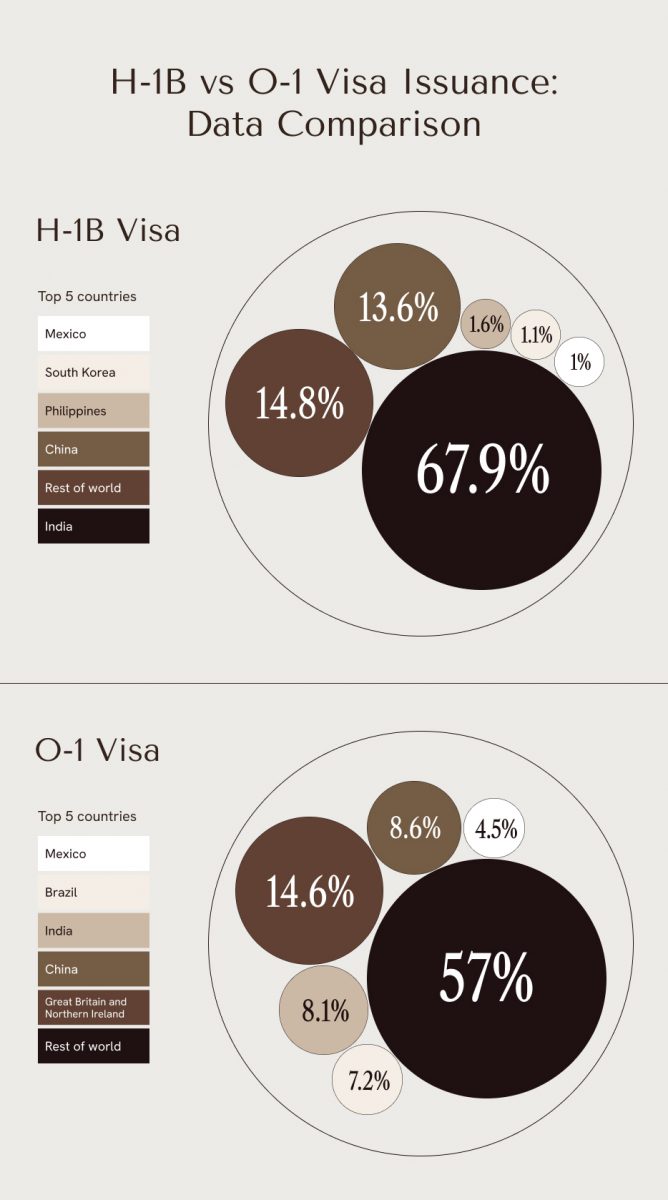
Immigration attorney Urizar says the contrast reflects how each visa channels talent into the U.S. The H-1B is built around long-term, employer-sponsored corporate roles, which rely heavily on established recruiting pipelines, particularly in India.
The O-1, by comparison, is structured for more flexible, project-based work across creative, academic, entrepreneurial, and research fields, drawing high-achieving professionals from a wider range of countries.
Why the O-1 visa market matters now
Public attention around U.S. work visas tends to center on the H-1B. But the data shows the O-1 plays a far more significant role in the modern labor market than it’s often given credit for, both in scale and in stability.
At a time when H-1B access is narrowing due to higher fees, lottery mechanics, and growing demand, the O-1 remains one of the few employment-based visas without a cap, with consistently high approval rates and unchanged eligibility standards. That predictability has made it an increasingly important option for professionals whose work does not fit neatly into traditional corporate hiring models.
The numbers also underscore a broader shift for international talent. Much of today’s high-impact work, across the arts, athletics, research, and emerging industries, is global, project-based, and mobile by design. The O-1 visa reflects that reality, drawing talent from a wide range of countries and supporting contributions that don’t depend on a single employer or long-term placement.
In that sense, the O-1 is not a niche alternative. It is a core pathway sustaining a segment of the U.S. economy that operates across borders, and one that is becoming more central, not less, as immigration policy and global work continue to evolve.