Employers and individuals could face immigration service delays if the government shuts down on December 12, 2026.
Right now, federal agencies are running on a continuing resolution that extended fiscal year 2026 spending levels through December 11. If legislators do not pass either a new deal or a stopgap measure before funding expires the next day, bureaus that depend on congressional funding, including the Department of Labor, will begin shutting down.
If several federal agencies suspend operations, global mobility leaders and foreign workers may expect disruptions and delays with their visa applications. Critical services such as case processing or appeal hearings would be paused until the government shutdown ends.
How does a government shutdown affect U.S. immigrants?
During a government shutdown, the United States Citizenship and Immigration Services (USCIS) will stay open, but the federally funded Department of Labor will stop processing labor condition applications and permanent labor certifications. Without these steps, employers cannot onboard new foreign employees or move their applications forward to USCIS: new H-1B, H-1B1, and E-3 petitions (Form I-129) require a certified LCA, and most EB-2 and EB-3 Green Card petitions (Form I-140) require a certified PERM labor certification.
Even if USCIS is still open, Manifest Law’s Head of Legal Operations Haesung Kim says those cases can’t move forward until the DOL reopens. Because the DOL largely relies on federal funding and cannot operate fully until a new budget is established, critical requirements such as PERM processing, prevailing wage applications, and labor condition applications could be suspended until the shutdown lifts.
By contrast, Kim says immigration pathways that go only through USCIS (such as the O-1, EB-1A, or EB-2 NIW) are less affected, since its operations don’t depend on Congress for funding. Instead, USCIS derives most of its funding from filing fees.
Which agencies that handle U.S. immigration would be affected by a government shutdown?
Below are some of the federal agencies involved in the U.S. immigration system, and how a government shutdown could impact them.
| Federal agency | Impacted by the government shutdown? |
|---|---|
| U.S. Citizenship and Immigration Services (USCIS) | No, although visas that require certification from other government agencies may experience delays. |
| Department of Labor (DOL) | Yes, new and pending LCAs, prevailing wage determination, and other employment certification applications will be halted until the shutdown ends. |
| Department of State (DOS) | Not right away, as consular services can run for a short time thanks to the DOS receiving partial funding through filing fees. |
| Customs and Border Patrol (CBP) | No, although staffing may be limited. |
U.S. Citizenship and Immigration Services
Most operations at U.S. Citizenship and Immigration Services will continue during the government shutdown. The E-Verify program is the exception, as it cannot run without federal funding from the Department of Homeland Security.
Foreign nationals applying for employer-sponsored visas should prepare for longer wait times regardless of whether USCIS is operating normally. Work certification requirements like LCAs and prevailing wage determinations require processing from federal agencies that rely on congressional funding.
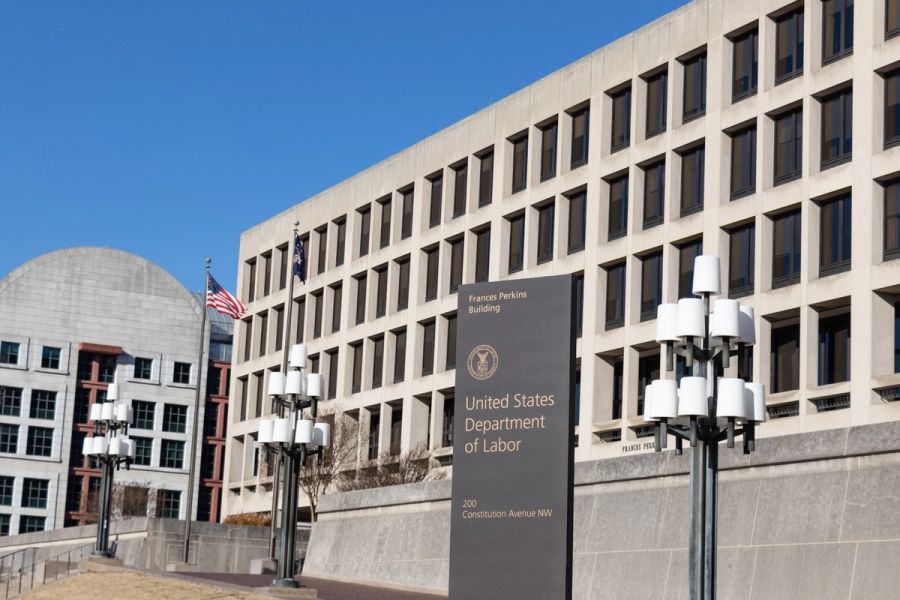
Department of Labor
Most immigration-related operations would pause at the Department of Labor, as the federal agency receives most of its funding from Congress. This means that several key services required to process employer-sponsored visas would be unavailable as a result, including:
- Labor Condition Applications (LCAs)
- PERM processing
- Prevailing wage determinations
- Temporary employment certifications
Additionally, the DOL would shut down access to FLAG, the online hub that employers can use to submit applications. This means that users could not submit new PERM requests or provide additional evidence for pending cases online.
Department of State
Because the U.S. Department of State receives partial funding from application and visa fees, consular services may continue for a short time during the government shutdown. However, embassies and consulates may be forced to cease operations if the government shutdown continues indefinitely.
What will happen to applications that require PERM processing?
PERM processing would halt during a government shutdown, and employers can’t file most EB-2 and EB-3 Green Card petitions without it. Before an employer can file Form I-140 with USCIS, the Department of Labor’s Office of Foreign Labor Certification must certify the employer’s PERM application. If the DOL closes, those sponsorships stop at the DOL stage, even though USCIS would stay open.
A pause in PERM processing could affect employers in a few ways:
- Green Card timelines would move back. The PERM filing date becomes the employee’s priority date, so a delayed filing also moves the employee back in the Green Card queue. That matters most for employees from countries with long backlogs, like India and China.
- Recruitment could expire. Employers must file the PERM application within 180 days of the first recruitment step, so a long shutdown could push some cases past that window and force the employer to recruit again.
- H-1B extensions beyond six years could be at risk. H-1B workers near the six-year limit generally need a PERM application or an I-140 pending for at least 365 days to extend in one-year increments, so filing delays now could affect extensions later.
Because FLAG would be offline during the shutdown, employers concerned about meeting a filing deadline may be able to submit PERM applications by mail. However, the DOL will not be able to accept or process the case until funding resumes.
Why would the U.S. government shut down in the first place?
The federal government’s fiscal year runs from October 1 to September 30. Before a new fiscal year begins, Congress must pass annual appropriations bills that set discretionary funding levels for federal agencies like the Department of Labor. When the U.S. government fails to pass a fiscal budget on time, most federal agencies cease operations.
While most government shutdowns only last a few days, a handful have lasted for weeks. In fact, the longest government shutdown in U.S. history occurred during the second Trump administration and lasted 43 days, from October 1 to November 12, 2025.
What else should employers and foreign nationals expect during a government shutdown?
In the past, federal employment eligibility services like E-Verify have become unavailable until a government shutdown ends. This can be troublesome for employers onboarding prospective foreign employees, as many of them are required by law to participate in the program.
“Although I-9 requirements continue during a government shutdown, if E-Verify becomes unavailable, it will be difficult for employers to verify an employee’s I-9 information,” Kim says. “However, USCIS has allowed alternative document review when E-Verify was down during previous government shutdowns, so if the shutdown happens, it’s worth monitoring what USCIS announces.”
Immigration courts may also experience disruptions during a government shutdown. As a subsidiary of the Department of Justice, the Executive Office for Immigration Review (EOIR) receives federal funding to process immigration court proceedings and appellate reviews. Without a designated budget, the EOIR would suspend all non-detained docket cases until funding resumes at a later date.
For those currently filing or waiting on an appeal hearing, a government shutdown could cause significant delays or reschedules for upcoming trial dates. If a hearing gets postponed, the issuing immigration court may provide an updated notice of hearing with a new date set after the government shutdown ends.
What should immigrants and businesses do in case of a government shutdown?
Kim says employers should also consider implementing proactive strategies to combat delays caused by the government shutdown, including proactively submitting eligible PERM labor certification and prevailing wage determination applications with the Department of Labor. Human resources and onboarding teams should still be prepared to submit I-9 documentation and consult USCIS for guidance on whether to wait for E-Verify to resume operations or file relevant documents through an alternative process.
Foreign nationals should expect longer processing times, particularly if they are filing applications that require input from the DOL. They should consult with an attorney to understand their next steps and to receive clarity on which immigration services are operating and which are on pause.
Looking for support during a government shutdown? Manifest helps employers and individuals navigate the U.S. immigration system through extraordinary circumstances, including pauses in PERM or LCA processing. Contact us today to learn more.
About the Author

Staff Writer
Caryl Espinoza Jaen is a Nicaraguan-born staff writer for Manifest Law. As a writer, he strives to cover complex topics like immigration policy with clarity, accuracy, and precision.
Read bioReviewed By

Head of Legal Operations
Haesung brings 20+ years of business immigration experience to Manifest Law, most recently as a Partner at BAL (Berry Appleman & Leiden) where she oversaw a legal team of 100+ professionals and serviced some of the most complex and largest corporate clients in the industry. As Head of Legal Operations, Haesung pairs her depth of experience as a practitioner with a tech platform designed for speed, transparency and scale.
Read bioShare this article: