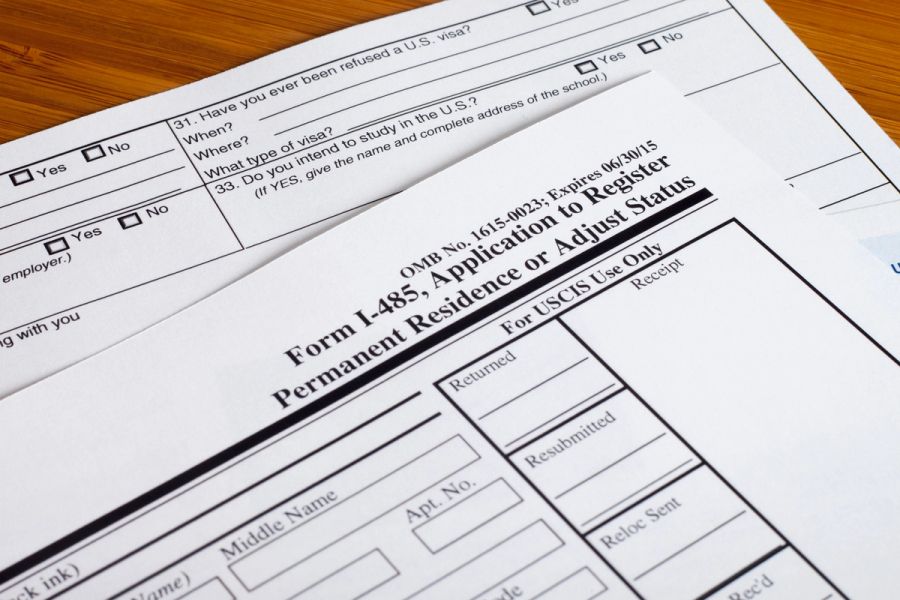
Four U.S. Citizenship and Immigration Services (USCIS) policy changes must be reversed, following a U.S. district court decision on June 5. These policies blocked processing for certain immigrants seeking benefits and reopened already-approved cases for people from countries affected by the USCIS adjudicative hold.
In Dorcas vs USCIS, District Court Chief Judge John J. McConnell ruled that USCIS implemented the following policies without legal authority; he also determined that they violate the law:
- Global Asylum Hold: Barring full processing of asylum applications
- Benefits Hold: Freezing final decisions on Green Card, work permit, citizenship, and other benefits applications for petitions and applications from certain countries
- Comprehensive Re-Review of Adjudicated Benefits Requests: Reexamining benefits already granted to individuals from certain countries
- Use of Country-Specific Factors in Adjudication: A Policy Manual change treating country-specific factors, like insufficient screening, as negative discretionary factors
In its decision, the court determined that the policies violate the Administrative Procedure Act (APA) because they are contrary to law and arbitrary and capricious. The court did not address the plaintiffs’ argument that the policies were issued without notice and comment.
What has happened since the policies were vacated?
Here’s how the Dorcas case has developed since the district court vacated the four USCIS policies:
June 12, 2026: USCIS released a statement that said it disagrees with the court’s decision, but will follow it. The agency filed its appeal to the First Circuit the same day.
July 15, 2026: A federal judge in Rhode Island denied the government’s request to pause the June ruling while it appeals. The government then took the same request to the appeals court.
August 14, 2026: A three-judge First Circuit panel gave the government part of what it asked for. The panel of Judges Lara E. Montecalvo, Seth R. Aframe, and Joshua D. Dunlap ruled that USCIS may resume the Comprehensive Re-Review Policy while the appeal plays out. That policy directs USCIS staff to re-examine approved benefit requests from nationals of the designated countries who entered the U.S. on or after January 20, 2021.
The panel denied the rest of the request. The government, it wrote, “has not met its burden to demonstrate entitlement to a stay with respect to the other two policies stayed by the district court.” The order does not name those policies.
So one of the four is back in play, and it is the one that reaches people who already won their cases.
In addition, on August 24, 2026, Northern District of California Judge Charles Breyer granted a preliminary injunction in Red Eagle Law, L.C. v. Edlow, a separate case challenging the same two policy memos at issue in Dorcas, PM-602-0192 and PM-602-0194.
Breyer found no evidence that the agency had “considered the reliance interests of immigration benefit applicants or alternatives to an indefinite pause” before freezing cases, borrowing that language from an earlier ruling in Sunny-Odio v. Trump. His order directs USCIS to adjudicate the affected applications in the normal course of its process.
In the same order, Breyer certified a class. That is why the ruling reaches past the roughly 400 plaintiffs who sued. It covers nationals of the 39 countries named in Presidential Proclamations 10949 and 10998, plus the Palestinian Authority, who had an asylum or other benefit application caught by the holds and not yet finally adjudicated when the class was certified.
On August 28, 2026, Breyer stayed the rest of the Red Eagle Law case, writing that the outcome of the Dorcas appeal “may have a considerable impact” on it. The injunction stays in force in the meantime, but the case itself is on hold until at least September 25, 2026, when he has set a status conference.
Subscribe to our newsletter.
*By clicking Submit and subscribing to our newsletter, you agree to the Manifest Terms and Privacy Policy.
How does the policy reversal affect foreign nationals?
In previous court cases challenging USCIS policies related to the expanded travel ban, courts issued decisions that affected only the plaintiffs involved. This ruling differs because the judge vacated the four USCIS policies, which lifted the holds for anyone affected.
That is still true of the asylum hold and the benefits hold. It is no longer true of re-review. Since August 14, USCIS has been free to reopen benefits it already granted to people from the designated countries who entered on or after January 20, 2021 — including green cards, work permits, and naturalization. An approval from that window is not necessarily the end of the matter while the appeal is pending.
For those whose cases have already been paused or reopened, Manifest immigration attorney Ana Gabriela Urizar says the next best step is to watch for any update from USCIS. The agency said in a June 12 alert that it disagrees with the ruling but “will follow its terms pending possible further judicial review.” That statement predates the First Circuit order, and USCIS has not issued a public alert about the August 14 ruling.
This is a developing story. We will continue to provide updates.
About the Author

Staff Writer
Caryl Espinoza Jaen is a Nicaraguan-born staff writer for Manifest Law. As a writer, he strives to cover complex topics like immigration policy with clarity, accuracy, and precision.
Read bioReviewed By

Legal Quality Lead
Former Associate General Counsel at USCIS overseeing various agency training and professional responsibilities programs. Prior to USCIS, Sairah was a trial attorney at the Department of Justice in Washington DC. Before her work in the public sector, Sairah was in the private sector as an attorney in leading immigration law firms handling a variety of cases ranging from litigation and litigation support to business immigration and naturalization cases.
Read bioShare this article: