
Fewer companies are applying for H-1B and L-1 work visas this year. But the wait to get one approved just got longer.
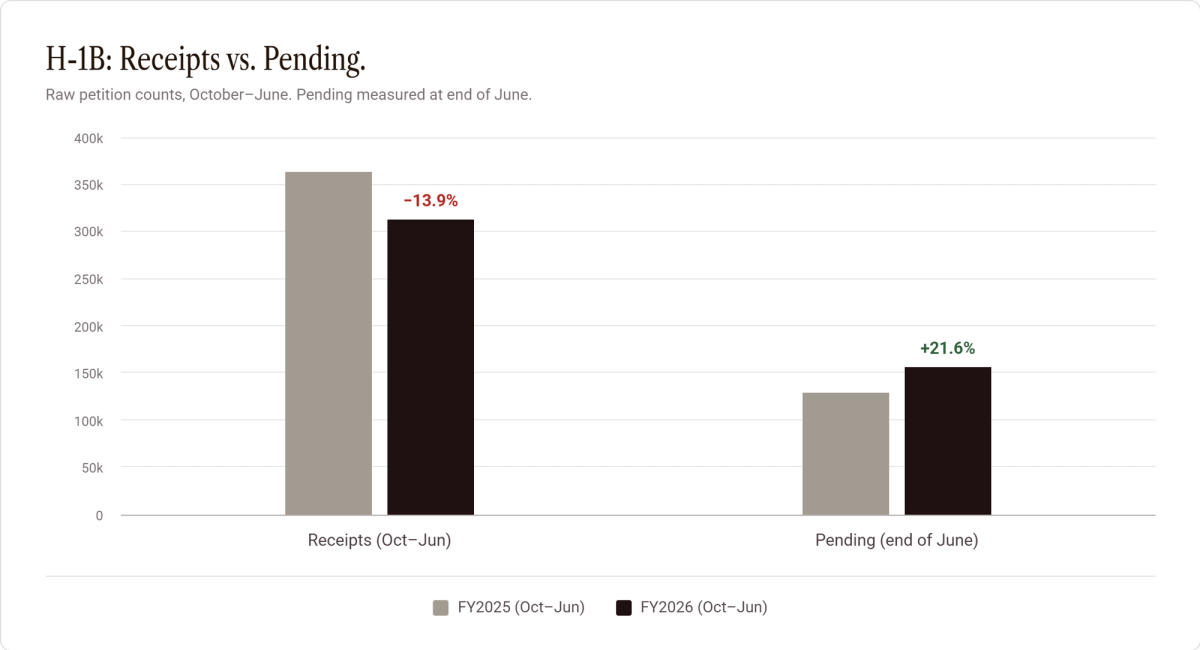
H-1B petitions dropped 14% between October and June, compared with the same months last year, according to the latest data from U.S. Citizenship and Immigration Services. But the backlog of pending cases jumped 22%.
It’s not because officers are asking more questions—requests for evidence stayed relatively flat. So what’s slowing things down?
“The rules are changing faster than officers can be trained to keep up,” said Manifest Law attorney Ana Gabriela Urizar. And it's left employers stuck waiting.
H-1B and L-1 Filings vs. Backlogs, FY2025–FY2026
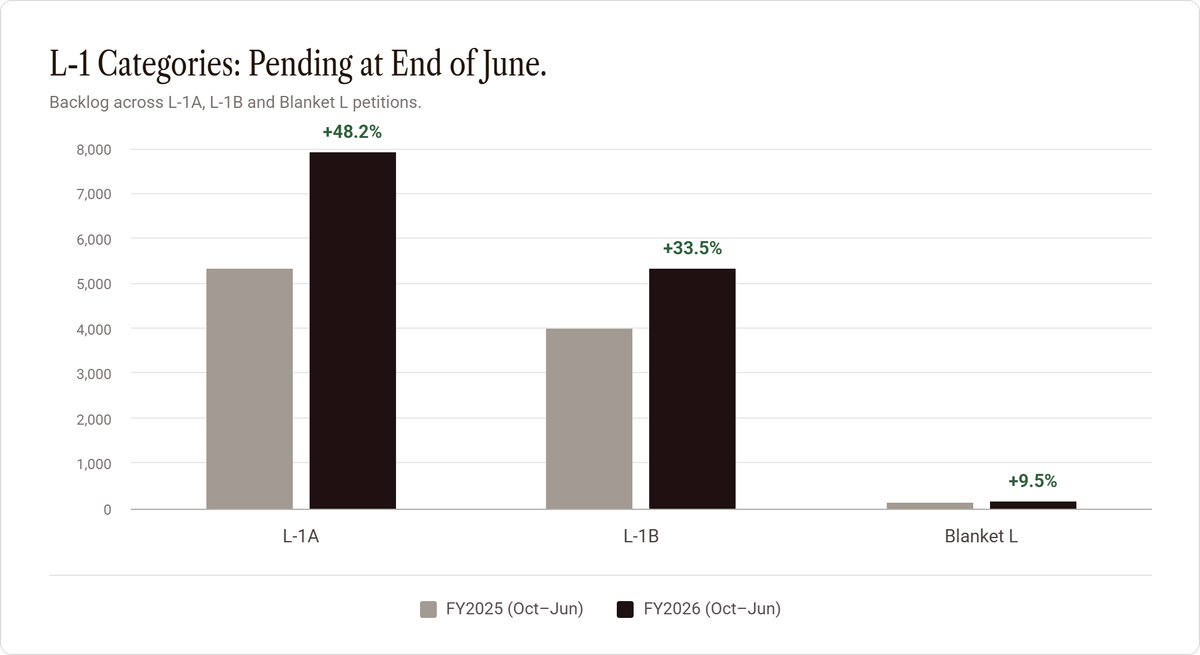
| Category | Receipts FY25 | Receipts FY26 | % chg | Pending FY25 | Pending FY26 | % chg |
|---|---|---|---|---|---|---|
| H-1B | 363,526 | 312,830 | -13.9% | 128,591 | 156,404 | +21.6% |
| L-1A | 20,181 | 20,766 | +2.9% | 5,332 | 7,900 | +48.2% |
| L-1B | 12,036 | 11,296 | -6.1% | 3,987 | 5,323 | +33.5% |
| Blanket L | 1,037 | 998 | -3.8% | 137 | 150 | +9.5% |
Why are backlogs growing while filings are falling?
USCIS data shows the agency’s total backlog across all forms grew 43% between FY2025 and FY2026, from about 5.4 million to 7.7 million cases. The backlog for nonimmigrant worker petitions (Form I-129, which includes H-1B and L-1) grew nearly four times, from 19,400 to 74,200. But the backlog of unopened mail shrank during the same period, indicating that the slowdown is happening when a case is in process, not at intake.
One reason is that there’s simply too much new guidance landing on officers’ desks, Urizar said, faster than they can be trained to apply it consistently.
The data backs this up. RFE rates for H-1B have stayed flat this year, even ticking down in Q3—the opposite of what you’d expect if reviews were getting tougher.
H-1B RFE rate by quarter, FY2026
| Quarter | Months | RFE Rate |
|---|---|---|
| Q1 | Oct–Dec | 9.0% |
| Q2 | Jan–Mar | 8.7% |
| Q3 | Apr–Jun | 7.8% |
Here are two of the new policies that landed on officers’ desks in just the past few months:
- In May, USCIS told officers that granting a Green Card from inside the U.S. isn’t automatic and specifically called out nonimmigrant workers as needing more than just a valid visa to get approved.
- In August, USCIS told officers that they have the option to deny a case outright, without an RFE, if the filing looks incomplete.
Even if a change doesn’t apply to H-1B or L-1, Urizar said, officers don’t specialize by visa type, so when guidance shifts, the effect cascades across categories.
Growing backlogs naturally lead to longer wait times. H-1B petitions now typically take about 10 months to process, up from about 7 months in December 2025. L-1 cases have gone from about 5 months to 7 months over that same stretch.
USCIS data shows the same pattern across all Form I-129 nonimmigrant worker petitions, not just H-1B and L-1. Standard processing time rose from 1.8 months in FY2021 to 5.3 months in FY2026 to date.
For employers, that means filing earlier. Building extra runway into hiring plans and extension filings can help preserve start dates and work authorization. Check current estimates with our USCIS processing times tool before committing to a date.
In the video below, Urizar delves deeper into the backlog.
This YouTube video is hidden until you accept functional cookies.
What does the latest FY2026 H-1B data show?
Between October and June, H-1B petitions dropped and the pending queue grew. Denial rates rose too, though approval odds are still strong at 97%.
The drop in filings is a separate story from the growing backlog. One clue is the lottery.
This June (the busiest month for new H-1B filings) saw 95,322 petitions, down 8% from 103,211 the year before. But that’s a small dip next to the preliminary numbers for the lottery: FY2027 registration collapsed from 343,911 the previous year to 211,600.
That suggests the new wage-weighted lottery and policies like the $100,000 fee may have scared off some applicants, though USCIS was still able to fill the 85,000 visa cap without a second lottery.
What does the latest FY2026 L-1 data show?
L-1 tends to appeal to employers because it’s straightforward.
“You either qualify as a manager or a specialized-knowledge employee, or you don’t,” Urizar said.
That clear standard is why approval rates tend to be high. But that doesn’t mean decisions are faster.
Even a clean L-1A case ends up in the same backlog as every other petition, and that backlog is growing for the same reason as H-1B: officers working through a wave of new guidance.
Employers who need a faster answer can pay for premium processing, which guarantees a decision within 15 days for a $2,965 fee. It won’t change the outcome of a case, but it can skip the backlog.
Blanket L remains a good bet for multinational employers who qualify. Approval rates sit near 98%, and RFE rates have barely budged.
What should H-1B and L-1 employers do?
- Pay for premium processing: It gets you a guaranteed 15-business-day decision instead of an open-ended wait. But it won’t rescue a weak case.
- File as early as the six-month window allows: USCIS won’t accept a petition more than six months before the requested start date, so waiting reduces any buffer for delays for an RFE.
- L-1 still works if you meet the requirements: It may take longer, but approval rates are still high. Just make sure the petition meets the manager or specialized-knowledge standard.
“These delays don’t necessarily mean employers are doing something wrong,” Urizar said. “But they still have to plan ahead for the backlogs.”
About the Author

Senior Staff Writer
Myles Ma is a veteran editor and journalist who has spent his career untangling complicated, sometimes unpleasant topics to help readers make smarter decisions. His reporting and insights have been featured in major outlets including the Washington Post, PBS, and CNBC.
Read bioReviewed By

Immigration Lawyer to Manifest Law
Ana Gabriela Urizar is an award-winning immigration attorney licensed in Arizona and New York. With nearly a decade of experience, she advises global corporations on complex U.S. immigration matters. Originally from Guatemala, Ana Gabriela previously spent close to ten years at the world’s largest immigration firm, managing business immigration matters for leading technology, science, and financial companies. She has been recognized by Best Lawyers: Ones to Watch (2027) and Negocios Now’s Tri-State 40 Under 40.
Read bioShare this article: