
Key Takeaways
- The O-1 and EB-1A are two different immigration categories, with the former being a temporary work visa and the latter a Green Card.
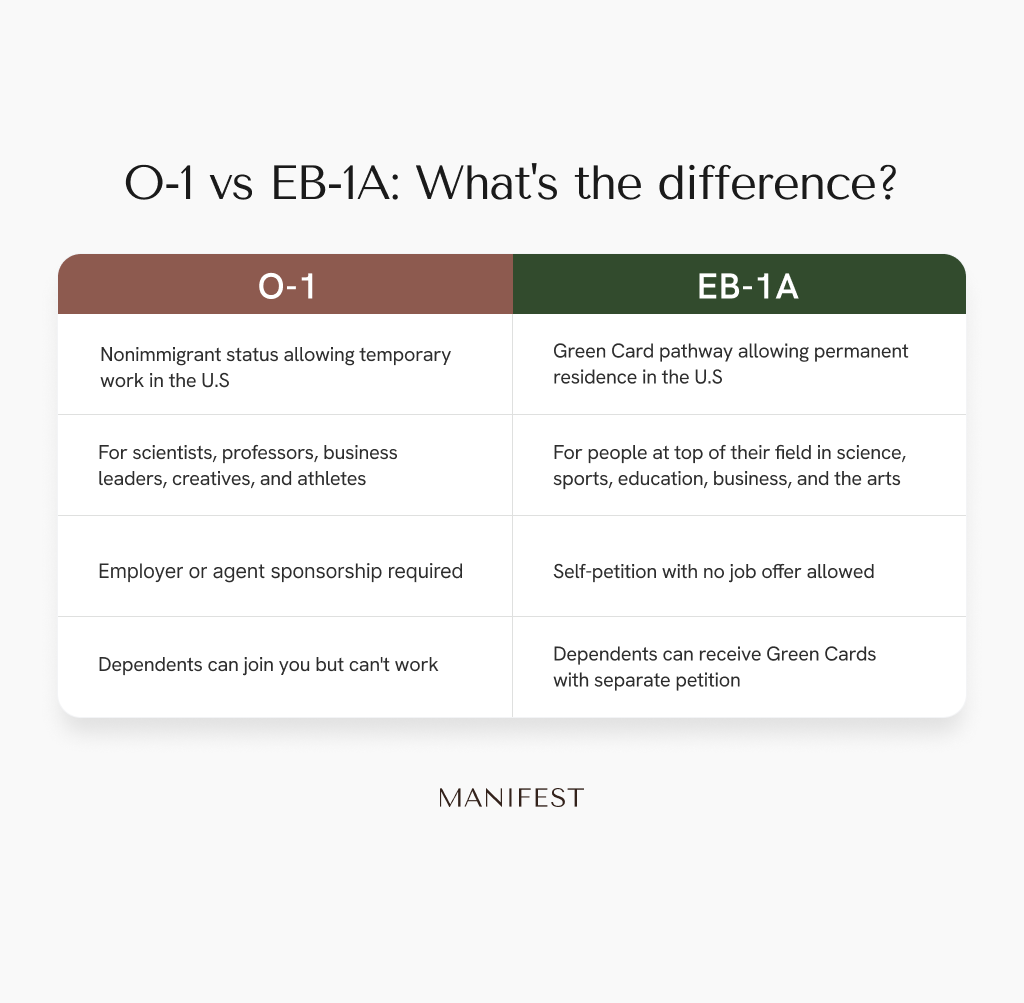
- The EB-1A requires no employer or sponsor, so you can self-petition. In contrast, the O-1 requires a U.S. employer or agent.
- Both have similar criteria, but are adjudicated differently. Generally speaking, the EB-1A has a higher eligibility bar than the O-1A.
- Many people qualify for the O-1 earlier in their career and meet the EB-1A bar later.
The O-1 and the EB-1A both recognize foreign nationals with extraordinary ability, but are two separate categories with different benefits and eligibility criteria.
The O-1 is a nonimmigrant work visa that lets you work in the U.S. temporarily, while the EB-1A is a Green Card category that lets you self-petition and live in the U.S. permanently. Many people transition from the O-1 to the EB-1A, and knowing how they differ can tell you which one is a better fit right now.
If you are still at the stage of working out what the extraordinary ability standard means, start there and come back for the head-to-head.
What’s the difference between the O-1 visa and the EB-1A Green Card?
The O-1 is a temporary nonimmigrant visa, while the EB-1A is an employment-based Green Card category. Both recognize extraordinary ability, but the O-1 only lets you work in the U.S. for a fixed period. Once you receive your actual permanent residence card, the EB-1A lets you stay live in the U.S. permanently and bring your family.
| Feature | O-1 | EB-1A |
|---|---|---|
| Type | Nonimmigrant visa | Green Card |
| Leads to a Green Card? | No | Yes |
| Employer/sponsor required? | Yes, an employer or O-1 agent | No, self-petition is allowed |
| Evidentiary standard | Sustained acclaim, top of your field | Same standard, weighed against a stricter final merits determination |
| Country backlog risk | None | India and China have backlogs |
| Premium processing | $2,965 | $2,965 (covers I-140 step only) |
| Dependents | O-3 visa; spouse/children can't work | Spouse and children get Green Cards; spouse can work |
| Typical use case | Enter the U.S. faster for specific work | Settle permanently in the U.S. |
Which is faster, the O-1 or the EB-1A?
Generally speaking, obtaining an O-1 visa takes fewer steps and less time than an EB-1A Green Card. As of September 2026, USCIS takes 14 months to complete 80% of O-1 cases, and premium processing returns a decision in 15 business days.
The EB-1A’s processing time takes much longer because it involves several steps, and only the I-140 petition allows premium processing. Adjustment of status or Green Card consular processing takes several months on average and cannot be sped up.
The EB-1A is also subject to per-country Green Card limits, which means applicants from high-demand countries (such as India or China) must wait years before they can even file for permanent residence. In contrast, the O-1 has no annual limits, and many people from backlogged countries use it to work in the U.S. while their priority date becomes current.
Do you need a sponsor for the O-1 or the EB-1A?
The O-1 requires a sponsor, while the EB-1A does not. Even if you have a U.S. agent who allows you to pursue freelance work, you cannot file Form I-129 on your own. And if your role changes or ends, you may need them to file an amended or new petition.
In contrast, EB-1A applicants can self-petition without an employer, job offer, or even an agent. That independence can be especially attractive to founders and entrepreneurs, who may not want their status locked to one sponsor.
How do the eligibility criteria differ between the O-1 and the EB-1A?
While they’re both commonly referred to as the extraordinary ability criteria, the O-1 and EB-1A criteria are not entirely similar. The O-1A’s eight criteria can be found in the federal regulation 8 CFR 214.2(o)(3)(iii), and the EB-1A's ten at 8 CFR 204.5(h)(3).
Between the two, eight of the ten match almost word for word, and both categories ask you to meet a minimum of three. However, the biggest difference is how the two are adjudicated, and immigration officers often place a stricter interpretation on EB-1A cases.
| O-1A criterion | EB-1A criteria | What changes with the EB-1A |
|---|---|---|
| (1) Nationally or internationally recognized prizes or awards for excellence | (i) Lesser nationally or internationally recognized prizes or awards | No real change. "Lesser" only distinguishes these from the one-time major award. |
| (2) Membership in associations requiring outstanding achievements, judged by recognized experts | (ii) Same wording | Identical text. |
| (3) Published material about you in professional or major trade publications or major media | (iii) Same, plus "other major media" | Identical in substance. Both require title, date, and author. |
| (4) Participation as a judge of the work of others | (iv) Same wording | Identical text. |
| (5) Original scientific, scholarly, or business-related contributions of major significance | (v) Original scientific, scholarly, artistic, athletic, or business-related contributions | The EB-1A version is wider. An athlete's contributions have no clean O-1A home but fit (v) directly. |
| (6) Authorship of scholarly articles | (vi) Same wording | Identical in substance. |
| (7) Employed in a critical or essential capacity for organizations with a distinguished reputation | (viii) Performed in a leading or critical role for organizations with a distinguished reputation | "Essential" drops out and "leading" comes in. A role that was essential to the work but neither leading nor critical does not carry over. |
| (8) Has commanded or will command a high salary or other remuneration | (ix) Has commanded a high salary or significantly high remuneration, in relation to others in the field | Two changes, and this is where O-1A holders most often get caught. The EB-1A drops the prospective "will command," so a signed future contract no longer counts. It also demands a comparison against others in your field, which the O-1A does not. |
| No counterpart | (vii) Display of your work at artistic exhibitions or showcases | Arts criterion with no O-1A equivalent. |
| No counterpart | (x) Commercial success in the performing arts | Arts criterion with no O-1A equivalent. |
Are the O-1A and EB-1A adjudicated differently?
The O-1A and EB-1A are adjudicated differently, even though their initial criteria share a lot of the same legal language. Both categories are also reviewed holistically, and the EB-1A’s second step is where they part ways.
For the EB-1A, USCIS conducts a final merits determination, where it asks whether your record as a whole shows sustained national or international acclaim at the very top of your field. The O-1 has a similar second step, commonly referred to as the totality of evidence review, and it only asks if you’re at the top of your field.
Manifest immigration attorney Ana Gabriela Urizar says that distinction makes it substantially harder. “What I often see is that applicants have to submit a timeline of evidence that proves they have been at the very top of their field for a sustained period of time,” she says. “This requires significantly more work, which is why many EB-1A visa holders take a few months to gather additional evidence or work on their profile before they apply for the EB-1A.”
But Urizar notes that approval rates only tell part of the story. USCIS explicitly states in its policy manual that a previous O-1 approval "is a relevant consideration and can be an indicator of eligibility" for the extraordinary ability Green Card, though it’s not enough to qualify. “My suggestion is that the O-1A is a good indicator that you can qualify for the EB-1A,” she says. “It just takes different case strategy and document preparation.”
How do family benefits compare for the O-1 and the EB-1A?
The EB-1A offers stronger family benefits. On the O-1, your spouse and unmarried children under 21 can join you on O-3 status. This allows them to live and study in the U.S., but they cannot work.
With the EB-1A, your spouse and unmarried children under 21 can obtain Green Cards as your dependents. They don't need to qualify for extraordinary ability themselves, and once approved, your spouse and children can live and pursue employment in the U.S. indefinitely.
Can you hold the O-1 and pursue the EB-1A at the same time?
Yes, and many people do, but it carries more risk than with a dual-intent visa like the H-1B. O-1 holders can pursue a Green Card under certain circumstances, but the timing of your EB-1A filing matters greatly.
Timing is the whole game here, and an O-1A to EB-1A transition works best when you file with your O-1 validity comfortably intact rather than against the clock. It's also why some people weigh the O-1 against the H-1B as a Green Card launchpad.
Should you pursue the O-1 or EB-1A?
The key difference is eligibility. O-1 eligibility can be more flexible, making it suitable for individuals who have demonstrated extraordinary ability but may still be building a record of sustained acclaim. EB-1A has a higher threshold, requiring evidence that you have risen to the very top of your field and achieved sustained national or international recognition.
If your evidence is strong but not yet at the EB-1A level, the O-1 may be a more realistic option while you continue strengthening your profile.
Here’s how to pick between the two:
- Choose the O-1 if you need speed, have a sponsor lined up, or aren't yet at the EB-1A evidentiary level.
- Choose the EB-1A if you want permanence and family Green Cards, prefer no employer, and can document sustained acclaim.
- Consider both, in sequence, if you qualify for the O-1 now and expect to meet the EB-1A bar later.
If you're unsure whether the O-1 visa or the EB-1A path makes sense for you, Manifest Law can help you evaluate your credentials and map out a strategy that aligns with your goals.
Request a consultation with us today, and we can assist you through the requirements and process of the O-1 and EB-1A.
FAQs about the O-1 vs. EB-1
Does qualifying for the O-1 mean you qualify for the EB-1A?
Not automatically. The two share criteria, but the EB-1A demands a higher standard of proof, so meeting the O-1 bar usually means you're approaching the EB-1A. Most people strengthen their record (more press, awards, judging, original contributions) before the EB-1A becomes realistic.
Which is better for founders, the O-1A or the EB-1A?
For most founders, the O-1A can be a great entry point to building a startup in the U.S. An EB-1A can come later in their immigration journey, once they have accumulated sustained national or international acclaim in their field.
Which has the higher approval rate, the O-1 or the EB-1A?
The O-1 has a higher approval rate than the EB-1A. In the third quarter of Fiscal Year 2026, approval rates for the O-1 remained above 90%, while the EB-1A averaged 32.2%.
Do you need a job offer for the O-1 or the EB-1A?
You need a U.S. employer or agent for the O-1, but not for the EB-1A. The EB-1A allows self-petitioning, so you can file without a job offer.
Which is cheaper, the O-1 or the EB-1A?
The cost for an O-1 visa or EB-1A Green Card depends on several factors, including whether you have a sponsor, self-petition, or pay for certain immigration benefits.
Can your family work on the O-1 or the EB-1A?
Only on the EB-1A. O-3 dependents (spouses and children under 21) can live and study in the U.S., but they cannot work. EB-1A dependents receive Green Cards, and the spouse can work legally in the U.S.
About the Author

Staff Writer
Caryl Espinoza Jaen is a Nicaraguan-born staff writer for Manifest Law. As a writer, he strives to cover complex topics like immigration policy with clarity, accuracy, and precision.
Read bioReviewed By

Immigration Lawyer to Manifest Law
Ana Gabriela Urizar is an award-winning immigration attorney licensed in Arizona and New York. With nearly a decade of experience, she advises global corporations on complex U.S. immigration matters. Originally from Guatemala, Ana Gabriela previously spent close to ten years at the world’s largest immigration firm, managing business immigration matters for leading technology, science, and financial companies. She has been recognized by Best Lawyers: Ones to Watch (2027) and Negocios Now’s Tri-State 40 Under 40.
Read bioShare this article: