Seasonal foreign workers play a significant role in helping U.S. employers address short-term labor shortages during periods of peak demand. The two primary pathways are the H-2A and H-2B temporary worker programs. The H-2A program allows agricultural employers to hire foreign workers for seasonal farm jobs when there are not enough available U.S. workers, while the H-2B program serves employers with temporary non-agricultural labor needs in industries such as landscaping, hospitality, seafood processing, construction, and recreation. Before employers can hire through either program, they must demonstrate a temporary need and satisfy federal labor certification requirements intended to protect U.S. workers and wages.
These visa programs have become an increasingly important component of the U.S. labor market as employers across a range of industries face persistent workforce shortages driven by demographic shifts, seasonal demand, and geographic mismatches between available jobs and workers. In agriculture, seasonal foreign workers primarily help farms plant, cultivate, and harvest crops that might otherwise face labor constraints. Outside agriculture, H-2B workers support industries that experience predictable seasonal surges, from maintaining parks and resorts to landscaping commercial properties and serving tourists during peak travel seasons. Because many of these industries are concentrated in particular regions, reliance on seasonal foreign labor can have an outsized effect on local economies, influencing business operations, consumer services, and employment patterns throughout the year.
The economic importance of seasonal foreign labor also varies considerably across the country. Agricultural regions often depend heavily on H-2A workers to sustain labor-intensive crop production, while many coastal and tourism-oriented communities rely on H-2B workers to meet seasonal demand in hospitality, recreation, and related services. Examining where employers request these workers—and the occupations they fill—provides a clearer picture of how different local economies have adapted to persistent labor shortages and evolving workforce needs.
This analysis, conducted by Manifest Law—a modern immigration law firm specializing in immigration visas—uses the U.S. Department of Labor's labor certification data to examine where demand for seasonal foreign labor is most concentrated across occupations, states, and metropolitan areas. The analysis compares both H-2A and H-2B labor certification requests to identify which industries rely most heavily on temporary foreign workers and where seasonal labor demand represents the largest share of the local workforce, highlighting regional differences in how employers meet seasonal staffing needs.
Which occupations are most reliant on seasonal foreign labor?
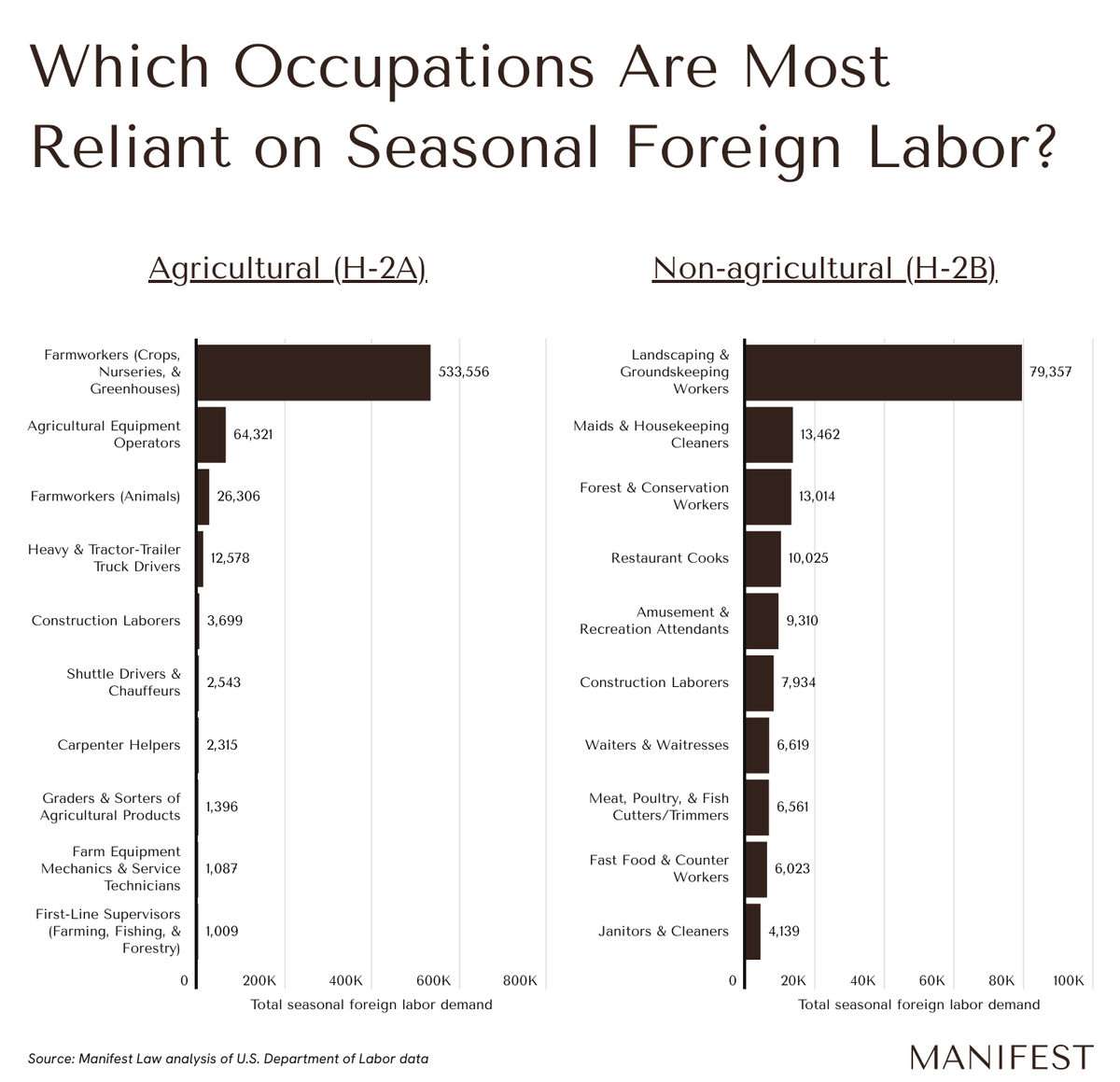
Among H-2A labor certification requests, employers in the 12-month period ending in March 2026 sought more than 533,000 farmworkers and laborers working in crops, nurseries, and greenhouses, making it by far the most-requested occupation. Other leading occupations include agricultural equipment operators (approximately 64,300 requested workers) and farmworkers working with animals (roughly 26,300). While the H-2A program is designed to support agricultural employers, certified requests also include occupations that support farming operations in secondary capacities, such as construction laborers (3,699), shuttle drivers and chauffeurs (2,543), and carpenter helpers (2,315). The concentration of requests among crop workers underscores the labor-intensive nature of U.S. agriculture and the industry's substantial seasonal workforce needs during planting and harvest periods.
Demand through the H-2B program is similarly concentrated, although across a broader range of industries. Unlike H-2A, which has no annual numerical limit, H-2B is generally capped at 66,000 visas each fiscal year, though Congress and the Department of Homeland Security have regularly authorized supplemental visas in recent years as employer demand has exceeded the statutory limit. As a result, certified labor requests reflect employer demand for seasonal workers rather than the number of workers ultimately admitted through the program. Landscaping and groundskeeping workers account for nearly 79,400 requested positions—almost six times more than the next-largest occupation, maids and housekeeping cleaners (13,462). Other leading occupations include forest and conservation workers (13,014), restaurant cooks (10,025), amusement and recreation attendants (9,310), and construction laborers (7,934). Together, these occupations illustrate how employers across landscaping, hospitality, recreation, forestry, construction, and other seasonal industries use the labor certification process to address recurring workforce shortages during predictable periods of peak demand.
Where non-farm industries rely most on seasonal foreign labor

The balance between agricultural and non-agricultural seasonal foreign labor varies considerably across the United States, reflecting differences in regional economies and industry composition. New England stands out as the region where employers rely most heavily on the H-2B program, with non-agricultural occupations accounting for the overwhelming majority of seasonal foreign labor requests. By contrast, many of the country's largest agricultural producers—including California and Washington—depend far more heavily on H-2A workers, resulting in some of the nation's lowest shares of non-agricultural seasonal labor demand.
Rhode Island has the highest concentration of non-agricultural seasonal labor requests, with 98.9% of requested workers tied to H-2B occupations. Alaska follows at 95.6%, while Massachusetts (91.4%), New Hampshire (84.2%), Maine (82.5%), and Vermont (78.8%) also rank among the states where seasonal foreign labor is overwhelmingly concentrated outside agriculture. Many of these states have relatively small agricultural sectors but significant demand from industries such as tourism, hospitality, landscaping, forestry, seafood processing, and recreation, all of which commonly rely on H-2B workers during peak seasons.
At the other end of the spectrum, agricultural states account for the lowest shares of non-agricultural seasonal labor demand. Just 6.3% of Washington's seasonal foreign labor requests are tied to H-2B occupations, followed by California at 7.7%, Georgia at 14.1%, New Mexico at 17.0%, and North Dakota at 19.6%. In these states, demand is driven primarily by H-2A requests supporting crop production and other agricultural operations, illustrating how regional industry specialization shapes employers' reliance on the nation's two seasonal foreign worker programs.
Immigration lawyers
H-2B visas have complex rules and tight deadlines and a mistake could put your application at risk. Working with an attorney focused on these visas can help with the paperwork and timing. Request a consultation with Manifest Law's experienced immigration lawyers now.
Which states request the most seasonal foreign labor?
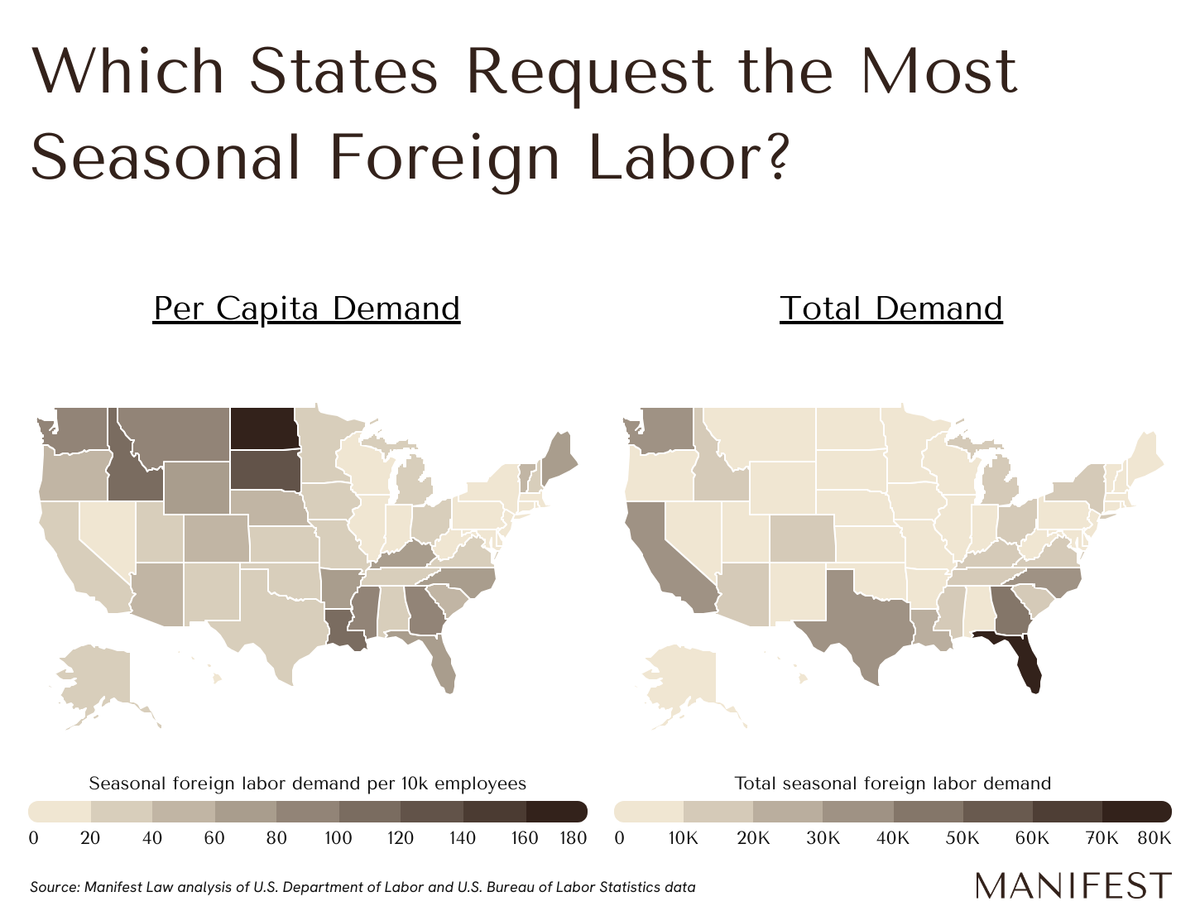
Seasonal foreign labor demand is most concentrated in a mix of agricultural and Gulf Coast states, where certified labor requests account for a comparatively large share of the local workforce. Measured by requested workers per 10,000 resident employees, North Dakota ranks first with 179 requested seasonal foreign workers, followed by South Dakota (132), Idaho (111), Louisiana (104), and Montana (95). Other states with relatively high concentrations include Mississippi (87), Washington (83), Georgia (81), Maine (79), and Florida (74). Although these states rely on different industries—from agriculture in the Great Plains and Pacific Northwest to seafood, hospitality, and tourism along the Gulf Coast—they share a common reliance on seasonal labor to meet recurring workforce shortages.
The ranking shifts when measured by the total number of requested seasonal foreign workers rather than workforce concentration. Florida leads the nation with 78,647 requested workers in certified labor cases, followed by Georgia (42,337), California (38,377), Texas (37,128), and Washington (32,099). Large populations and diverse economies allow many of these states to generate substantial demand even when seasonal foreign labor represents a smaller share of the overall workforce than in less populous states.
The metropolitan data further illustrates how seasonal labor demand is often concentrated in agricultural communities. Among all metropolitan and micropolitan areas, Othello, Washington, recorded the nation's highest concentration, with 11,482 requested seasonal foreign workers per 10,000 resident employees. Other leading communities include Clewiston, Florida (5,947), Arcadia, Florida (5,386), Moses Lake, Washington (4,976), and Wenatchee-East Wenatchee, Washington (2,666). These communities are major agricultural production centers where seasonal hiring demand can approach or even exceed the size of the local resident workforce during peak growing seasons.
That pattern extends across larger metropolitan areas as well, although at lower concentrations. Tampa–St. Petersburg–Clearwater, Florida, ranks first among large metropolitan areas with 137 requested seasonal foreign workers per 10,000 resident employees, while Naples–Marco Island, Florida, leads midsize metros with 510. Together, the metro-level rankings demonstrate that seasonal foreign labor demand is often shaped by highly localized industries, with agricultural regions generating especially large concentrations of certified labor requests relative to the size of their resident workforce.
Full results
This embedded content is hidden until you accept functional cookies.
Looking ahead: The H-2A and H-2B outlook
Demand for seasonal foreign labor is expected to remain strong as employers continue to face persistent workforce shortages in agriculture, hospitality, landscaping, seafood processing, forestry, and other industries with highly seasonal labor needs. Demographic trends, including an aging domestic workforce and lower labor force participation in many physically demanding occupations, have contributed to continued reliance on the H-2A and H-2B programs. While H-2A requests can continue to grow without a statutory cap, demand for H-2B workers is likely to remain constrained by the program's annual limit, even as Congress and the Department of Homeland Security have repeatedly authorized supplemental visas in recent years to help employers experiencing severe labor shortages.
At the same time, both programs remain at the center of broader immigration and labor policy debates. Agricultural groups have continued to advocate for reforms that would streamline the H-2A process and expand eligibility to year-round agricultural industries such as dairy and livestock production, while business organizations representing seasonal employers have pushed for a permanent increase to the H-2B cap. Worker advocates, meanwhile, have called for stronger labor protections and enforcement to ensure temporary foreign workers receive fair wages and working conditions. How policymakers balance employer demand, worker protections, and broader immigration priorities will likely shape the future of seasonal foreign labor in the United States for years to come.
Methodology
This analysis was conducted by researchers at Manifest Law using certified labor certification data from the U.S. Department of Labor's Office of Foreign Labor Certification Performance Data and employment estimates from the U.S. Bureau of Labor Statistics' Local Area Unemployment Statistics (LAUS) program. Labor certification requests submitted through the H-2A and H-2B programs were used to measure employer demand for seasonal foreign labor, while workforce estimates were used to calculate requested workers per 10,000 resident employees at the national, state, and metropolitan levels. For relevance, the latest 12-month period of available data from the Department of Labor (April 2025–March 2026) was used, and only the total requested workers for certified cases were considered in this analysis.
State and metropolitan totals may exceed the national total because certified labor cases can include worksites that span multiple jurisdictions. When a certified case includes work performed in more than one state or metropolitan area, all requested workers are attributed to each applicable jurisdiction. For example, if an employer requests 10 farmworkers to work at locations in both Los Angeles County and San Diego County, all 10 requested workers are counted in each metropolitan area. As a result, state, metropolitan, and national totals should not be compared directly.
For brevity, the term "seasonal labor" is used throughout this report to broadly describe temporary employment requested for one-time occurrences, seasonal needs, peak-load needs, or intermittent labor requirements under the H-2A and H-2B programs. References to metropolitan areas include both metropolitan and micropolitan statistical areas as defined by the U.S. Census Bureau.
For relevance, metropolitan and micropolitan areas were grouped into the following population cohorts:
- Large: more than 1,000,000
- Midsize: 350,000 to 999,999
- Small: 100,000 to 349,999
- Extra Small: less than 100,000
About the Author

Content Lead
Haley Davidson is Manifest Law's Content Lead, covering all topics related to U.S. visas and Green Cards. She's passionate about making complex topics easy to understand, like immigration law.
Read bioReviewed By

Immigration Lawyer to Manifest Law
Ana Gabriela Urizar is an award-winning immigration attorney licensed in Arizona and New York. With nearly a decade of experience, she advises global corporations on complex U.S. immigration matters. Originally from Guatemala, Ana Gabriela previously spent close to ten years at the world’s largest immigration firm, managing business immigration matters for leading technology, science, and financial companies. She has been recognized by Best Lawyers: Ones to Watch (2027) and Negocios Now’s Tri-State 40 Under 40.
Read bioShare this article: